Agents in
p. 36 · Read in the full issue
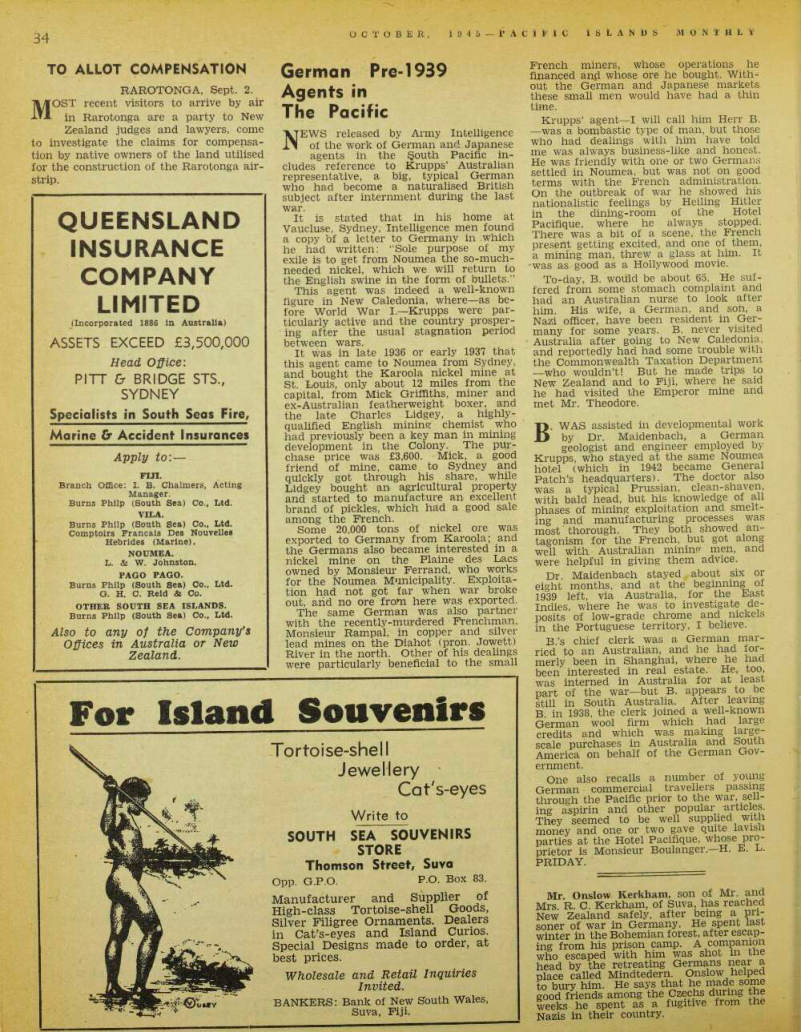
German Pre-1939 Agents in The Pacific
NEWS released by Army Intelligence of the work of German and Japanese agents in the §outh Pacific in cludes reference to Krupps’ Australian representative, a big, typical German who had become a naturalised British subject after internment during the last war.
It is stated that in his home at Vaucluse, Sydney, Intelligence men found a copy of a letter to Germany in which he had written: “Sole purpose of my exile is to get from Noumea the so-much needed nickel, which we will return to the English swine in the form of bullets.”
This agent was indeed a well-known figure in New Caledonia, where—as be fore World War I.—Krupps were par ticularly active and the country prosper ing after the usual stagnation period between wars.
It was in late 1936 or early 1937 that this agent came to Noumea from Sydney, and bought the Karoola nickel mine at St. Louis, only about 12 miles from the capital, from Mick Griffiths, miner and ex-Australian featherweight boxer, and the late Charles Lidgey, a highly qualified English mining chemist who had previously been a key man in mining development in the Colony. The pur chase price was £3,600. Mick, a good friend of mine, came to Sydney and quickly got through his share, while Lidgey bought an agricultural property and started to manufacture an excellent brand of pickles, which had a good sale among the French.
Some 20,000 tons of nickel ore was exported to Germany from Karoola; and the Germans also became interested in a nickel mine on the Plaine des Lacs owned by Monsieur Ferrand, who works for the Noumea Municipality. Exploita tion had not got far when war broke out, and no ore from here was exported.
The same German was also partner with the recently-murdered Frenchman, Monsieur Rampal, in copper and silver lead mines on the Diahot (prop. Jowett) River in the north. Other of his dealings were particularly beneficial to the small
French miners, whose operations he financed an£ whose ore he bought. With out the German and Japanese markets these small men would have had a thin time.
Krupps’ agent—l will call him Herr B. —was a bombastic type of man, but those who had dealings with him have told me was always business-like and honest.
He was friendly with one or two Germans settled in Noumea, but was not on good terms with the French administration.
On the outbreak of war he showed his nationalistic feelings by Heiling Hitler in the dining-room of the Hotel Pacifique, where he always stopped.
There was a bit of a scene, the French present getting excited, and one of them, a minfng man, threw a glass at him. It was as good as a Hollywood movie.
To-day, B. would be about 65. He suf fered from some stomach complaint and had an Australian nurse to look after him. His wife, a German, and son, a Nazi officer, have been resident in Ger many for some years. B. never visited Australia after going to New Caledonia, and reportedly had had some trouble with the Commonwealth Taxation Department —who wouldn’t! But he made trips to New Zealand and to Fiji, where he said he had visited the Emperor mine and met Mr. Theodore.
B. WAS assisted in developmental work by Dr. Maidenbach, a German geologist and engineer employed by Krupps, who stayed at the same Noumea hotel (which in 1942 became General Patch’s headquarters). The doctor also was a typical Prussian, clean-shaven, with bald head, but his knowledge of all phases of mining exploitation and smelt ing and manufacturing processes was most ’ thorough. They both showed an tagonism for the French, but got along well with Australian mining men, and were helpful in giving them advice.
Dr. Maidenbach stayed about six or eight months, and at the beginning of 1939 left, via Australia, for the East Indies, where he was to investigate de posits of low-grade chrome and nickels in the Portuguese territory, I believe.
B.’s chief clerk was a German mar ried to an Australian, and he had for merly been in Shanghai, where he had been interested in real estate. He, too, was interned in Australia for at least part of the war—but B. appears to be still in South Australia. After leaving B. in 1938, the clerk joined a well-known German wool firm which had large credits and which was making large scale purchases in Australia and South America on behalf of the German Gov ernment.
One also recalls a number of young German commercial travellers passing through the Pacific prior to the war, sell ing aspirin and other popular articles.
They seemed to be well supplied with money and one or two gave quite lavish parties at the Hotel Pacifique, whose pro prietor is Monsieur Boulanger.—H. E. L.
Friday.
Mr. Onslow Kerkham, son of Mr. and Mrs. R. C. Kerkham, of Suva, has reached New Zealand safely, after being a pri soner of war in Germany. He spent last winter in the Bohemian forest, after escap ing from his prison camp. A companion who escaped with him was shot in the head by the retreating Germans near a place called Mindtedern. Onslow helped to bury him. He says that he made some good friends among the Czechs during the weeks he spent as a fugitive from the Nazis in their country.