Islands
pp. 20-21 · Read in the full issue
King Of The Cocos
Youth Reported at London University
AN article in “PIM” in June last, headed “Search for King of Cocos Islands” appears to have created considerable interest. It appears that the King has been found.
The Cocos Islands are in the tropical seas between West Australia and Sumatra. There are 24 of them, and the largest is only 2i miles long. There are some 1,200 inhabitants, part European, part Malayan.
A grim Scot, John Clunies-Ross, settled in the atoll in 1825. He had married Elizabeth Dymock, who had saved him from the press-gang in London. They had several children.
A fellow-adventurer, Alexander Hare, settled on an adjoining islet with a harem of 165 women—Malays, Chinese and half castes. There was no friendship between the two establishments. Eventually, the men of the Clunies-Ross party robbed Hare of nearly all his women, and mar ried them, and Hare departed. Thus was Cocos Island settlement established.
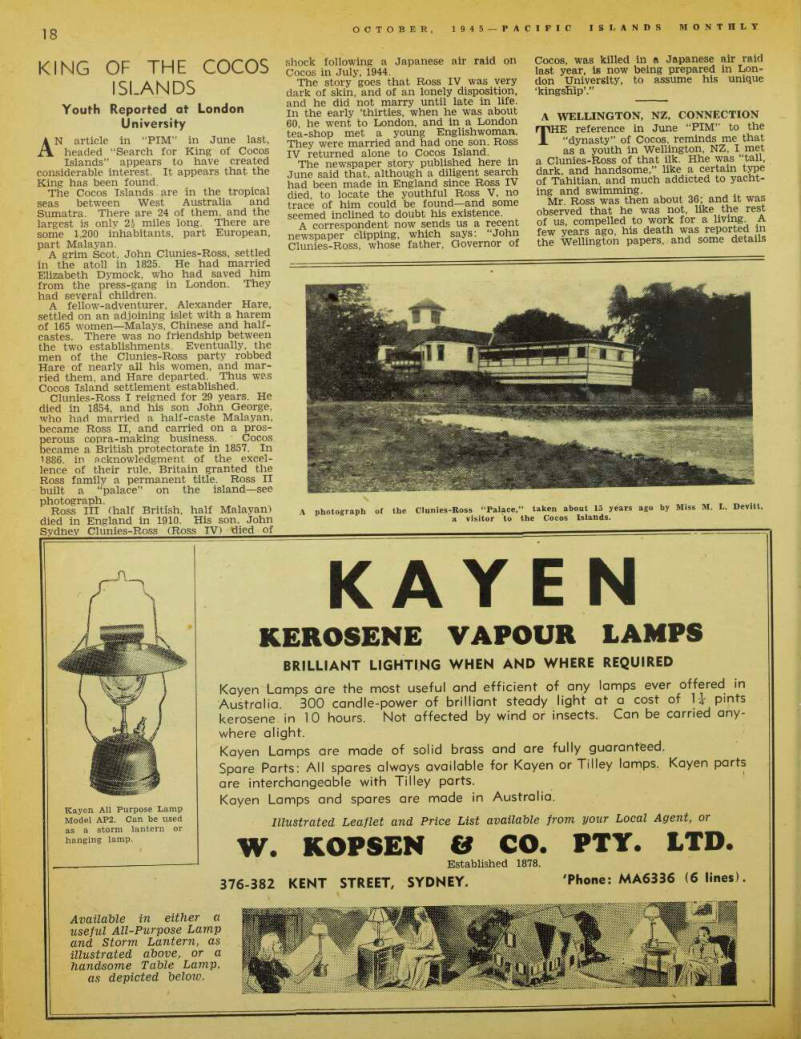
Clunies-Ross I reigned for 29 years. He died in 1854, and his son John George, who had married a half-caste Malayan, became Ross 11, and carried on a pros perous copra-making business. Cocos became a British protectorate in 1857. In 1886. in acknowledgment of the excel lence of their rule, Britain granted the Ross family a permanent title. Ross II built a “palace” on the island —see
photograph.
Ross 111 (half British, half Malayan) died in England in 1910. His son, John Sydney Clunies-Ross (Ross IV) died of
shock following a Japanese air raid on Cocos in July, 1944.
The story goes that Ross IV was very dark of skin, and of an lonely disposition, and he did not marry until late in life.
In the early ’thirties, when he was about 60, he went to London, and in a London tea-shop met a young Englishwoman.
They were married and had one son. Ross IV returned alone to Cocos Island.
The newspaper story published here in June said that, although a diligent search had been made in England since Ross IV died, to locate the youthful Ross V, no trace of him could be found—and some seemed inclined to doubt his existence.
A correspondent now sends us a recent newspaper clipping, which says: “John Clunies-Ross, whose father, Governor of
Cocos, was killed in a Japanese air raid last year, is now being prepared in Lon don University, to assume his unique
‘kingship’.”
A Wellington, Nz, Connection
THE reference in June “PIM” to the “dynasty” of Cocos, reminds me that as a youth in Wellington, NZ, I met a Clunies-Ross of that ilk. Hhe was “tall, dark, and handsome,” like a certain type of Tahitian, and much addicted to yacht ing and swimming.
Mr Ross was then about 36; and it was observed that he was not, like the rest of us, compelled to work for a living. A few years ago, his death was reported in the Wellington papers, and some details
A photograph of the Clunies-Ross “Palace,” taken about 15 years ago by Miss M. L. Devitt, a visitor to the Cocos Islands.
given of his mysterious connection with Cocos Island.
Ross was a reticent individual; but he was well known as a frequenter of the bays on the eastern side of Wellington Harbour. One of these has a Pacific island appearance, greatly resembling Avarua, tne town of Rarotonga. We Cook; Islanders visit it, when in the NZ city, because of that resemblance.
Did Day’s Bay perhaps remind Clunies- Ross of Cocos? And was this Ross per haps a lost heir? His comparatively early death, I believe without issue, sur prised me, for he was a vigorous man,
of excellent physique.