Nauru Officials Murdered
pp. 8-9 · Read in the full issue
By Japs
Tragic Story of Events from 1942 to 1945
AS soon as the Japanese garrison on Nauru surrendered, on September 13, to a force of 250 Australians who arrived on two small vessels guarded by HMAS “Diamantina,” a search was com menced for the peonle who had been left on Nauru in 1942—seven Europeans, about 1,200 Nauru natives, and some hundreds of Chinese. The Chinese, and a few natives, were found —all others were missing. . ..
It was announced in the Australian Parliament on September 19 that, on March 26, 1943, the Japanese murdered the following Europeans, who had volun tarily remained on the island, in 1942, to care for the natives;—
Lieut.-Colonel F. R. Chalmers,
Administrator. A , DR. B. H. QUIN, Government Medical Officer. , . . , , MR W H. SHUGG, Medical Assistant.
MR F. HARMER (Engineer), and MR.
W H DOYLE (Overseer), of the British Phosphate Commission’s staff.
Two Roman Catholic missionaries,
Father Kayser and Father Clivaz, who also remained on the island, were tyans ferred by the Japanese in 1943 to the Caroline Islands, together with 1.200 Nauruans, including the head-chief an the maiority of Nauruan women. the general 3 health of the remaining natives and the Chinese was found to be better than expected, and few were actually sick, although subsistence had been re- SW lf e appe o ar P e U d m ?ha n t 'the Japanese had made extensive plans for against what they imagined would be a frontal assault. Enormous labour.had been expended in getting big guns ashore, dragging them up to high places on the island among the coralpmnacles, and bedding them in cement among most elaborate fortifications. The island was by-passed by the Allied Forces, towever. the Jap garrison was cut off from an communications with Japan; and th Japanese were close to starvation when they surrendered. 11 THEN the surrendered Jap officers were ff questioned, they declared that the Europeans were killed by Allied bombs when the American Air Force made its first raid upon Nauru about on March 26, 1943. But it was soon estab lished that the Japs had declared that, if Nauru was attacked by our aircraft, the Europeans in their hands would be
executed. That is precisely what hap pened.
Here is the story as told to our officials by Harry, a Nauru police boy: “About 5 a.m. (in the morning follow ing the air raid) just as dawn was com ing, the Japanese officers gathered the white men in a room, and told them they were to die by beheading.
“I peered through the door, though they never knew I was there.
“They killed Dr. Quin first. Just before they led him forward he put a rosary around his neck and I supposed he was praying. Then came the sweep of the sword.
“I was overcome with horror and panicked at the thought of what they would do if they knew I was a witness of their crime.
“I ran away. From a distance I saw them loading the bodies into a truck.
The white feet protruded from the cover ing tarpaulin.
“The bodies were buried—l don’t know where. , “The Japanese took care to hide all evidence of their crime. They burned the white men’s distinguishing shoes, and socks and clothing.”
Who gave the order for the execution is not vet known, but Harry named Lieut.- Comm'ander Nakvama, a thin, cold-faced marine staff officer, as having been pre sent at the butchery. Nakyama is now a prisoner.
MAJOR CAMERON, a South Australian MP, paid a high tribute in the Aus tralian Parliament to the character and courage of Lieut.-Colonel Chalmers, under whom he served in World War I.
He demanded that Australia “should peel off her kid gloves,” and see that this horrible crime was properly punished.
Territories Minister Ward said that all possible information was being gathered, with a view to punishing those respon sible for the murder. There were legal difficulties, because Nauru was a man date, held jointly by Britain, Australia and New Zealand.
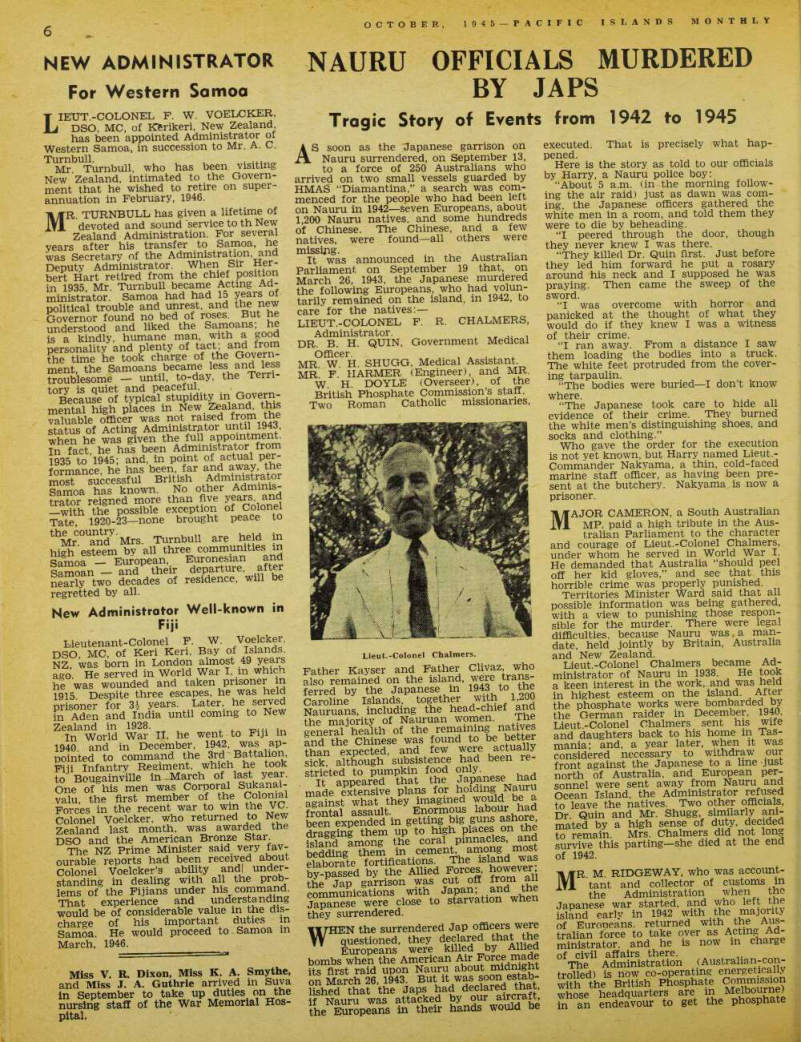
Lieut.-Colonel Chalmers became Ad ministrator of Nauru in 1938. He took a keen interest in the work, and was held in highest esteem on the island. After the phosphate works were bombarded by the German raider in December, 1940, Lieut.-Colonel Chalmers sent his wife and daughters back to his home in Tas mania; and, a year later, when it was considered necessary to withdraw our front against the Japanese to a line just north of Australia, and European per sonnel were sent away from Nauru and Ocean Island, the Administrator refused to leave the natives. Two other officials, Dr Quin and Mr. Shugg, similarly ani mated by a high sense of duty, decided to remain. Mrs. Chalmers did not survive this parting—she died at the end of 1942.
MR M. RIDGEWAY, who was account tant and collector of customs in the Administration when the Japanese war started, and who left the island early in 1942 with the majority of Eurooeans. returned with the aus tralian force to take over as Acting Ad ministrator, and he is now in charge of civil affairs there.
The Administration (Austrahamcon trolled) is now co-operating energetically with the British Phosphate Commission whose headquarters are in Melbourne) in an endeavour to get the phosphate
Lieut.-Colonel Chalmers.
plants of Nauru and Ocean Island back into operation. Much damage has been done, both by demolition prior to evacua tion in 1942, and by the Jap invaders.
Months must elapse before the two islands are again producing an appreci able amount of the valuable phosphatic rock.
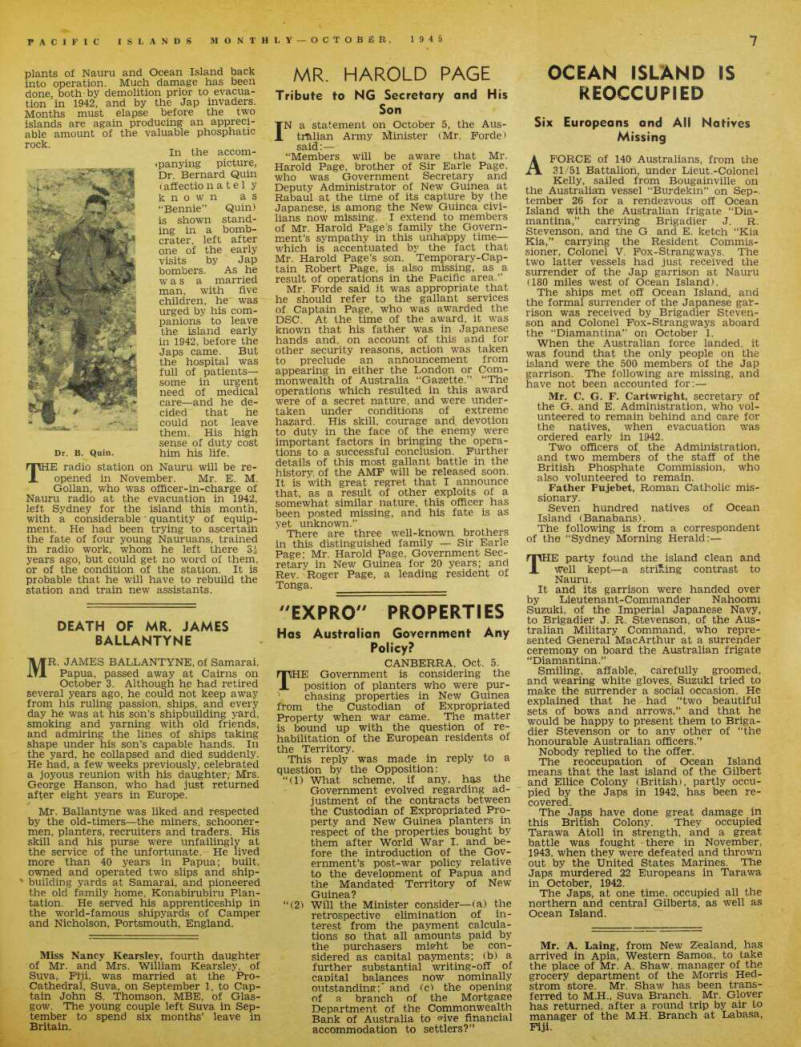
In the accom
panying picture,
Dr. Bernard Quin (affection a tel y known as “Bennie” Quin) is shown stand ing in a bomb crater, left after one of the early visits by Jap bombers. As he was a married man, with five children, he was urged by his com panions to leave the island early in 1942, before the Japs came. But the hospital was full of patients— some in urgent need of medical care—and he de cided that he could not leave them. His high sense of duty cost him his life.
rjIHE radio station on Nauru will be re- X opened in November. Mr. E. M.
Gollan, who was officer-in-charge of Nauru radio at the evacuation in 1942, left Sydney for the island this month, with a considerable * quantity of equip ment. He had been trying to ascertain the fate of four young Nauruans, trained in radio work, whom he left there Si years ago, but could get no word of them, or of the condition of the station. It is probable that he will have to rebuild the station and train new assistants.
Dr. B. Quin.