A Polynesian Island
p. 62 · Read in the full issue
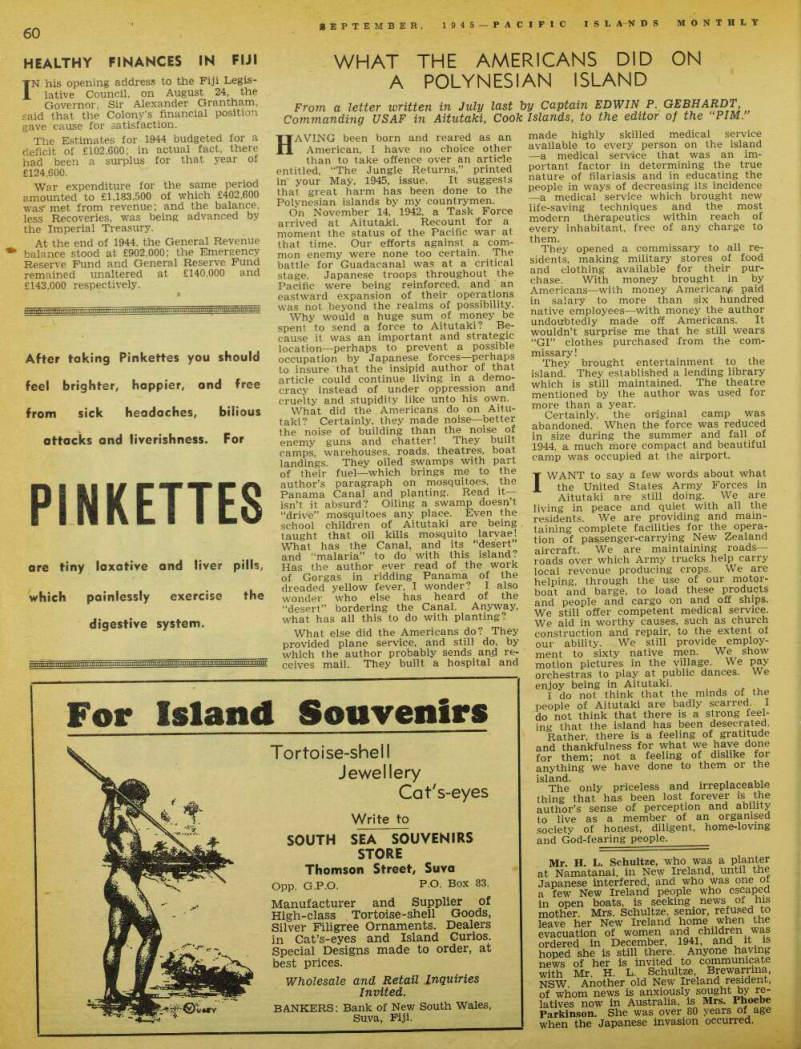
What The Americans Did On
From a letter written in July last by Captain EDWIN P . GEBHARDT, Commanding USAF in Aitutaki, Cook Islands, to the editor of the PIM.
HAVING been born and reared as an American, I have no choice other than to take offence over an article entitled, “The Jungle Returns,” printed in your May, 1945, issue. It suggests that great harm has been done to the Polynesian islands by my countrymen.
On November 14, 1942, a Task Force arrived at Aitutaki. Recount for a moment the status of the Pacific war at that time. Our efforts against a com mon enemy were none too certain. The battle for Guadacanal was at a critical stage. Japanese troops throughout the Pacific were being reinforced, and an eastward expansion of their operations was not beyond the realms of possibility.
Why would a huge sum of money be spent to send a force to Aitutaki? Be cause it was an important and strategic location—perhaps to prevent a possible occupation by Japanese forces —perhaps to insure that the insipid author of that article could continue living in a demo cracy instead of under oppression and cruelty and stupidity like unto his own.
What did the Americans do on Aitu taki? Certainly, they made noise—better the noise of building than the noise of enemy guns and chatter! They built camps, warehouses, roads, theatres, boat landings. They oiled swamps with part of their fuel—which brings me to the author’s paragraph on mosquitoes, the Panama Canal and planting. Read it— isn’t it absurd? Oiling a swamp doesn t “drive” mosquitoes any place. Even the school children of Aitutaki are being taught that oil kills mosquito larvae!
What has the Canal, and its “desert” and “malaria” to do with this island?
Has the author ever read of the work of Gorgas in ridding Panama of the dreaded yellow fever, I wonder? I also wonder who else has heard of the “desert” bordering the Canal. Anyway, what has all this to do with planting?
What else did the Americans do? They provided plane service, and still do, by which the author probably sends and re ceives mail. They built a hospital and
made highly skilled medical service available to every person on the island —a medical service that was an im portant factor in determining the true nature of filariasis and in educating the people in ways of decreasing its incidence —a medical service which brought new life-saving techniques and the most modern therapeutics within reach of every inhabitant, free of any charge to them.
They opened a commissary to all re sidents, making military stores of food and clothing available for their pur chase. With money brought in by Americans —with money American/; paid in salary to more than six hundred native employees—with money the author undoubtedly made off Americans. It wouldn’t surprise me that he still wears “GI” clothes purchased from the com missary !
They brought entertainment to the island. They established a lending library which is still maintained. The theatre mentioned by the author was used for more than a year.
Certainly, the original camp was abandoned. When the force was reduced in size during the summer and fall of 1944, a much more compact and beautiful camp was occupied at the airport.
IWANT to say a few words about what the United States Army Forces in Aitutaki are still doing. We are living in peace and quiet with all the residents. We are providing and main taining complete facilities for the opera tion of passenger-carrying New Zealand aircraft. We are maintaining roads roads over which Army trucks help carry local revenue producing crops. We are helping, through the use of our motor boat and barge, to load these products and people and cargo on and off ships.
We still offer competent medical service.
We aid in worthy causes, such as church construction and repair, to the extent of our ability. We still provide employ ment to sixty native men. We show motion pictures in the village. We pay orchestras to play at public dances. We enjoy being in Aitutaki.
I do not think that the minds of the people of Aitutaki are badly scarred. I do not think that there is a strong feelthat the island has been desecrated.
Rather, there is a feeling of gratitude and thankfulness for what we have done for them; not a feeling of dislike for anything we have done to them or the island. , , . The only priceless and irreplaceable thing that has been lost forever is the author’s sense of perception and ability to live as a member of an organised society of honest, diligent, home-loving and God-fearing people.
Mr. H. L. Schultze, who was a planter at Namatanai, in New Ireland, until the Japanese interfered, and who was one of a few New Ireland people who escaped in open boats, is seeking news of his mother. Mrs. Schultze, senior, refused to leave her New Ireland home when the evacuation of women and children was ordered in December, 1941, and it is hoped she is still there. Anyone having news of her is invited to communicate with Mr. H. L. Schultze, Brewarrma, NSW Another old New Ireland resident, of whom news is anxiously sought by re latives now in Australia, is Mrs. Phoebe Parkinson. She was over 80 years of age when the Japanese invasion occurred.