Sea Riddles of the Solomons
pp. 19-20 · Read in the full issue
Solomons
By Alma Cross
AS a newcomer to the Solomons I was disappointed at the lack of know ledge of “old timers” with regard to the native shrubs and trees, and the weird and colourful sea things which crawl and darted in and out of the coral reef. Botanical gardens, museums, and aquariums have supplied some informa tion, but the Coral Sea still has many mysteries.
There was, for example, that forma tion of tiny banana-like fish. They formed-fours, about-turned, right-wheeled with great precision, not swimming in a manner parallel with the ocean surface, but in a horizontal position, heads up and tails down.
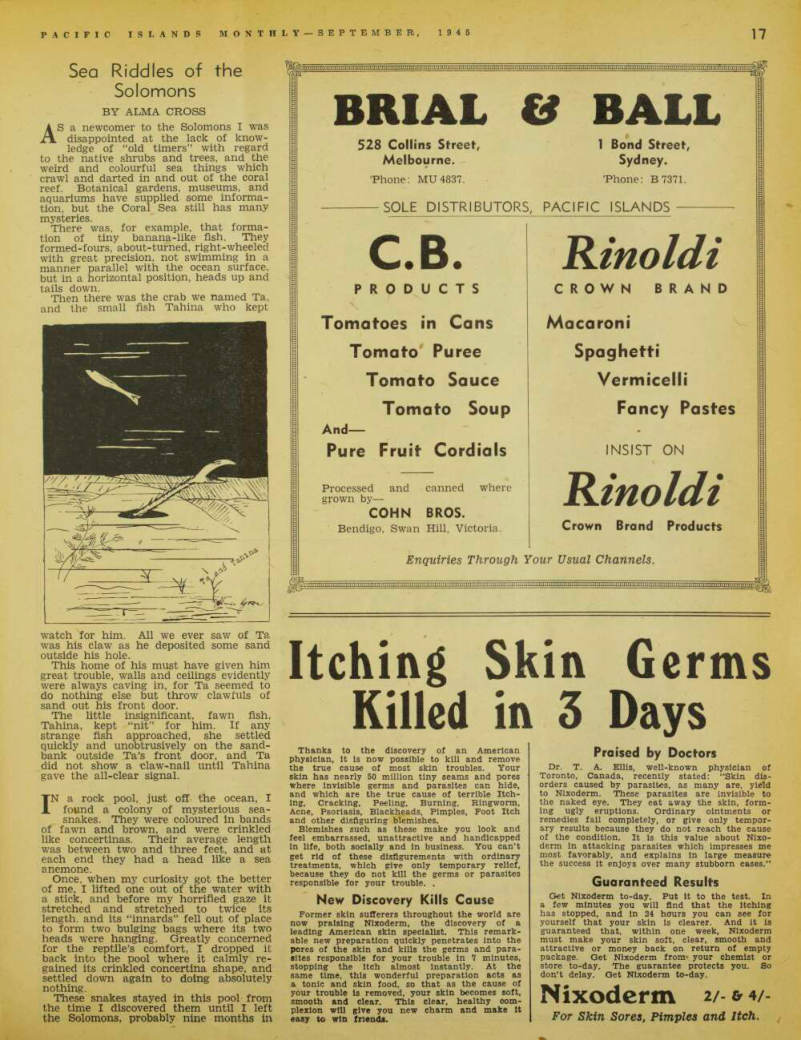
Then there was the crab we named Ta, and the small fish Tahina who kept
watch for him. All we ever saw of Ta was his claw as he deposited some sand outside his hole.
This home of his must have given him great trouble, walls and ceilings evidently were always caving in, for Ta seemed to do nothing else but throw clawfuls of sand out his front door.
The little insignificant, fawn fish, Tahina, kept “nit” for him. If any strange fish approached, she settled quickly and unobtrusively on the sand bank outside Ta’s front door, and Ta did not show a -claw-nail until Tahina gave the all-clear signal.
IN a rock pool, just off the ocean, I found a colony of mysterious sea snakes. They were coloured in bands of fawn and brown, and were crinkled like concertinas. Their average length was between two and three feet, and at each end they had a head like a sea anemone.
Once, when my curiosity got the better of me, I lifted one out of the water with a stick, and before my horrified gaze it stretched and stretched to twice its length, and its “innards” fell out of place to form two bulging bags where its two heads were hanging. Greatly concerned for the reptile’s comfort, I dropped it back into the pool where it calmly re gained its crinkled concertina shape, and settled down again to doing absolutely nothing.
These snakes stayed in this pool from the time I discovered them until I left the Solomons, probably nine months in
all. They may be there yet despite tidal waves and Japanese invasions, and al though I have consulted books, museums and aquariums these sea things still re main my sea-enigmas.
The Rev. H. T. Williams, of the Metho dist Mission, arrived in Sydney from Papua in July. He will do deputation work in NSW.