World War II: Greater USA
pp. 5-6 · Read in the full issue
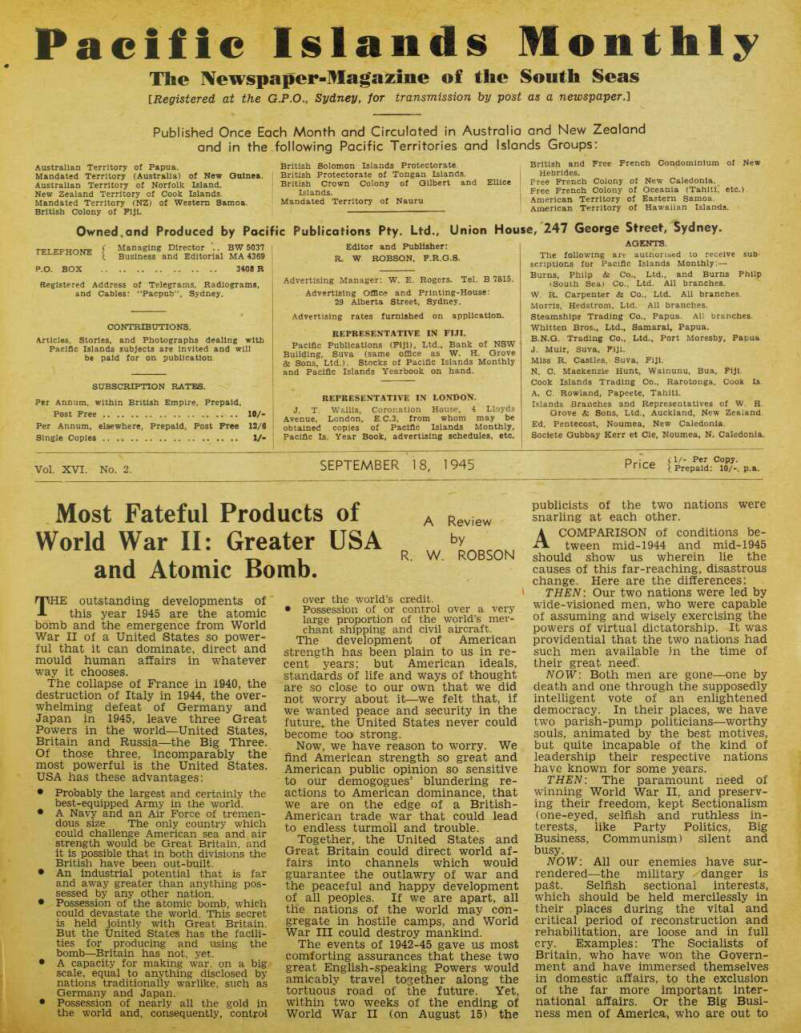
Most Fateful Products of World War II: Greater USA and Atomic Bomb.
THE outstanding developments of
this year 1945 are the atomic bomb and the emergence from World War II of a United States so power ful that it can dominate, direct and mould human affairs in whatever way it chooses.
The collapse of France in 1940, the destruction of Italy in 1944, the over whelming defeat of Germany and Japan in 1945, leave three Great Powers in the world—United States, Britain and Russia—the Big Three.
Of those three, incomparably the most powerful is the United States.
USA has these advantages: • Probably the largest and certainly the best-equipped Army in the world. • A Navy and an Air Force of tremen dous size The only country which could challenge American sea and air strength would be Great Britain, and it is possible that in both divisions the British have been out-built. • An industrial potential that is far and away greater than anything pos sessed by any other nation. • Possession of the atomic bomb, which could devastate the world. This secret is held jointly with Great Britain.
But the United States has the facili ties for producing and using the bomb—Britain has not, yet. • A capacity for making war. on a big scale, equal to anything disclosed by nations traditionally warlike, such as Germany and Japan. • Possession of nearly all the gold in the world and, consequently, control
A Review
by
R. W. Robson
over the world’s credit. • Possession of or control over a very large proportion of the world’s mer chant shipping and civil aircraft.
The development of American strength has been plain to us in re cent years; but American ideals, standards of life and ways of thought are so close to our own that we did not worry about it—we felt that, if we wanted peace and security in the future, the United States never could become too strong.
Now, we have reason to worry. We find American strength so great and American public opinion so sensitive to our demogogues’ blundering re actions to American dominance, that we are on the edge of a British- American trade war that could lead to endless turmoil and trouble.
Together, the United States and Great Britain could direct world af fairs into channels which would guarantee the outlawry of war and the peaceful and happy development of all peoples. If we are apart, all the nations of the world may con gregate in hostile camps, and World War 111 could destroy mankind.
The events of 1942-45 gave us most comforting assurances that these two great English-speaking Powers would amicably travel together along the tortuous road of the future. Yet, within two weeks of the ending of World War II (on August 15) the
publicists of the two nations were snarling at each other.
A COMPARISON of conditions be tween mid-1944 and mid-1945 should show us wherein lie the causes of this far-reaching, disastrous change. Here are the differences: THEN : Our two nations were led by wide-visioned men, who were capable of assuming and wisely exercising the powers of virtual dictatorship. It was providential that the two nations had such men available in the time of their great need.
NOW : Both men are gone—one by death and one through the supposedly intelligent vote of an enlightened democracy. In their places, we have two parish-pump politicians—worthy souls, animated by the best motives, but quite incapable of the kind of leadership their respective nations have known for some years.
THEN : The paramount need of winning World War 11, and preserv ing their freedom, kept Sectionalism (one-eyed, selfish and ruthless in terests, like Party Politics, Big Business, Communism) silent and busy.
NOW : All our enemies have sur rendered—the military danger is past. Selfish sectional interests, which should be held mercilessly in their places during the vital and critical period of reconstruction and rehabilitation, are loose and in full cry. Examples: The Socialists of Britain, who have won the Govern ment and have immersed themselves in domestic affairs, to the exclusion of the far more important inter national affairs. Or the Big Busi ness men of America, who are out to
grab world trade, no matter what they may sacrifice in good international relations. Or the “Red Raggers” of Australia who, defying an utterly weak and spineless Government* are taking advantage of Australia’s des-r perate shortage of manpower to bush range most of the big industries of the country.
THEN : The necessities of war com pelled us to pool all our resources— food and manufactured goods and transport, as well as fighting strength.
NOW : Immediately the war is over, property rights and interests are re asserted. All pooling machinery is withdrawn or abandoned.
If we want proof of endless and incredible stupidity in the handling of the new international situation created by the events between July 15 and August 15, we need go no further than Lend-Lease.
EVEN to-day, after Lend-Lease has held the stage for over five years—and the front pages for the last fortnight—few people under stand its purpose and operation.
The Office of Lend-Lease Adminis tration was established late in 1941 to promote the defence of the United States. It empowered the President in the interests of national defence “to manufacture or procure, to the extent that funds and contract authorisations are made available by Congress, any defence article for the Government of any country whose defence the President deems vital to the United States. To lend, lease, transfer or sell, or otherwise dispose of such defence articles. ...” In 1943, this organisation was merged in the office of the Foreign Economic Administration.
It was a simple and most effective formula, under which the United States, from its own enormous re sources of gold and manufacturing capacity, could supply goods, equip ment, food and service to any ally of the United States, whose war efforts might be deemed to be assisting in the defence of the United States.
It was clearly laid down, both by President Roosevelt and his Congress, that Lend-Lease was being operated only for war-winning purposes; not for reconstruction and rehabilitation.
In view of all that America has done, no one could object to that. It clearly is right and proper that, the moment the war is over, and we may contemplate with confidence the pre servation of the Four Freedoms, Lend- Lease should cease.
But all intelligent folk will con demn the way in which cessation was brought about. There was no warn ing, no preparation of the mind of the uninstructed public—simply a flat-footed, unamplified announce ment from the White House that Lend-Lease should forthwith cease.
It caught the Governments of all other countries —and especially the new Socialist Government of Britain —unprepared and off-balance, and there were some angry reactions.
Such a thing never would have happened had Roosevelt and Chur chill been in charge. Lend-Lease certainly would have been brought to
an end, but the nations would have been prepared for it; and all the people of the world, instead of being shocked into a bitter rejoinder, would have understood the situation and would fittingly have paid tribute to the generosity as well as. the magni ficent industrial achievements of the United States. The Americans, on their part, would have recognised that the British people, having literally stripped themselves of every thing in order to contribute their utmost to the war effort, would deserve some special consideration after withdrawal of Lend-Lease.
The leading economists of both countries now are seeking a mutually acceptable formula. It is apparent that the one-eyed Socialists of Britain, as well as the greedy Big Business men of USA, can see the danger.
ONLY good sense can prevent a far-reaching trade war between the British Empire and the United States. If it occurs, all hopes of a better-ordered world may go down in that calamity.
The United States, as already shown, enters this post-war period with tremendous initial advantages.
It is vital to her national economic set-up that she develops a great volume of export trade, and she is going to reach out after it ruthlessly.
We of the Pacific, more than any other non-American countries, are going to feel that development.
But Britain, while comparatively poor, is herself not without advan tages. There are a very large number of countries within the Sterling Bloc; and those countries are all generally in the same condition of post-war poverty, and very eager to trade with each other. In a general survey, one would say that each country in the Sterling Bloc has something that the other is eager to obtain, and thus avenues for active and sound trade, the basis of ■ abundant employment, can be seen everywhere.
Britain’s position, at the centre of the Sterling Bloc, is good. She wants raw materials and food, for her enormous manufacturing industries; and the other countries generally can supply her with those things, in re turn for her manufactured goods.
AMERICA’S situation, by comparison, is bad—and most extraordinary.
America cannot maintain her high standards of living unless she sells to other countries vast quantities of her manufactures and products—motor cars, films, oil, machinery, canned goods, and so forth. But America already has nearly everything she needs in the way of raw materials, manufactured goods and foodstuffs.
That was her situation after World War I. and probably it will be even more her problem after this war.
In the twenty years between wars, the United States maintained her national economy, built in the pre vious fifty years upon a vast export trade, by a remarkable expedient. As she could not absorb the goods of other nations (having plenty of her own), she accepted the world’s gold.
She bought all the gold that was
offered to her. It was piled up in “a hole in the ground.”
In the final analysis, there is only one basis for sound and permanent international trade —namely, the ex change of commodities (commodities, of course, including various kinds of services). A nation with a surplus of exports over imports can, for a time, accept in place of commodities a token of fixed international value, such as gold—the length of time be ing governed by that country’s skill in handling her accumulated credit.
But a people cannot eat gold, or turn it into machinery or textiles —a time must come when that country must either reduce its exports (involving a disturbing readjustment of its inter nal economy) or discover new needs for its people, creating more jobs.
IN 1939, the recorded gold in tlie world was worth 25,702 millions of dollars; and, of that, 17,644 millions of dollars’ worth was held by the United States. By the end of 1943, US stock of gold had increased to 22,387 millions of dollars.
In 1939, there were between 6,000,000 and 8,000,000 unemployed in the United States; the problems associated with unemployment were increasing, and apparently defying solution.
That is bound to happen in any country which is wholly self-sufficient, and which yet insists on basing its national economic structure upon the maintenance of export trade.
World War II saved the United States from major economic and social disaster. No amount of “New Deals” could have got the nation away from the operation of funda mental laws of economics.
EXACTLY the same kind of thing will happen after 1945, unless something is done to balance Ameri can overseas trade. If thsre is to be a trade war between Sterling Bloc and Dollar Bloc, and the United States cannot buy the goods of other coun tries, the United States will almost certainly suffer disaster.
Individual Americans are not fools they can see this situation and this danger as clearly as anyone. But they are cursed, as all democratic countries are cursed, with parish • pump politicians in the leadership of their country—little men who permit themselves to be pushed around by utterly selfish interests.
MAYBE this terrible atomic bomb is a blessing in disguise. We know, for a certainty, that it will be employed in the next war, and that it is quite capable of destroying not only “civilisation,” but also mankind.
Greed and selfishness are the com monest human traits, and they lead invariably to wars and suffering. They cannot be eliminated—but they can be over-ridden and controlled. The instinct of self-preservation dominates human life. That instinct surely will compel the nations to seek better leadership, and to dwell together in justice and harmony, so that tne frightful power discovered m the splitting of the atom may be con trolled and guarded.