blemished''by’
p. 39 · Read in the full issue
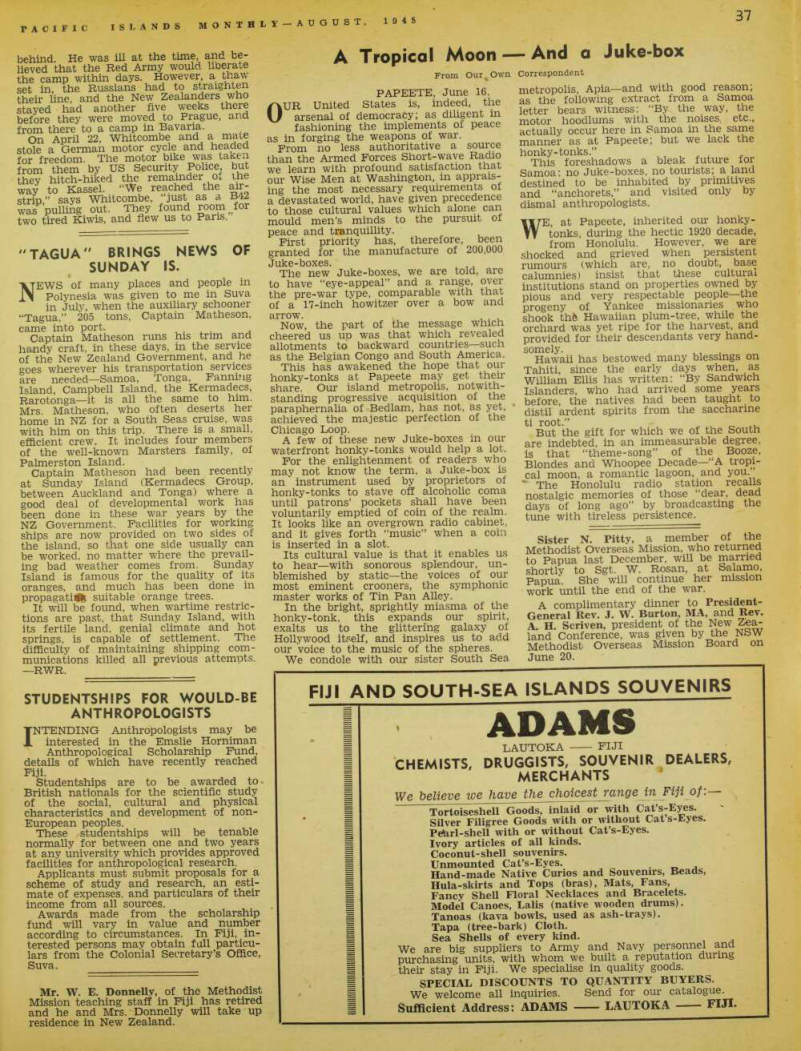
A Tropical Moon And a Juke-box
From Our Own Correspondent
Papeete June 16.
Ottr united States is 1 indeed, the UR United states it., muccu, w arsenal of democracy; as diligent m fashioning the implements of peace as in forging the mpw ow.
From no less autnontatiye a souice than the Armed Forces Short-wave Radio we learn with profound satisfaction that our Wise Men at Washington, in appraising the most necessary requirements of a devastated world, have given precedence to those cultural values which alone can mould men’s minds to the pursuit of peace and tranquillity.
First priority has, therefore, been granted for the manufacture of 200,000 Juke-boxes.
The new Juke-boxes, we are told, are to have “eye-appeal” and a range, over the pre-war type, comparable with that of a 17-inch howitzer over a bow ana arrow.
Now, the part of the message which cheered us up was that which revealed allotments to backward countries—such as the Belgian Congo and South America.
This has awakened the hope that our honky-tonks at Papeete may get their share. Our island metropolis, notwithstanding progressive acquisition of the paraphernalia of Bedlam, has not, as yet, achieved the majestic perfection of the Chicago Loop. , , A few of these new Juke-boxes in our waterfront honky-tonks would help a lot.
For the enlightenment of readers who may not know the term, a Juke-box is an instrument used by proprietors oi honky-tonks to stave off alcoholic coma until patrons’ pockets shall have been voluntarily emptied of com of the realm.
It looks like an overgrown radio cabinet, and it gives forth "music” when a coin “.SC that it enables us
blemished''by’
most eminent crooners, the symphonic master works of Tin Pan Alley.
In the bright, sprightly miasma of the honky-tonk, this expands our spirit, exalts us to the glittering galaxy of Hollywood itself, and inspires us to add our voice to the music of the spheres.
We condole with our sister South Sea
metropolis, Apia—and with good reason; as the following extract from a Samoa letter bears witness: “By the way, the motor hoodlums with the noises, etc., actually occur here in Samoa in the same manner as at Papeete; but we lack the honky-tonks.” , , .
This foreshadows a bleak future for Samoa: no Juke-boxes, no tourists; a land destined to be inhabited by primitives and “anchorets,” and visited only by dismal anthropologists.
WE, at Papeete, inherited our honky tonks, during the hectic 1920 decade, from Honolulu. However, we are shocked and grieved when persistent rumours (which are, no doubt, base calumnies) insist that these cultural institutions stand on properties owned by pious and very respectable people—the progeny of Yankee missionaries who shook thfe Hawaiian plum-tree, while the orchard was yet ripe for the harvest, and provided for their descendants very hand somely.
Hawaii has bestowed many blessings on Tahiti, since the early days when, as William Ellis has written: “By Sandwich Islanders, who had arrived some years before, the natives had been taught to distil ardent spirits from the saccharine ti root.”
But the gift for which we of the South are indebted, in an immeasurable degree, is that “theme-song” of the Booze, Blondes and Whoopee Decade —“A tropi cal moon, a romantic lagoon, and you. - The Honolulu radio station recalls nostalgic memories of those “dear, dead days of long ago” by broadcasting the tune with tireless persistence.
Sister N. Pitty, a member of the Methodist Overseas Mission, who returned to Papua last December, will be married shortly to Sgt. W. Rosan, at Salamo, Papua She will continue her mission work until the end of the war.
A complimentary dinner to President- General Rev. J. W. Burton, MA, and Rev.
A. H. Scriven, president of the New Zea land Conference, was given by the NSW Methodist Overseas Mission Board on June 20.