New Deal Or Mis-Deal?
pp. 10-50 · Read in the full issue
Papua-N. Guinea Provisional Administration Bill Passed by Both Houses
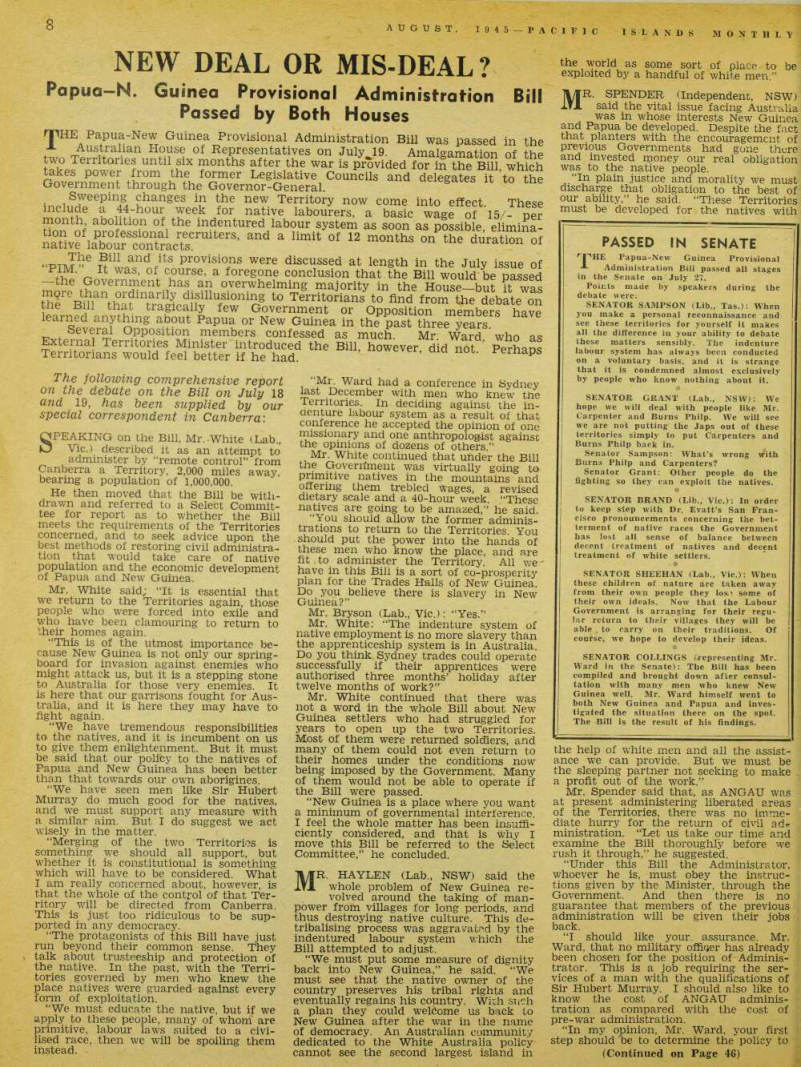
T'HE Papua-New Guinea Provisional Administration Bill was passed in the + Australian House of Representatives on July 19. Amalgamation of the two Territories until six months after the war is provided for in the Bill which takes power from the former Legislative Councils and delegates it to the Government through the Governor-General. g 0 tne Sweeping changes in the new Territory now come into effect These include a 44-hour week for native labourers, a basic wage of 15/- per Hnn nmf llon ° f i the md f entured lab °ur system as soon as possible, elimina native CSS" 11 a lnmt 0f 12 months on the duration of “PiJ” 8 provisi ° ns were discussed at length in the July issue of ll was > of . course, a foregone conclusion that the Bill would be passed the Government has an overwhelming majority in the House but it was d |? illas^ordto Territorial to find from the debate on the Bill that tragically few Government or Opposition members have learned anything about Papua or New Guinea in the past three years. f eV€ ; ia * Opposition members confessed as much. Mr. Ward who as External Territories Minister introduced the Bill, however, did not * Perhaps Temtonans would feel better if he had. -remaps
The following comprehensive report on the debate on the Bill on July 18 and 19, has been supplied by our special correspondent in Canberra : SPEAKING on the Bill, Mr.-White (Lab., Vic.) described it as an attempt to administer by “remote control” from Canberra a Territory, 2,000 miles away, bearing a population of 1,000,000.
He then moved that the Bill be with drawn and referred to a Select Commit tee for report as to whether the Bill meets the requirements of the Territories concerned, and to seek advice upon the best methods of restoring civil administra tion that would take care of native population and the economic development of Papua and New Guinea.
Mr. White said; “It is essential that we return to the Territories again, those people who were forced into exile and who have been clamouring to return to their homes again.
“This is of the utmost importance be cause New Guinea is not only our spring board for invasion against enemies who might attack us, but it is a stepping stone to Australia for those very enemies. It is here that our garrisons fought for Aus tralia, and it is here they may have to fight again.
“We have tremendous responsibilities to the natives, and it is incumbent on us to give them enlightenment. But it must be said that our policy to the natives of Papua and New Guinea has been better than that towards our own aborigines.
“We have seen men like Sir Hubert Murray do much good for the natives, and we must support any measure with a similar aim. But I do suggest we act wisely in the matter.
“Merging of the two Territories is something we should all support, but whether it is constitutional is something which will have to be considered. What I am really concerned about, however, is that the whole of the control of that Ter ritory will be directed from Canberra.
This is just too ridiculous to be sup ported in any democracy.
“The protagonists of this Bill have just run beyond their common sense. They talk ab<put trusteeship and protection of the native. In the past, with the Terri tories governed by men who knew the place natives were guarded against every form of exploitation.
“We must educate the native, but if we apply to these people, many of whom are primitive, labour laws suited to a civi lised race, then we will be spoiling them instead.
“Mr. Ward had a conference in Sydney last December with men who knew the Territories, in deciding against the in denture labour system as a result of that conference he accepted the opinion of one missionary and one anthropologist against the opinions of dozens of others.”
Mr. White continued that under the Bill tne Government was virtually going to primitive natives in the mountains and offering them trebled wages, a revised dietary scale and a 40-hour week “These natives are going to be amazed,” he said.
“You should allow the former adminis trations to return to the Territories. You should put the power into the hands of these men who know the place, and are fit to administer the Territory. All we have in this Bill is a sort of co-prosperity plan for the Trades Halls of New Guinea.
Do you believe there is slavery in New Guinea?”
Mr. Bryson (Lab., Vic.): “Yes.”
Mr. White: “The indenture system of native employment is no more slavery than the apprenticeship system is in Australia.
Do you think Sydney trades could operate successfully if their apprentices were authorised three months’ holiday after twelve months of work?”
Mr. White continued that there was not a word in the whole Bill about New Guinea settlers who had struggled for years to open up the two Territories.
Most of them were returned soldiers, and many of them could not even return to their homes under the conditions now being imposed by the Government. Many of them would not be able to operate if the Bill were passed.
“New Guinea is a place where you want a minimum of governmental interference.
I feel the whole matter has been insuffi ciently considered, and that is why I move this Bill be referred to the Select Committee,” he concluded.
MR. HAYLEN (Lab., NSW) said the whole problem of New Guinea re volved around the taking of man power from villages for long periods, and thus destroying native culture. Tliis de tribalising process was aggravated by the indentured labour system which the Bill attempted to adjust.
“We must put some measure of dignity back into New Guinea,” he said. “We must see that the native owner of the country preserves his tribal rights and eventually regains his country. With such a plan they could welcome us back to New Guinea after the war in the name of democracy. An Australian community dedicated to the White Australia policy cannot see the second largest island in
the world as some sort of place to be exploited by a handful of white men.”
MR. SPENDER (Independent, NSW) said the vital issue facing Australia was in whose interests New Guinea and Papua be developed. Despite the fact that planters with the encouragement of previ(3us Governments had gone there and invested money our real obligation was to the native people.
“In plain justice and morality we must discharge that obligation to the best of our ability,” he said. “These Territories must be developed for the natives with
the help of white men and all the assist ance we can provide. But we must be the sleeping partner not seeking to make a profit out of the work.’' Mr. Spender said that, as ANGAU was at present administering liberated areas of the Territories, there was no imme diate hurry for the return of civil adr ministration. “Let us take our time and examine the Bill thoroughly before we rush it through,” he suggested.
“Under this Bill the Administrator, whoever he is, must obey the instruc tions given by the Minister, through the Government. And then there is no guarantee that members of the previous administration will be given their jobs back.
“I should like your assurance. Mr.
Ward, that no military officer has already been chosen for the position of Adminis trator. This is a job requiring the ser vices of a man with the qualifications of Sir Hubert Murray. I should also like to know the cost of ANGAU adminis tration as compared with the cost of pre-war administration.
“In my opinion, Mr. Ward, your first step should "be to determine the policy to
(Continued on Page 46)
be followed in these Territories. Then you must generously provide for compensation for men, who have put their lifetime into managing plantations there, who are affected by the policy. Certainly we in this House want to be better informed on the matter before we commit our selves to any policy. It will be seen here that complete control is vested in Can berra in the 'Minister, and even if the Administrator is given full power to con trol the Territory he must carry out his duties in acordance with the instructions of the Minister.
“I support the amendment for the reference of the bill to a Select Com mittee.”
Representation for Territorians
SPEAKING to Mr. White’s amendment, Mr. Cameron (Lib., SA) said that New Guinea was most valuable to Australia strategically, taut this was some thing the Government had ignored in the past. Since then, however, Mr. Ward has “become one of the great discoverers and ranks himself with Marco Polo —he was responsible for the discovery of that won derful ‘Brisbane Line’ and I’m surprised he takes any interest in anything north of it.”
Mr. Ward appeared to think he was going to bring tne New Guinea native to a state of civilisation something akin to our own. Mr. Cameron, for his part, had never believed that Western civilisation and Western ideas could be applied to these people whose living conditions are so vastly different.
“We have to have due regard for the welfare of the natives, but I do hope we are not going to the islands Just as a sort of Father Christmas to them. They have certain rights, but let us not forget they also have obligations. As for this Bill—it proposes what virtually amounts to a New Guinea dictatorship.
“The Bill provides for a mongrel type of administration where there should be one of a local type on which white residents could have representation. I think the people residing in these Terri tories should have at least one represen tative in Parliament here. Then we would not have to rely on Ministerial statements purporting to give an accurate picture of what is going on in New Guinea.
“I don’t know whether the Minister is qualified to decide what New Guinea should have. Certainly he has been face to face with the Fuzzy Wuzzies, although whether he has been admitted to theii societies I do not know . . . he con cluded.
An All-Party Committee
MR. ANTHONY (CP, NSW) who also supported the amendment, sug gested that an all-party Committee be sent to New Guinea to study condi tions there first hand. Whatever legisla tion was finally passed in respect of the island Territories, he said, its first con sideration would have to be the advance of Australia.
Education of the natives could ulti mately result in their amalgamation with enemies of Australia, such as Japan. They would then become a menace to this country. The Government was protecting the natives, but not Australia. Mr.
Anthony said the native would not be helped by Mr. Warn going up and talk ing “Domain platitudes” to them. In any case the changes proposed in the Bill would probably end up killing off the natives.
“I would like the Minister to indicate to the House just who is advising him in these matters,” Mr. Anthony concluded.
Mr. Rankin (CP, Vic.) said the measures proposed by the Government would mean the ruination of the New Guinea planter. Contrary to general opinion, the average copra planter had difficulty in making ends meet, especially as many of them were in the grip of trading companies. He calculated the price of copra would have to be raised £4 to counter added expense which would be incurred by planters as a result of Mr. Ward’s “improvements” for natives.
If the Government insisted on its present plans, it would have to subsidise these planters if they were to exist.
Mr. Abbott (CP, NSW) said if adminis tration were contemplated it should be placed in the hands of competent men like Sir Hubert Murray, or Sir William MacGregor. .
“What is proposed under this bill is centralised government. The curse of the world has been the centralisation of gov ernment in the hands of people who did not know the needs and requirements of the native races, and whose opinions could be swayed by sectional interests on the spot. If a gallup poll could be taken amongst the natives they wouxd just want to be left alone.”
Territorians Slandered
MR. CHAMBERS (Lab., SA) said natives had suffered greatly in Papua right up to the beginning of the Pacific war. Very many of tnem throughout both the Territories were suf fering from malnutrition —he would rather close down Papuan industries than see them carried on with labour being paid the slave rate of 2/6 a week. I have seen and met Papuan native intel lectuals, and they are comparable to any Australian 'people.
Mr. Bryson (Lab., Vic.) said white planters in Papua and New Guinea had only been interested in making money, and had not waited to fight when the Japs poured down from the north. He added: “The only fighting done there was by troops sent from Australia.”
Mr. Anthony (CP,NSW): “That’s a lie.
Haven’t you ever heard of the Volunteer Rifles?”
Speaker: “Order! I will have- to ask you to withdraw that statement.”
Mr. Anthony: “In deference to you, I will withdraw.”
Speaker: “There must be an unquali fied withdrawal.” . , , Mr. Anthony: “All right. I withdraw.’
Mr Bryson (continuing his speech): “Planters in these Territories were some times returned soldiers and sometimes not, but they went there to make money, and get what they could out of the country. They went there to exploit the country and make a good profit out of that exploitation. There is no reason why they should get labour to help exploit it. And if this is not slave-labour, then I have the wrong idea of what slave labour is.
“If these exploiters cannot make their money when we give the inhabitants better conditions, then they had better walk out of the country and leave it to the natives. I commend this Bill to the House as a piece of humane legislation.
Mr. Chambers (Lab.. SA) supported Mr.
Bryson’s remarks about the planters.
During debate he interjected, saying that white residents of the Territories had done little in their defence. He said that one man in Papua had employed a native child aged about six years. This man had been one of the first to leave Papua when danger threatened.
The Minister for External Territories (Mr Ward), who was in charge of the Bill, was more cautious. He said: “Many planters entered the services. Many of them entered • ANGAU and gave very valuable service. But there were also many absentee shareholders of companies operating in the Territories, and they weren’t there to face the Japs.
“The man who had most to fight for in New Guinea was the man who was mak ing the money out of the Territories—and these absentee shareholders were not there.”
Mr. Ward's Aims
SECOND-READING debate closed with an address by Mr. Ward, who. in his opening sentence, abruptly told the Opposition that the amendment could not be accented, as it would result in delay in establishment of an administration.
Other points were: — • Proper administration would be re turned to the Territories just as soon as the white population went back. • That power temporarily vested in the Governor-General by the Bill would be returned to Legislative Councils of the former type upon return of the tration. • That natives would ultimately take an “intelligent” part and interest in their own Government. • That the Bill would later afford some protection for white residents of the Ter ritories, but that it would first and fore most cater for the native population. • Natives would be taught agricultural
methods and encouraged to sell their pro ducts on island markets. • That arbitration machinery would be set up in the islands to investigate and determine wages for natives. • Employers would have to report to a Department of Native Employment every time they worked their native labourers overtime on the 44-hour week basis. • That control of the Territories from Canberra would not be “remote control” because the Administrator in New Guinea would be free to make his own decisions.
He would, however, be given directions as to the policy to be followed. • That Labour’s New Guinea would set an example to the world.
One of the first things to be done under the Bill, said Mr. Ward, would be a sur vey to be taken of villages. This wohld estimate how many men each village could spare for outside labour with out upsetting “native economy.” and no more than that number could then be taken from the village.
Then there would also be workers com pensation for natives who previously had been cast aside by companies, after they had done their part in amassing wealth for mining firms.
The Government would send a compe tent officer to the Territory to find out what the rates of pay should be for natives performing certain work under certain conditions.
Mr. Ward said that all the best advice had been obtained before deciding on the measures now proposed. Advisers had in cluded Sir Hubert Murray, whom the Opposition had mentioned several times.
It was intended to abolish the indenture system of labour at the earliest possible moment, and professional recruiting was being banned. Previous administrations in the islands had done a good job, al though they had been starved by Federal Parliament.
“There will be a Native Labour De partment whose particular duty would be to see that the Government terms are ob served. Employers will not be permitted to work their natives overtime, unless very special circumstances warrant it. In those cases, the employers will be obliged to report the incidents to the Native Labour Department.”
The Government was going to see that
the native got his full value from planter employers, by enforcing revised dietary scales. It was the intention of the Gov ernment, through skilled agriculturalists, to teach natives to improve the standard of their crops. They would later be able to use their own crops, and would be en couraged to sell them on island markets.
This would not affect Australian currency.
Natives would also be encouraged to take an interest in their own affairs.
“We want to make it quite clear that we intend having the care of the natives themselves the primary objective,” said Mr. Ward.
It was the Government’s opinion that at the present stage, with the great majority of the Territory’s population evacuated from the islands, it would be absolutely ridiculous to establish any form of legislative machinery. But that will be done later.
In the meantime the control will be under an Administrator who will be given directions by the Government in regard to policy matters, but in regard to deci sions of government there will be no inter ference.
The Minister said the Government would not interfere with missions in the Territory.
Mr. Ward concluded: “We hope to be able to set an example to the world in the conditions which we will establish in New Guinea, and by the way we treat the inhabitants. When the system of trusteeship begins to operate this coun try will have no need to be ashamed of what has been accomplished by the Labour Government for New Guinea Territories and for the people living therein.” . ..
A division was taken on Mr. Whites amendment, which was lost by 36 votes to 14.
The Bill is Passed WHEN the Bill entered the committee stages (during which each clause is debated)—the Government encoun tered very little opposition on every clause except one—clause 8. . .
Clause 8 states: “Subject to this Act the Governor-General shall have power to make ordinances for the peace, order, and good government of the Territory.
Mr White moved an amendment, later defeated, that the words “Gpvernor- General” be omitted and “Administrator’ inserted in their place.
Mr. Cameron commented: “I am con cerned about the power that the Minister for External Territories will exercise under this clause. Whether the power is vested in the Administrator or the Governor- General, the whole essence of the thing Is these ordinances will express the views of the Minister.
“Under these Regulations, whatever they may happen to be, the Minister pro poses to conduct, by Regulation, virtually a revolution in the strategic, economic and social spheres of Papua and the parts of New Guinea under his control. And all this power is to be granted in this single clause, “It is quite obvious that the Minister proposes to set up by Regulation authori ties which will handle all the reforms he has explained.
“His authority for supervision o r native labour will be done by Regulation, and so will it be for all his other proposals.
The Minister, through his satellites, will have a really new New Guinea before long.
“I think the whole of clause G from start to finish is the really dangerous part of this Bill. This is the clause which will deny the Commonwealth Parliament any right to supervision over these matters “This is the clause under which ihe Minister is going to put in force, without further reference to Parliament, his ideas on how New Guinea is going to be run.
He is no better qualified to do that than 1 am - .
“Under this clause he will oe able to do things, which would alter the face of New Guinea, in a short couple of years or even less than that. And worse, the things he will do under clause 8 will be
permanent—despite his protestations. ’
In reply, Mr. Ward said the Territories had been governed by ordinance for years.
The only difference was that, in this case, the Government, and not the Administra tor, was to make the ordinances.
“Whoever is appointed to the post of Administrator will have the cortfidence of the Government, and he will be in con stant touch with the External Territories Minister,” he said.
The Bill was then passed in all stages in the House of Representatives.
After a short leave in NSW, Major Stanley Cowled, chaplain with the Fiji troops, has returned to his unit in Suva.