Private Enterprise — Flourishing in Central Pacific
pp. 5-6 · Read in the full issue
But Murdered in the West
UNDER the stimulus of returning freedom and of a three-years’ accumulation of United States dollars, enterprise in all the South Pacific Territories which are not under militory occupation is showing remarkable activity and eagerness. Conditions in Fiji may be exceptional; nonetheless, Fiji provides a good example of what we may expect in the Territories generally. Except the Australian-controlled Territories, of coarse! .j A considerable number of American Servicemen passed through Fiji. They spent their money freely on services and goods; and especially did they • ¥ Fi l iai l Z ur l os , and ?S«ii enirs T ar -i les of shell tortoisenii^prn^ d TnH^%ra e H P v oCially * T - h u to q ? lck mpnf 6 aqvantage °f fbis develop- J/ 16 Indian community of Fiji did little or nothing for the United hp Sn W n a o r .f2 r^a fact which will be taken care of in good tune by the mevitable law of compensation—but fh^ o pvfri e nv^o nca S do ? lar , s - , And Si? 1 t 0^? na *rX S0 A uven * r trade 18 ° n ‘ Americans have m ° S V y ' ; but the arrival of th© Fiji curios in the United States suDDW d of such 11 arHcl h f e T /' r a f large 15 an " some . of tj l6 bigger traders n Fiji to receive drafts for £20,000 m payment for shipments of “curios.”
In an economic sense, that new money has enriched and sweetened Fiji. All classes have benefited. There is more money in the Colony to-day than ever before. Big firms and little firms—they all are holding big bal ances in their banks which, under present conditions, they generally are unable to profitably employ. Any thing that looks like a sound invest ment is literally rushed. Indians in Fiji always are land-hungry. There is no control over property values in Fiji. The value of all property on the Suva Peninsula, in response to the demand, has at least doubled in the last two or three years. rpHE shrewdest minds in Fiji are seeking avenues for the profit able employment of accumulated funds. Compared with conditions in other countries, taxation in Fiji is very low—s/- in the £ on companies, a limit of 1/3 in the £ on incomes from personal exertion. All this means that, somehow or other, new industries will be established in Fiji, to .1 bake care of all that idle capital, FIJI has the capital, almost endless resources of raw material, and a very limited reserve of labour—which may be increased when the Fijian bat talions are demobilised.
But Fiji wants markets for what she car * Produce. Fiji s business men are seeking the answer. Private enter prise, stimulated by such conditions, is holding up its head and going
There is no one there to tie a tin-can to the tail of private enter prise in the Central and East Pacific Territories, in the way that the political lunatics of Australia are do ing in the Western Pacific Territories of Papua and Mandated New Guinea, TT is not easy to find employment in 1 these Central and Eastern Terri tories for private enterprise, backed by plenty of capital Copra is now very much in world demand; but when the Philippines and East Indies come back to prc duction, copra will return to its pre war levels. It probably can always be sold; but not at to-day’s exciting prices. Sugar has no interest for small concerns; its sale and distri bution are matters for international arrangement, and can be handled only b y big companies like the CSR.
T be production of cocoa, coffee, rub ber, and so on—all may be grown well m thes e Territories, but all must m eet world competition, so production mu st be kept, by careful, big-scale operation, on an economic basis, T*HE minds of experienced men are 1 running towards the production of semi-manufactured articles in stead of what might be called raw materials and raw foodstuffs. For instance, Carpenter & Co., Ltd., are far advanced with the installation in Suva of a factory which will use from 12,000 to 20,000 tons of coprapS annum in the production of vegetable lard—refined coconut oil—for & which there is a world-wide demand—but all of which probably can be used in or near Fiji.
There was an expert in Fiji recently
looking at the masses of husks from nee, thrown away *as refuse behind the rice-mills. Those husks contain two vitamins—useless while in the husks, but precious when brought to another condition. That expert actually was in Fiji looking for hammerhead sharks—in the livers of those creatures is a vitamin that has come into tremendous world-wide demand.
Another man is in the Central Pacific at the present time looking for supplies of candle-nuts—the possible basis of a new industry.
M R - R. W. ROBSON, editor and publisher of this journal, visited Fiji during July and August, and is at present in New Zealand. Affairs, as he found them in Fiji, are described in several articles in this issue.
And so on. Everywhere one turns in the Pacific Territories—except the unfortunate regions under the trol of the madheaded Australian politicians—one finds private enter prise eagerly at work, laying foun dations of activities that will bring great prosperity to all classes of the Islands’ communities. Fiji, New Cale donia, New Hebrides, and, in a lesser degree, Samoa, Cook Islands, Tahiti, Tonga—all have plenty of money for investment, and an eagerness to establish new or enlarged industries, based on their abundant supplies of raw materials. Wise direction and encouragement now of private enter prise will establish long-term pros perity for all classes throughout many of these Territories. They deserve it —some of them—especially those who kept their economic eggs in one basket —have had a pretty thin time of it'in past decades.
IN contrast with all this, the con dition and prospects of the Aus tralian Territories of Papua and Mandated New Guinea are pitiful and appalling.
The whole subject is dealt with in reports and articles elsewhere in this issue. Two rich tropical Territories, which are completely dependent upon private enterprise for future develop ment, are being dragged at the tail of an ignorant and intensely class biassed Australian Socialist Govern ment, which will go to any lengths to destroy private enterprise and Bol shevise all institutions.
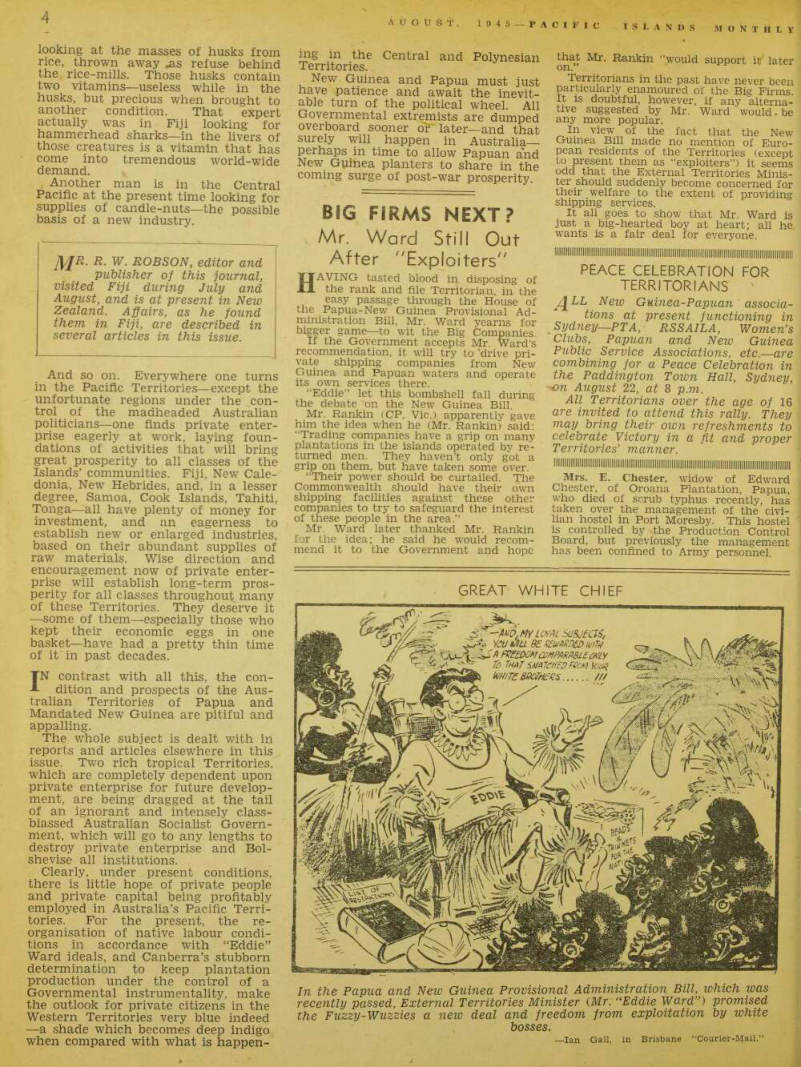
Clearly, under present conditions, there is little hope of private people and private capital being profitably employed in Australia’s Pacific Terri tories. For the present, the re organisation of native labour condi tions in accordance with “Eddie”
Ward ideals, and Canberra’s stubborn determination to keep plantation production under the control of a Governmental instrumentality, make the outlook for private citizens in the Western Territories very blue indeed —a shade which becomes deep indigo when compared with what is happen
ing in the Central and Polynesian Territories.
New Guinea and Papua must just have patience and await the inevit able turn of the political wheel. All Governmental extremists are dumped overboard sooner or later—and that surely will happen in Australia— perhaps in time to allow Papuan and New Guinea planters to share in the coming surge of post-war prosperity.