Pacific News-Review
Notes And Comment On
International Affairs
From July 16 To August 12
July 16: The two-months-old constitu tional deadlock in Belgium appears likely to continue indefinitely, because of King Leopold’s decision neither to abdicate nor to return to Belgium.
July 22: The Big Three are still meet ing in Potsdam, although great secrecy surrounds their deliberations. It is be lieved that one topic of discussion is the future conduct of the war against Japan.
Sensational developments of a diplomatic and military nature are expected in this connection. There are rumours that the Japanese have asked Marshal Stalin to put forward peace proposals on their behalf, and that President Truman car ried a draft of US surrender terms to Japan, to the conference, July 23: The trial of Marshal Petain has begun in Paris. He is accused of treason during the German occupation in that he inaugurated personal rule— the final realisation of a long prepared plot against the Republi can regime in France. The aged Marshal has protested his innocence—he says that while de Gaulle was fighting for France outside, he was fighting inside France to prepare for victory—and that he had always fought France’s enemies. He begged the Court to remember his record in 1916.
July 26: Big Three talks have adjourned while Mr. Churchill and Mr. Attlee return to England to hear the result of the British elections. Counting begins to-day at 9 a.m., London time.
July 26: Labour swept the polls in the British general elections, winning 376 out of the 640 seats in the Commons. Mr.
C. Hi. Attlee becomes the new Prime Minister. This has shattered the calm of the talks at Potsdam. It is thought that Mr, Attlee will extend an invitation to Mr. Churchill to return with him, but few think Churchill will accept. 29: The United States has become the first major power to join the United Nations Organisation. The Senate, by 89 votes to 2, ratified the United Nations Charter on July 28.
July 3: The Big Three conference at Potsdam ended yesterday, and an official report of the deliberations has been issued. No mention of the Pacific war is made; but many decisions have been made with regard to Europe. Large por tions of Eastern Germany (Pomerania.
Silesia, and two-thirds of East Prussia) have been given to Poland. Russia takes the remainder of East Prussia, including Komgsberg. There is to be complete dis armament and demilitarisation of Ger many, and eaual rights for all German citizens. Germany is to pay reparations.
A peace treaty with Italy is to be pre pared. Spain, under its present Govern ment is not to be permitted membership of the United Nations. War criminals are to be brought to swift and sure ius tice, and a Council 0 f Foreign Ministers from Britain. USA. Russia, China and France is to be established.
August 6.: Nokrashv Pasha. Premier of Egypt, has demanded full independence for Egypt, with the withdrawal of all British troons from the country, includ ing the Canal Zone.
War In The Pacific
July 17: Units of the British Pacific Fleet are co-operating with the American Fleet to shell coastal areas of the Japanese home islands following intense air attacks on Tokio by about 1,500 earner-based planes. of the fl Shtlng is near in both the Northern and British Solo mons. The Japs withdrew the remains of their garrison from Choiseul Island south-east of Bougainvlle (but belonging
to the BSI Protectorate) a fortnight ago.
On Bougainville the Australians have sealed off the Jap troops on the north and laid siege to those near Buin in the south.
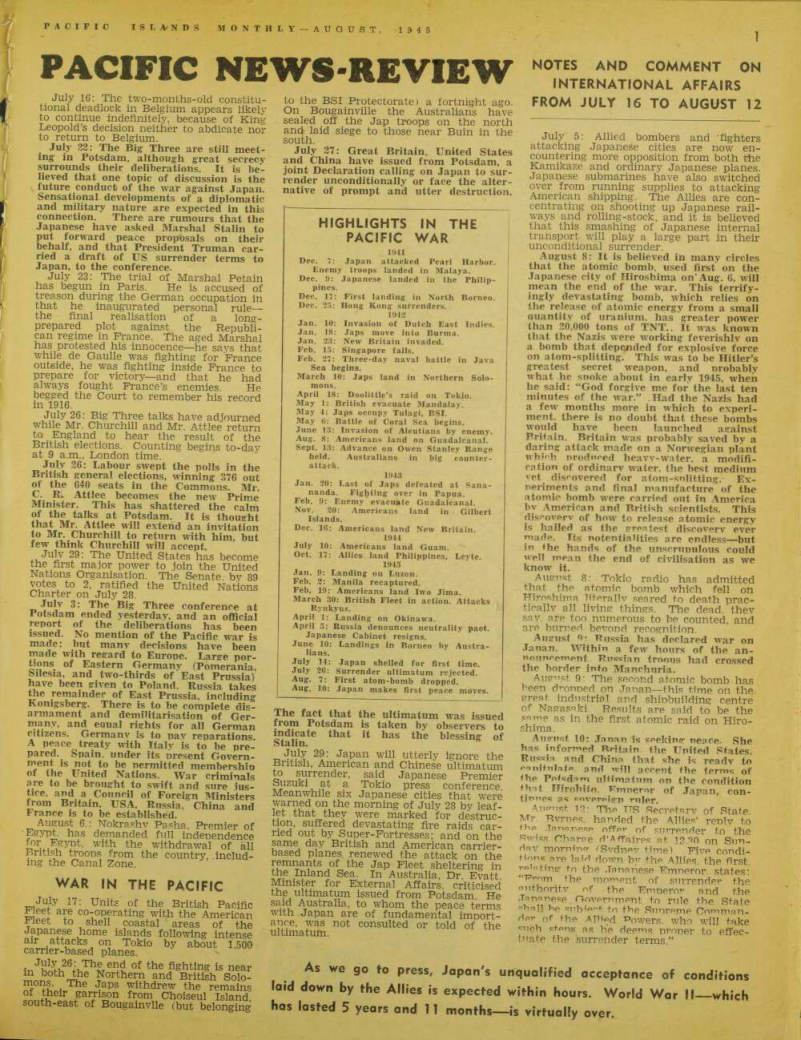
July 27: Great Britain, United States and China have issued from Potsdam, a joint Declaration calling on Japan to sur render unconditionally or face the alter native of prompt and utter destruction.
The fact that the ultimatum was issued from Potsdam is taken by observers to indicate that it has the blessing of Stalin.
July 29; Japan will utterly ignore the British, American and Chinese ultimatum to surrender, said Japanese Premier Suzuki at a Tokio press conference Meanwhile six Japanese cities that were warned on the morning of July 28 by leaf let that they were marked for destruc tion, suffered devastating fire raids car ried out by Super-Fortresses; and on the same day British and American carrier based planes, renewed the attack on the remnants of the Jap Fleet sheltering in the Inland Sea. In Australia, Dr Evatt Minister for External Affairs, criticised the ultimatum issued from Potsdam. He said Australia, to whom the peace terms with Japan are of fundamental import ance. was not consulted or told of the ultimatum.
July 5: Allied bombers and fighters attacking Japanese cities are now en countering more opposition from both the Kamikaze and ordinary Japanese planes.
Japanese submarines have also switched over from running supplies to attacking American shipping. The Allies are con centrating on shooting up Japanese rail ways and rolling-stock, and it is believed that this smashing of Japanese internal transport will play a large part in their unconditional surrender.
August 8: It is believed in many circles that the atomic bomb, used first on the Japanese city of Hiroshima on* Aug. 6, will mean the end of the war. This terrify ingly devastating bomb, which relies on the release of atomic energy from a small quantity of uranium, has greater power than 20,000 tons of TNT.. It was known that the Nazis were working feverishly on a bomb that for explosive force on atom-splitting. This was to be Hitler’s greatest secret weapon, and nrobably what he snoke about in early 1945, when he said: “God forgive me for the last ten minutes of the war.” Had the Nazis had a few months more in which to experi ment. there is no doubt that these bombs would have been launched asrainst Britain. Britain was probably saved by a daring attack made on a Norwegian plant which nrodnced heavy-water, a modifi cation of ordinary water, the best medium vet discovered for atom-snlitting. Ex periments and final manufacture of the atomic bomb were carried out in America by American and British scientists. This discoyerv of how to release atomic energy is hailed as the sreatest discovery ever made. Its potentialities are endless—but in the hands of the unscrupulous could well mean the end of civilisation as we know it.
August 8: Tokio radio has admitted that the atomic bomb which fell on Hiroshima literally seared to death prac tically all living things. The dead, thev sav. are too numerous to be counted, and are burned bevond recognition.
August ft: Russia has declared war on Janan. Within a few hours of the an nouncement Russian troops had crossed the border into Manchuria.
August 9: The second atomic bomb has been dronned on Janan—this time on the great industrial and shipbuilding centre of Nagasaki. Results are said to be the seme as in the first atomic raid on Hiro shima.
August 10: Janan is seeking peace. She has informed Britain the United States, Russia and China that she is ready to r*nitiilat<v and will accent the term* of the Pot«dem ultimatum on the condition that Hirohito. Fmneror of Japan, con tinues as sovereign ruler.
August, 12: The ITS Secretary of State Mr. Byrnes, handed the Allies’ renly to tv>p jnr>oripße offer of surrender to the Swiss Charge d’Affaires at 12 90 on Sun day morning fSvdnev time') Five condi tions are lair? down by the Allies, the first, vein ting to the Jananese Fmneror. states: “•Prom the moment of surrender the authority of the Fmneror and the Japanese Government to rule the State chall he to the Supreme Comman der 0 f the Allied Bowers, who will take s!7eh stops as he deems nroner to effec tuate the surrender terms.”
As we go to press, Japan's unqualified acceptance of conditions laid down by the Allies is expected within hours. World War II which has lasted 5 years and 11 months—is virtually over.