Ramsden's Story of Mangareva's Priest Refuted
pp. 61-62 · Read in the full issue
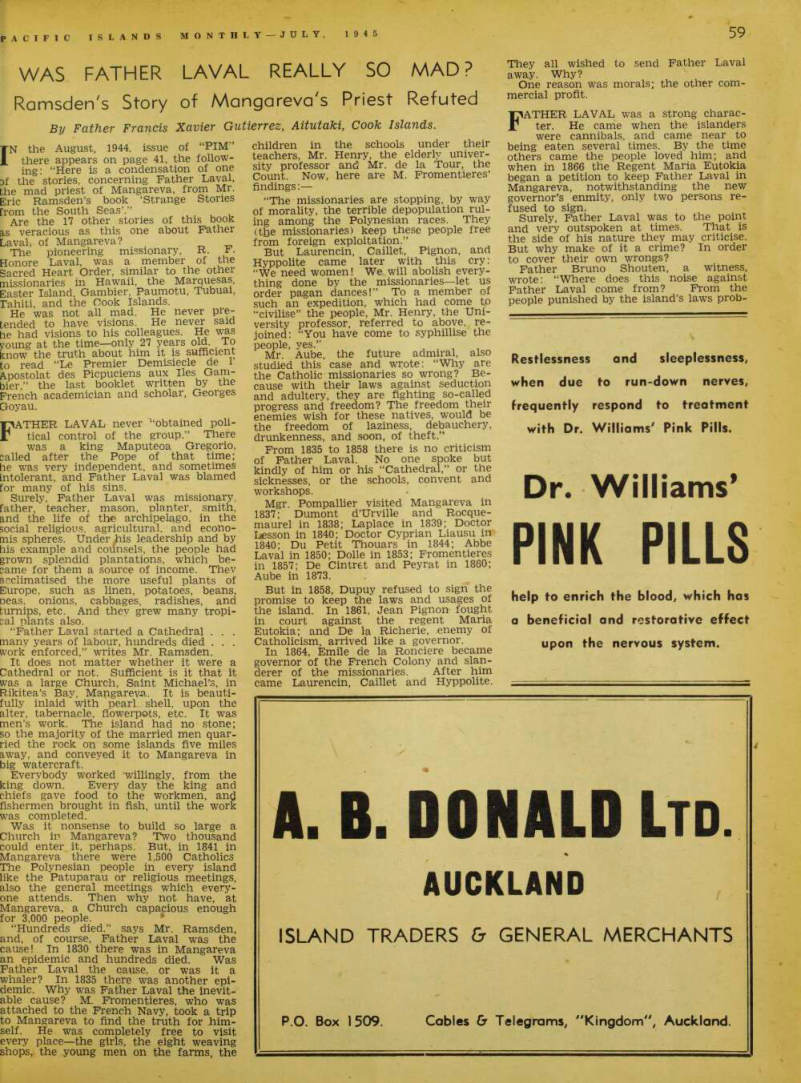
Was Father Laval Really So Mad?
By Father Francis Xavier Gutierrez, Aitutaki, Cook Islands.
IN the August, 1944, issue of “PIM” there appears on page 41, the follow ing: “Here is a condensation of one Df the stories, concerning Father Laval, the mad priest of Mangareva, from Mr.
Eric Ramsden’s book ‘Strange Stories from the South Seas’.” , , Are the 17 other stories of this book as veracious as this one about Father Laval> of Mangareva?
The pioneering missionary, R. r.
Honore Laval, was a member of the Sacred Heart Order, similar to the other missionaries in Hawaii, the Marquesas, Easter Island. Gambier, Paumotu, Tubuai, Tahiti, and the Cook Islands.
He was not all mad. He never pre tended to have visions. He never said be had visions to his colleagues. He was young at the time—only 27 years old. To know the truth about him it is sufficient to read “Le Premier Demisiecle de l Apostolat des Picpuciens aux lies Gam bier,” the last booklet written by the French academician and scholar, Georges Goyau.
FATHER LAVAL never '“obtained poli tical control of the group.” There was a king Maputeoa Gregorio, called after the Pope of that time; be was very independent, and sometimes intolerant, and Father Laval was blamed for many of his sins.
Surely, Father Laval was missionary, father, teacher, mason, planter, smith, and the life of the archipelago, in the social religious, agricultural, and econo mis spheres. Under leadership and by bis example and counsels, the people had grown splendid plantations, which be came for them a source of income. Thev acclimatised the more useful plants of Europe, such as linen, potatoes, beans, oeas. onions, cabbages, radishes, and turnips, etc. And they grew many tropi cal plants also.
“Father Laval started a Cathedral . . . many years of labour, hundreds died . . . work enforced,” writes Mr. Ramsden.
It does not matter whether it were a Cathedral or not. Sufficient is it that it was a large Church, Saint Michael’s, in Rikitea’s Bay, Mangareva. It is beauti fully inlaid with pearl shell, upon the alter, tabernacle, flowerpots, etc. It was men’s work. The island had no stone; so the majority of the married men quar ried the rock on some islands five miles away, and conveyed it to Mangareva in big watercraft.
Everybody worked willingly, from the king down. Every day the king and chiefs gave food to the workmen, and fishermen brought in fish, until the work was completed.
Was it nonsense to build so large a Church in Mangareva? Two thousand could enter it, perhaps. But, in 1841 in Mangareva there were 1,500 Catholics The Polynesian people in every island like the Patuparau or religious meetings, also the general meetings which every one attends. Then why not have, at Mangareva, a Church capacious enough for 3,000 people.
“Hundreds died.” says Mr. Ramsden, and, of course, Father Laval was the cause! In 1830 there was in Mangareva an epidemic and hundreds died. Was Father Laval the cause, or was it a whaler? In 1835 there was another epi demic. Why was Father Laval the inevit able cause? M. Fromentieres, who was attached to the French Navy, took a trip to Mangareva to find the truth for Aim self. He was completely free to visit every place—the girls, the eight weaving shops, the young men on the farms, the
children in the schools under their teachers, Mr. Henry, the elderly univer sity professor and Mr. de la Tour, the Count. Now, here are M. Fromentieres’ findings:— “The missionaries are stopping, by way of morality, the terrible depopulation rul ing among the Polynesian races. They (the missionaries) keep these people free from foreign exploitation.”
But Laurencin, Caillet, Pignon, and Hyppolite came later with this cry: “We need women! We will abolish every thing done bv the missionaries—let us order pagan dances!” To a member of such an expedition, which had come to “civilise” the people, Mr. Henry, the Uni versity professor, referred to above, re joined; “You have come to syphillise the people, yes.” , . , Mr. Aube, the future admiral, also studied this case and wrote: “Why are the Catholic missionaries so wrong? Be cause with their laws against seduction and adultery, they are fighting so-called progress and freedom? The freedom their enemies wish for these natives, would be the freedom of laziness, debauchery, drunkenness, and soon, of theft.”
From 1835 to 1858 there is no criticism of Father Laval, No one spoke but kindly of him or his “Cathedral,” or the sicknesses, or the schools, convent and workshops.
Mgr. Pompallier visited Mangareva in 1837; Dumont d’Urville and Rocque maurel in 1838; Laplace in 1839; Doctor Lesson in 1840; Doctor Cyprian Liausu in 1840: Du Petit Thouars in 1844; Abbe Laval in 1850; Dolle in 1853; Fromentieres in 1857; De Cintret and Peyrat in 1860; Aube in 1873.
But in 1858, Dupuy refused to sign the promise to keep the laws and usages of the island. In 1861, Jean Pignon fought in court against the regent Maria Eutokia; and De la Richerie, enemy of Catholicism, arrived like a governor.
In 1864, Emile de la Ronciere became governor of the French Colony and slan derer of the missionaries. After him came Laurencin, Caillet and Hyppolite.
They all wished to send Father Laval away. Why?
One reason was morals; the other com mercial profit.
FATHER LAVAL was a Strong charac ter. He came when the islanders were cannibals, and came near to being eaten several times. By the time others came the people loved him; and when in 1866 the Regent Maria Eutokia began a petition to keep Father Laval in Mangareva, notwithstanding the new governor’s enmity, only two persons re fused to sign.
Surely, Father Laval was to the point and very outspoken at times. That is the side of his nature they may criticise.
But why make of it a crime? In order to cover their own wrongs?
Father Bruno Shouten, a witness, wrote; “Where does this noise against Father Laval come from? From the people punished by the island’s laws prob
ably. They wanted Father Laval to be inactive, deaf and dumb when the wolves approached and killed the sheep.”
In 1869 Louis Jallicot wrote, under the title “La Verite’ sur Tahiti,” a tissue of calumnies against Father Laval and the Sacred Heart Fathers. Under the pseu donym, Jean Paul Chopar, Captain Gar derein answered the same year to every slander contained in it.
In 1871 Father Laval returned to Papeete and sued Jallicot in court. Jalli cot could not prove his slanders, and was ordered to pay 15,000 francs damages.
This sum was used for the welfare of the native people of Mangareva, Mr. Cardella, navy officer, and later Tahiti’s governor, said to Bishop Hermel; “Why should we not hate Father Laval?” As soon as our ship is seen on the horizon the Church bell rings—it is the sign for the girls to go home.” That, in a nutshell, was the reason why Father Laval was hated.
Once Father Laval disappeared from Mangareva was the island better off?
Then ther Hippolites and the De La Ron cieres, were masters of the place. It was so easy for these people to undo in a week what the missionaries had laboured for years to achieve.
Then also a bell was rung. It was the ship's bell, ringing a warning to the girl prostitutes to swim out to the sailors on the ship.
That was progress—civilisation!
Hundreds died, and there was sick nesses—yes. Then as now, after lustful Venus comes the black horse of death.
Lustful dances, drinking, under-nourish ment, weak lungs, weak blood, syphilis, pneumonia and consumption, not in including the old native ills. Father Laval had done what orderlv homes and honest families should have done. He fought for the salvation of the people like everybody should have done.
And what about the pearl and the native sisters? The 80 Maori sisters Mr.
Ramsden speaks of came from heathen ism and consecrated themselves to God.
That may be astonishing now, but it shall be to Father Laval’s everlasting glory. .o- A^* or , “King’s” pearl—never mind if this be true or no. What would be ) An t oi’T to sell the P earl for 25,000 or 50,000 francs and alcoholise the people for 25 or J*° ys? ° r to give it to His Holi ness the Pope who supports all the mis sions? Or to a missinary like Father
Laval, who had given his life for these people, in order that he should purchase a boat on their behalf?
IN 1876, after several years of exile, Father Laval was permitted to join Father Collette, the Provincial, in a trip to Mangareva. Notwithstanding the hour they arrived (11 p.m.); the shout of “Father Laval is here” flew round the island like the wind.
Next morning the whole population was there and the following dav, the popula tion of three other islands. Father Collette astounded, exclaimed, “I knew Father Laval was loved: But never would have believed that he was so tenderly cherished.” * Sources: (1) “Le Premier Demi-Siecle de I’Apostolades Picpuciens aux lies Gambler,” by Georges Goyau; pp. 30, 34, 38, 48. 37, 54, 46, 55, 35, 36. (2) ‘‘Quelques personages officiels a Tahiti, sous le regne de Napoleon 3,” by Jean Paul Chopart (pseudonym of Captain Garderein). (3) “Revue Maritime, 1869” (article by Mr.
Aube).