Policy Of The Nickel Company
pp. 40-42 · Read in the full issue
Concern Felt for Future of N. Caledonia From Our Own Correspondent
Noumea, May 21.
Monsieur dewez, one of the European directors of the Nickel Company, has been visiting Noumea, where new mining and smelting equip ment is expected shortly from the USA.
M. Dewez is a Belgian who became a naturalised Frenchman some years ago.
He came to New Caledonia in 1941 with the approval of both the Vichy Govern ment and General de Gaulle, and then left for New York to discuss wartime use of the colony’s mineral output. He was also in touch with Pan American Airways over their proposal to establish a large up-to-date ,hotel beside one of Noumea’s beaches.
He has a son serving as a captain in the British Army, but Dewez pere remains a man of mystery to the average New Caledonian who knows that Belgian bankers have long been interested in French nickel exploitation, but who is completely mystified by the great com pany’s relations with Canada, Japan, Britain, USA, Germany and maybe others of the international bunch.
Most Caledonians would like to see the nickel industry nationalised, and head quarters moved from Paris to Noumea.
This company has greatly altered the balance of New Caledonia population by introducing hordes of Asiatic coolies— Japanese, Javanese, Indo-Chinese—whose descendents have taken firm root and who are breeding at a rate that is appar ent to anybody who watches the children going to town and country schools.
As the years go by, if Frenchmen refuse to emigrate and if the present policy is pursued, the white population of the island will get smaller and smaller and the Asiatic and mixed population larger and larger until the original French element is entirely absorbed.
Statistics hide what is going on because they do not distinguish between whites and the so-called “assimilated whites, and the move to make natives t rench citizens, instead of classing them as French subjects will probably aid the process of white assimilation' by the ASlEttlC.
But, then, the profits of the Nickel Company and not the welfare and the future of New Caledonia, seem always to have been the chief concern of the French Government. Whether a post war leftist administration in Paris will reverse the order of things in so distant and (so far as the local population is concerned) so relatively unimportant a country, remains to be seen. Of General de Gaulle, personally, New Caledonians are not now very hopeful.
IN the above connection, it may be interesting to quote the number of people employed in the mining indus try at the end of 1944.
There were 2,031 Javanese (3,434 in 1940), 2,209 Tonkinese (2,526 in 1940), and 28 natives (84 in 1940). Against these there were 499 French employees (622 in 1940), mostly clerks, mechanics and fore men. The proportion of foremen to coolies was about 1 to 20.
The nickel industry employed about 76 per cent, of this labour, including 30 per cent, at the Pointe Doniambo (Noumea) smelters, where housing of coolie labour ers has been viciously bad. The chrome
mines accounted for a further 22 per cent, of employment, and gypsum (used for nickel smelting) the remaining 2 per cent. The percentage of French to col oured labour in the industry was there fore only about 10 per cent., and many of these French are, of course, assimilated Frenchmen. The Melanesian natives refuse to work in the mines, but are use ful in wharf jobs and on barges.
It should be added that previous hordes of Japanese, Javanese and Tonkinese have left their progeny as a permanent gift to the Colony.
"Slave" Labour Condstions
AS a result of the intervention of the Dutch Consul, the Nickel Company is to undertake the construction of new buildings to house its many hun dreds of Javanese and Indo-Chinese coolie labourers at the Pointe Doniambo smelters, Noumea.
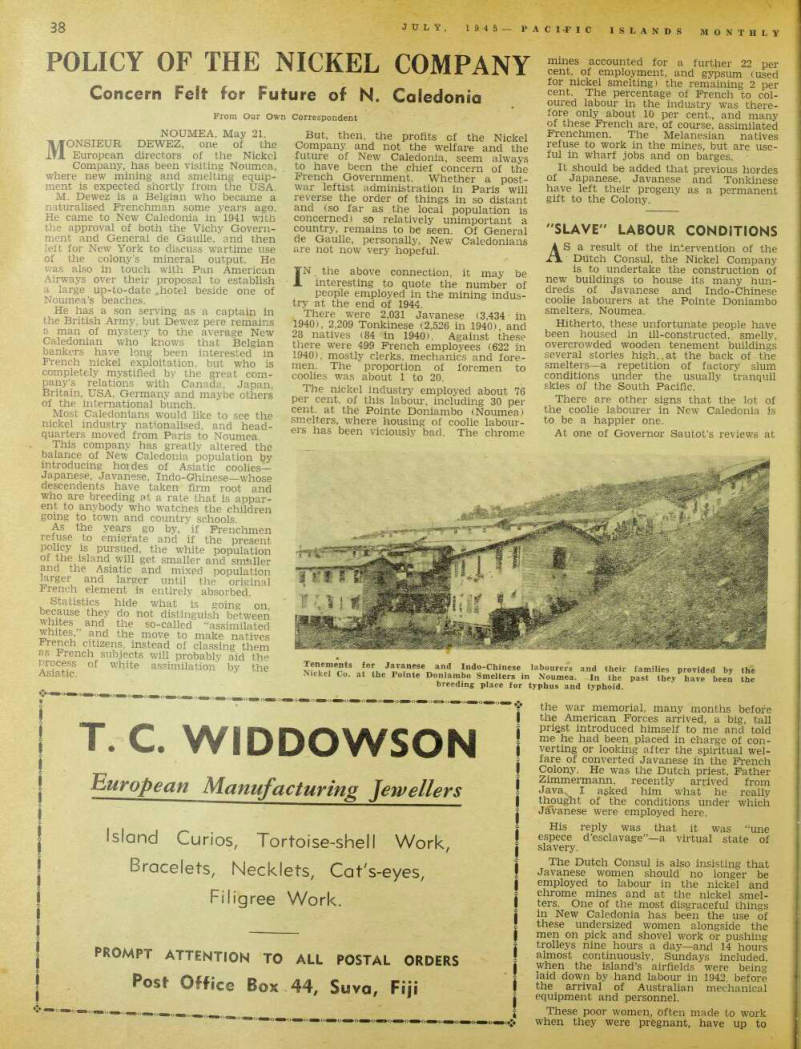
Hitherto, these unfortunate people have been housed in ill-constructed, smelly, overcrowded wooden tenement buildings several stories high, at the back of the smelters —a repetition of factory slum conditions under the usually tranquil skies of the South Pacific.
There are other signs that the lot of the coolie labourer in New Caledonia is to be a happier one.
At one of Governor Sautot’s reviews at
the war memorial, many months before the American Forces arrived, a big, tall priest introduced himself to me and told me he had been placed in charge of con verting or looking after the spiritual wel fare of converted Javanese in the French Colony. He was the Dutch priest, Father Zimmermann, recently arrived from Java.. I agked him what he really thought of the conditions under which Javanese were employed here.
His reply was that it was “une espece d’esclavage”—a virtual state of slavery.
The Dutch Consul is also insisting that Javanese women should no longer be employed to labour in the nickel and chrome mines and at the nickel smel ters. One of the most disgraceful things in New Caledonia has been the use of these undersized women alongside the men on pick and shovel work or pushing trolleys nine hours a day—and 14 hours almost continuously, Sundays included, when the island’s airfields were being laid down by hand labour in 1942, before the arrival of Australian mechanical equipment and personnel.
These poor women, often made to work when they were prbgnant, have up to
Tenements for Javanese and Indo-Chinese labourers and their families provided by the Nickel Co. at the Pomte Doniambo Smelters in Noumea. In the past they have been the breeding place for typhus and typhoid.
now been paid only two or three dollars a month.
Their sisters in domestic service in Noumea have a lot that is far less oner ous and have profited considerably “on the side” from the presence of the American troops.
In the mining camps the Javanese, who are great gamblers and money spenders when they have the money, fre quently play for the privilege of sleep ing with the women, who outside Noumea are outnumbered by the males about ten to one.
By a recent count there were some 7,249 Javanese in New Caledonia, of whom 985 had won for themselves the privilege of free residence. Those work ing in the mines, on the land, and in the colonists’ homes under the old contract system number 6,264 coolies, of whom 5,044 are men.
The Dutch Consul to whom these reforms are due is Dr. J. van Beusekom.
It was the presence of so many Javanese in the country and the need for revision of conditions of their appointment (a matter reported upon unfavourably by Dutch officers passing through the Colony), that led to his appointment a year ago in succession to Caledonian born Vice-consul Carlo Leoni.
The American mining geologist, Mr.
Don Frasche, who has succeeded the Eng lishman, Major Oughton, as inspector of the Tiebaghi (British) Company, the largest chrome exploiters in New Cale donia, has returned to Noumea after an absence of several months. Mr. Frasche is a highly experienced mining expert who has spent years in the Philippines and Central Africa.