America in the Pacific—and Our Future
pp. 5-6 · Read in the full issue
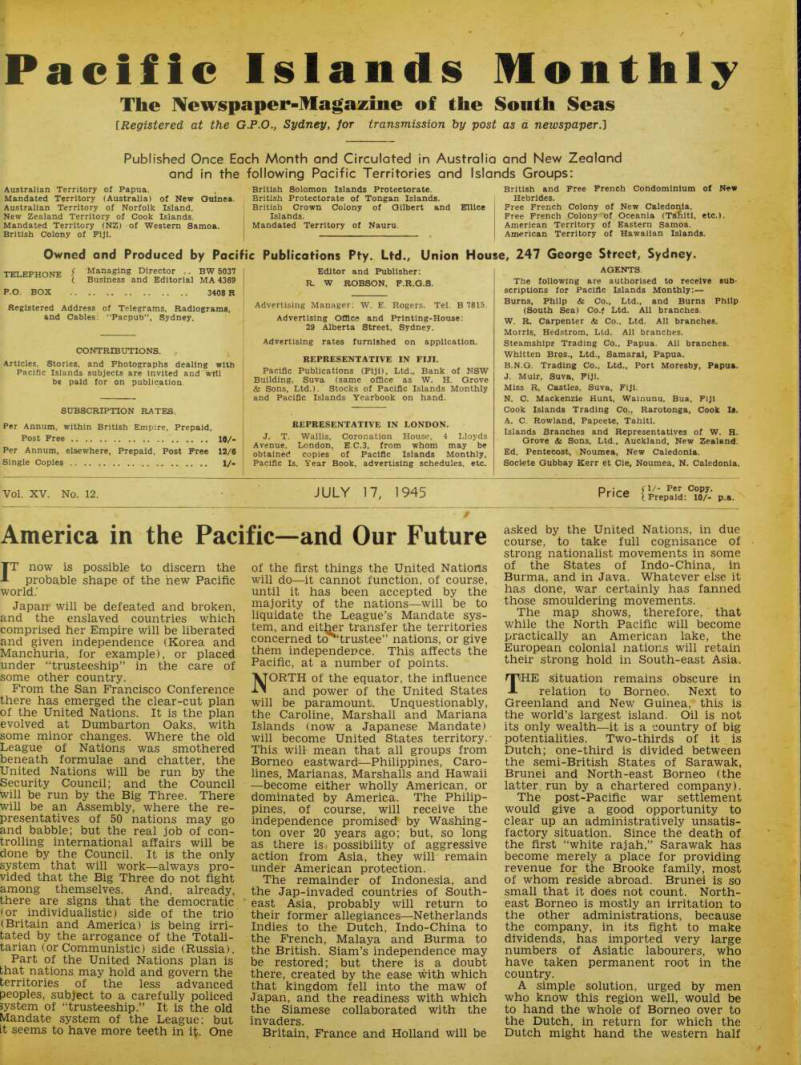
IT now is possible to discern the probable shape of the hew Pacific world.' Japan will be defeated and broken, and the enslaved countries which comprised her Empire will be liberated and given independence (Korea and Manchuria, for example), or placed under “trusteeship” in the care of some other country.
From the San Francisco Conference there has emerged the clear-cut plan of the United Nations. It is the plan evolved at Dumbarton Oaks, with some minor changes. Where the old League of Nations was smothered beneath formulae and chatter, the United Nations will be run by the Security Council; and the Council will be run by the Big Three. There will be an Assembly, where the re presentatives of 50 nations may go and babble; but the real job of con trolling international affairs will be done by the Council. It is the only system that will work—always pro vided that the Big Three do not fight among themselves. And, already, there are signs that the democratic (or individualistic) side of the trio (Britain and America) is being irri tated by the arrogance of the Totali tarian (or Communistic) side (Russia).
Part of the United Nations plan is that nations may hold and govern the territories of the less advanced peoples, subject to a carefully policed system of “trusteeship.” It is the old Mandate system of the League: but it seems to have more teeth in it. One
of the first things the United Nations will do—it cannot function, of course, until it has been accepted by the majority of the nations—will be to liquidate the League’s Mandate sys tem, and either transfer the territories concerned nations, or give them independence. This affects the Pacific, at a number of points.
NORTH of the equator, the influence and power of the United States will be paramount. Unquestionably, the Caroline, Marshall and Mariana Islands (now a Japanese Mandate) will become United States territory.- This will mean that all groups from Borneo eastward—Philippines, Caro lines, Marianas, Marshalls and Hawaii —become either wholly American, or dominated by America. The Philip pines, of course, will receive the independence promised by Washing ton over 20 years ago; but, so long as there is possibility of aggressive action from Asia, they will remain under American protection.
The remainder of Indonesia, and the Jap-invaded countries of South east Asia, probably will return to their former allegiances—Netherlands Indies to the Dutch, Indo-China to the French, Malaya and Burma to the British. Siam’s independence may be restored; but there is a doubt there, created by the ease with which that kingdom fell into the maw of Japan, and the readiness with which the Siamese collaborated with the invaders.
Britain, France and Holland will be
asked by the United Nations, in due course, to take full cognisance of strong nationalist movements in some of the States of Indo-China, in Burma, and in Java. Whatever else it has done, war certainly has fanned those smouldering movements.
The map shows, therefore, that while the North Pacific will become practically an American lake, the European colonial nations will retain their strong hold in South-east Asia.
THE situation remains obscure in relation to Borneo. Next to Greenland and New Guinea, this is the world’s largest island. Oil is not its only wealth—it is a country of big potentialities. Two-thirds of it is Dutch; one-third is divided between the semi-British States of Sarawak, Brunei and North-east Borneo (the latter run by a chartered company).
The post-Pacific war settlement would give a good opportunity to clear up an administratively unsatis factory situation. Since the death of the first “white rajah,” Sarawak has become merely a place for providing revenue for the Brooke family, most of whom reside abroad. Brunei is so small that it does not count. North east Borneo is mostly an irritation to the other administrations, because the company, in its fight to make dividends, has imported very large numbers of Asiatic labourers, who have taken permanent root in the country.
A simple solution, urged by men who know this region well, would be to hand the whole of Borneo over to the Dutch, in return for which the Dutch might hand the western half
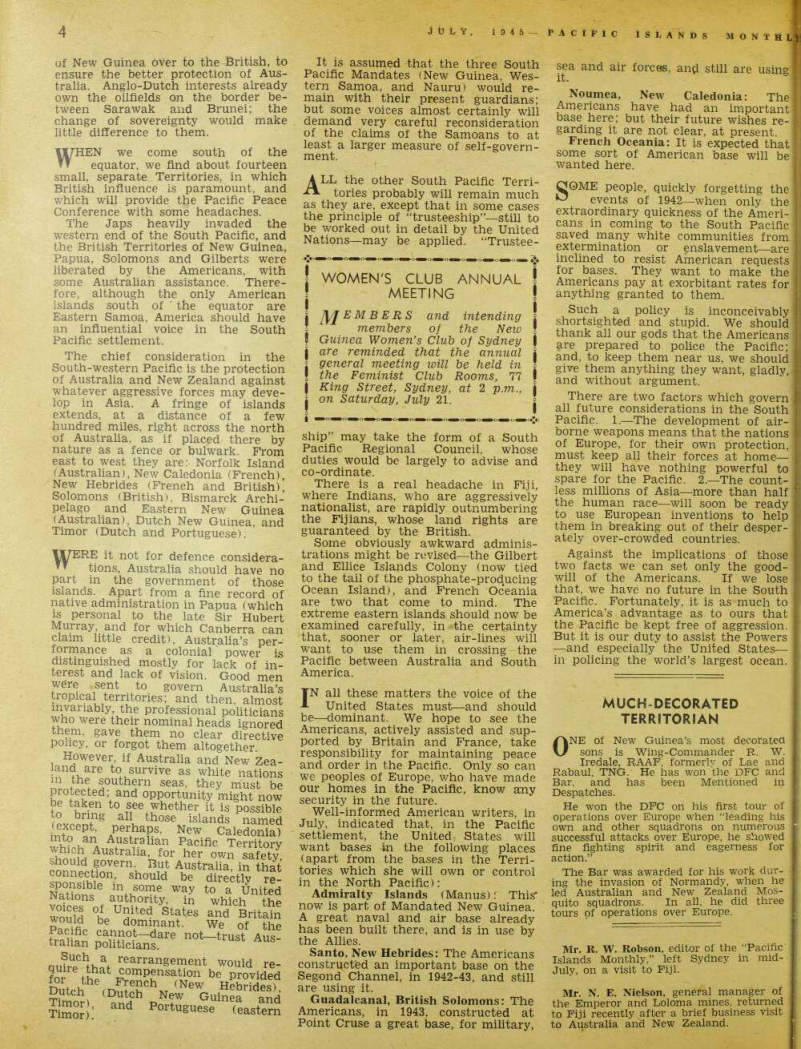
of New Guinea over to the British, to ensure the better protection of Aus tralia. Anglo-Dutch interests already own the oilfields on the border be tween Sarawak and Brunei; the change of sovereignty would make little difference to them.
WHEN we come south of the equator, we find about fourteen small, separate Territories, in which British influence is paramount, and which will provide the Pacific Peace Conference with some headaches.
The Japs heavily invaded the western end of the South Pacific, and the British Territories of New Guinea, Papua, Solomons and Gilberts were liberated by the Americans, with some Australian assistance. There fore, although the only American islands south of the equator are Eastern Samoa, America should have an influential voice in the South Pacific settlement.
The chief consideration in the South-western Pacific is the protection of Australia and New Zealand against whatever aggressive forces may deve lop in Asia. A fringe of islands extends, at a distance of a few hundred miles, right across the north of Australia, as if placed there by nature as a fence or bulwark. From east to west they are: Norfolk Island (Australian), New Caledonia (French), New Hebrides (French and British), Solomons (British), Bismarck Archi pelago and Eastern New Guinea (Australian), Dutch New Guinea, and Timor (Dutch and Portuguese). it not for defence considera ” tions, Australia should have no part in the government of those islands. Apart from a fine record of native administration in Papua (which is personal to the late Sir Hubert Murray, and for which Canberra can claim little credit), Australia’s per formance as a colonial power is distinguished mostly for lack of in terest and lack of vision. Good men were sent to govern Australia’s tropical territories; and then, almost invariably, the professional politicians who were their nominal heads ignored them, gave them no clear directive policy, or forgot them altogether.
However, if Australia and New Zea and are to survive as white nations ninw south5 outh ! rn seas > they must be protected; and opportunity might now be taken to see whether it is possible (pYi’ent l ® al l * ;lose islands named intn . per . ha P’ New Caledonia) S' ln . Australian Pacific Territory which Australia, for her own safety should govern. But Australia, in that snn« e vu lon -’ should be directly re sponsible in some way to a United Nations authority, in which the
would Wes and Britain
S be dominant. We of the Sffl SEfcS” no, - tr “ J "“-
AiSSSSSSS'b.’Ste
for the French (New Hebrides) S , (Dutch New Guinea and TtoOT).’ d Portu 6uese (eastern
It is assumed that the three South Pacific Mandates (New Guinea, Wes tern Samoa, and Nauru) would re main with their present guardians; but some voices almost certainly will demand very careful reconsideration of the claims of the Samoans to at least a larger measure of self-govern ment.
ALL the other South Pacific Terri ** tories probably will remain much as they are, except that in some cases the principle of “trusteeship”—still to be worked out in detail by the United Nations—may be applied. “Trustee
ship” may take the form of a South Pacific Regional Council, whose duties would be largely to advise and co-ordinate.
There is a real headache in Fiji, where Indians, who are aggressively nationalist, are rapidly outnumbering the Fijians, whose land rights are guaranteed by the British.
Some obviously awkward adminis trations might be revised—the Gilbert and Ellice Islands Colony (now tied to the tail of the phosphate-producing Ocean Island), and French Oceania are two that come to mind. The extreme eastern islands should now be examined carefully, in the certainty that, sooner or later, air-lines will want to use them in crossing the Pacific between Australia and South America.
IN all these matters the voice of the United States must—and should be—dominant. We hope to see the Americans, actively assisted and sup ported by Britain and France, take responsibility for maintaining peace and order in the Pacific. Only so can we peoples of Europe, who have made our homes in the Pacific, know any security in the future.
Well-informed American writers, in July, indicated that, in the Pacific settlement, the United States will want bases in the following places (apart from the bases in the Terri tories which she will own or control in the North Pacific): Admiralty Islands (Manus): This* now is part of Mandated New Guinea.
A great naval and air base already has been built there, and is in use by the Allies.
Santo, New Hebrides: The Americans constructed an important base on the Segond Channel, in 1942-43, and still are using it.
Guadalcanal, British Solomons: The Americans, in 1943, constructed at Point Cruse a great base, for military,
sea and air forces, and still are using it.
Noumea, New Caledonia: The Americans have had an important base here; but their future wishes re garding it are not clear, at present.
French Oceania: It is expected that some sort of American base will be wanted here.
OOME people, quickly forgetting the events of 1942—when only the extraordinary quickness of the Ameri cans in coming to the South Pacific saved many white communities from extermination or enslavement—are inclined to resist American requests for bases. They want to make the Americans pay at exorbitant rates for anything granted to them.
Such a policy is inconceivably shortsighted and stupid. We should thank all our gods that the Americans 9-re prepared to police the Pacific; and, to keep them near us, we should give them anything they want, gladly, and without argument.
There are two factors which govern all future considerations in the South Pacific. I.—The development of air borne weapons means that the nations of Europe, for their own protection, must keep all their forces at home— they will have nothing powerful to spare for the Pacific. 2.—The count less millions of Asia—more than half the human race—will soon be ready to use European inventions to help them in breaking out of their desper ately over-crowded countries.
Against the implications of those two facts we can set only the good will of the Americans. If we lose that, we have no future in the South Pacific. Fortunately, it is as much to America’s advantage as to ours that the Pacific be kept free of aggression.
But it is our duty to assist the Powers —and especially the United States— in policing the world’s largest ocean.