Let There Be Light !
p. 56 · Read in the full issue
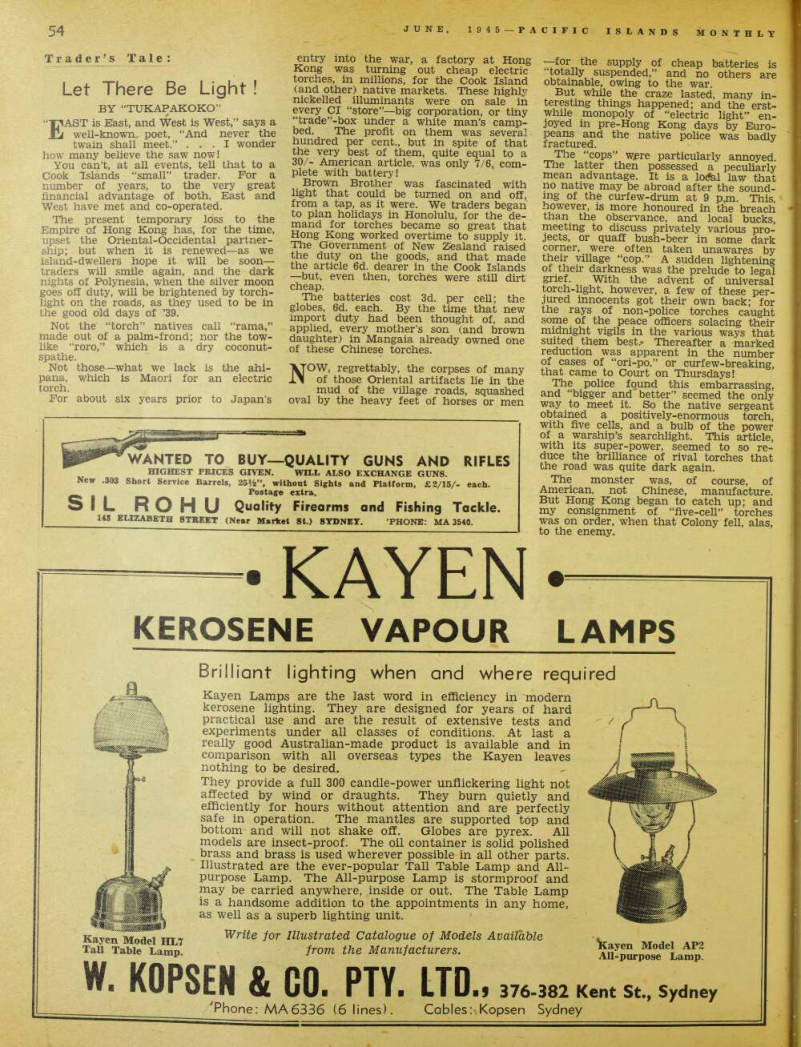
Trader’s Tale: Let There Be Light !
By “Tukapakoko”
EAST is East, and West is West,” says a well-known poet, “And never the twain shall meet.” ... I wonder how many believe the saw now!
You can’t, at all events, tell that to a Cook Islands “small” trader. For a number of years, to the very great financial advantage of both, East and West have met and co-operated.
The present temporary loss to the Empire of Hong Kong has, for the time, upset the Oriental-Occidental partner ship; but when it is renewed—as we island-dwellers hope it will be soon traders will smile again, and the dark nights of Polynesia, when the silver moon goes off duty, will be brightened by torch light on the roads, as they used to be in the good old days of ’39. - T Z. ,< „ Not the torch natives call rama, made out of a pahn-frond; nor the tow spa'he r °’ 15 a 7 COC ° Not those-what we lack is the ahi pana, which is Maori for an electric
to L ch - , .
For about six years prior to Japan’s
, he war ’ a factory at Hong Kong was turning out cheap electric torches, in millions, for the Cook Island (and other) native markets. These highly were .9 n sale .. m every 9 u store ,~ bl § corporation, or tiny trade -box under a white man’s camp bed - T* l6 profit on them was several hundred per cent., but in spite of that the very best of them, quite equal to a 3 y'“ American article, was only 7/6, com- Plete with battery!
"J°wn Brother was fascinated with b £ht that could be turned on and off, J rorr s a ta P» as were. We traders began for t ? e fS e 7 * grea t that g r^°" g n "°S e^ f o^ *? spppl ? ‘‘i th 6 rais S d
Hf® pS.Th a 2 e
p? k f h ’ 6ven then ’ torches were still dirt hc , Horioc . m „ lnhp 6r fJPf the 6d each. By the time that new import duty had been thought of, and applied, every mother’s son (and brown daughter) in Mangaia already owned one ° f theSG ChineSe torcheS * VTOW, regrettably, the corpses of many JM of those Oriental artifacts lie in the mud of the village roads, squashed oval by the heavy feet of horses or men
—for the supply of cheap batteries is totally suspended,” and no others are obtainable, owing to the war.
But while the craze lasted, many in teresting things happened; and the erst while monopoly of “electric light” en joyed in pre-Hong Kong days by Euro peans and the native police was badly fractured.
The “cops” W£re particularly annoyed.
The latter then possessed a peculiarly mean advantage. It is a lo<fel law that no native may be abroad after the sound ing of the curfew-drum at 9 pjn. This, however, is more honoured in the breach than the observance, and local bucks, meeting to discuss privately various pro jects, or quaff bush-beer in some dark corner, were often taken unawares by their village “cop.” A sudden lightening of their darkness was the prelude to legal grief. With the advent of universal torch-light, however, a few of these per jured innocents got their own back; for the rays of non-police torches caught some of the peace officers solacing their midnight vigils in the various ways that suited them best.* Thereafter a marked reduction was apparent in the number of cases of “ori-po,” or curfew-breaking, that came to Court on Thursdays!
The police found this embarrassing, and “bigger and better” seemed the only way to meet it. So the native sergeant obtained a positively-enormous torch, with five cells, and a bulb of the power of a warship’s searchlight. This article, with its super-power, seemed to so re duce the brilliance of rival torches that the road was quite dark again.
The monster was, of course, of American, not Chinese, manufacture.
But Hong Kong began to catch up; and my consignment of “five-cell” torches was on order, when that Colony fell, alas, to the enemy.