Population Of
p. 53 · Read in the full issue
Fiji
Analysis of Recent Startling Figures
'THE following notes upon recent
figures, indicating the startling
increase in the Indian community in Fiji, have been kindly supplied by Sir
Maynard Hedstrom, of Suva, whose
knowledge of conditions in Fiji is
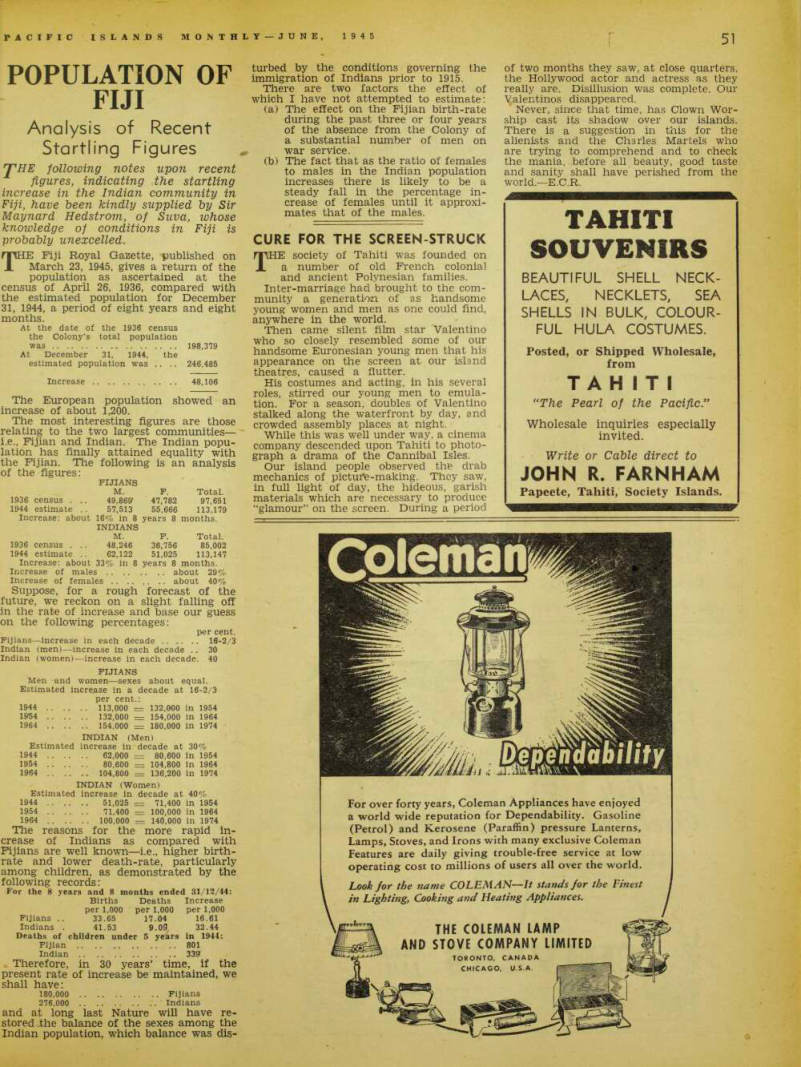
probably unexcelled. rpHE Fiji Royal Gazette, published on X March 23, 1945, gives a return of the population as ascertained at the census of April 26, 1936, compared with the estimated population for December 31, 1944, a period of eight years and eight months.
At the date of the 1936 census the Colony’s total population was 198,379 At December 31, 1944, the estimated population was .. . . 246,485 Increase 48,106 The European population showed an increase of about 1,200.
The most interesting figures are those relating to the two largest communities— i.e., Fijian and Indian. The Indian popu lation has finally attained equality with the Fijian. The following is an analysis of the figures:
Increase: about 33% in 8 years 8 months.
Increase of males about 29% Increase of females about 40% Suppose, for a rough forecast of the future, we reckon on a slight falling off in the rate of increase and base our guess
on the following percentages:
per cent.
Fijians—increase in each decade 16-2/3 Indian (men) —increase in each decade .. 30 Indian (women) —increase in each decade. 40
The reasons for the more rapid in crease of Indians as compared with Fijians are well known—i.e., higher birth rate and lower death-rate, particularly among children, as demonstrated by the following records; For the 8 years and 8 months ended 31/12/44:
Therefore, in 30 years’ time, if the present rate of increase be maintained, we shall have; 180.000 Fijians 276.000 Indians and at long last Nature will have re stored the balance of the sexes among the Indian population, which balance was dis
turbed by the conditions governing the immigration of Indians prior to 1915.
There are two factors the effect of which I have not attempted to estimate; (a) The effect on the Fijian birth-rate during the past three or four years of the absence from the Colony of a substantial number of men on war service. (b) The fact that as the ratio of females to males in the Indian population increases there is likely to be a steady fall in the percentage in crease of females until it approxi mates that of the males.
Fijians
M. P. Total. 1936 census . .. 49.869 47,782 97,651 1944 estimate .. 57,513 55,666 113,179 Increase: about 16% in 8 years 8 months.
Indians
M. F. Total. 1936 census . . . 48,246 36,756 85,002 1944 estimate .. 62,122 51,025 113,147
Men and
Fijians
women—sexes about equal.
Estimated increa.se in a decade at 16-2/3 1944 .. .. per cent.: .. 113,000 = 132,000 in 1954 19-54 . . . . .. 132,000 — 154,000 in 1964 1964 . . . . .. 154,000 — 180,000 in 1974 Estimated
Indian (Men)
increase in decade at 30% 1944 . . . . 62,000 — 80,600 In 1954 1954 . . . . 80,600 — 104,800 in 1964 1964 . . . . .. 104,800 — 136,200 in 1974 Estimated INDIAN (Women) increase in decade at 40% 1944 . . . . 51,025 — 71,400 in 1954 1954 .. .. 71.400 — 100,000 in 1964 1964 .. . . . . 100,000 — 140,000 in 1974
Births Deaths Increase per 1,000 per 1.000 per 1,000 Fijians .. 33.65 17.04 16.61 Indians . 41.53 9.09, 32.44 Deaths of children under 5 years In 1944: Fijian 801 Indian 339