How Captain Smith Kept
pp. 29-30 · Read in the full issue
Japs On Abemama
How Captain Smith Kept His Head
THE war has moved far away from the Gilbert Islands, and it is now possible to tell something more of what hap pened there during the Jap occupation -1942 and 1943.
Events on Tarawa are well-known already. In October, 1942, the Japs on Tarawa foully murdered five British civi lians and 17 New Zealand soldiers (coast watching service), whom they had cap tured in the Central Gilberts; and in November, 1943, the United States Marines, in one of their finest achieve ments, fought the Japs to the end and occupied Tarawa. One of the Americans’ first acts was to erect a memorial to the 22 Britishers who, “Standing unarmed to their posts, matched brutality with gal lantry, and met death with fortitude.”
Now, we have the story of Abemama, another of the Gilbert Islands. The editor of the “PIM” was ashore on Abe mama in 1941, shortly before the Japs arrived there; and when he heard re cently that Captain “Jimmy” Smith, a resident of Abemama, had arrived in Fiji, he wrote and asked the old skipper: (1) how he escaped the Japs; (2) what hap pened to Agnes Murdoch; (3) what happened to the garrison of young NZ soldiers who were there.
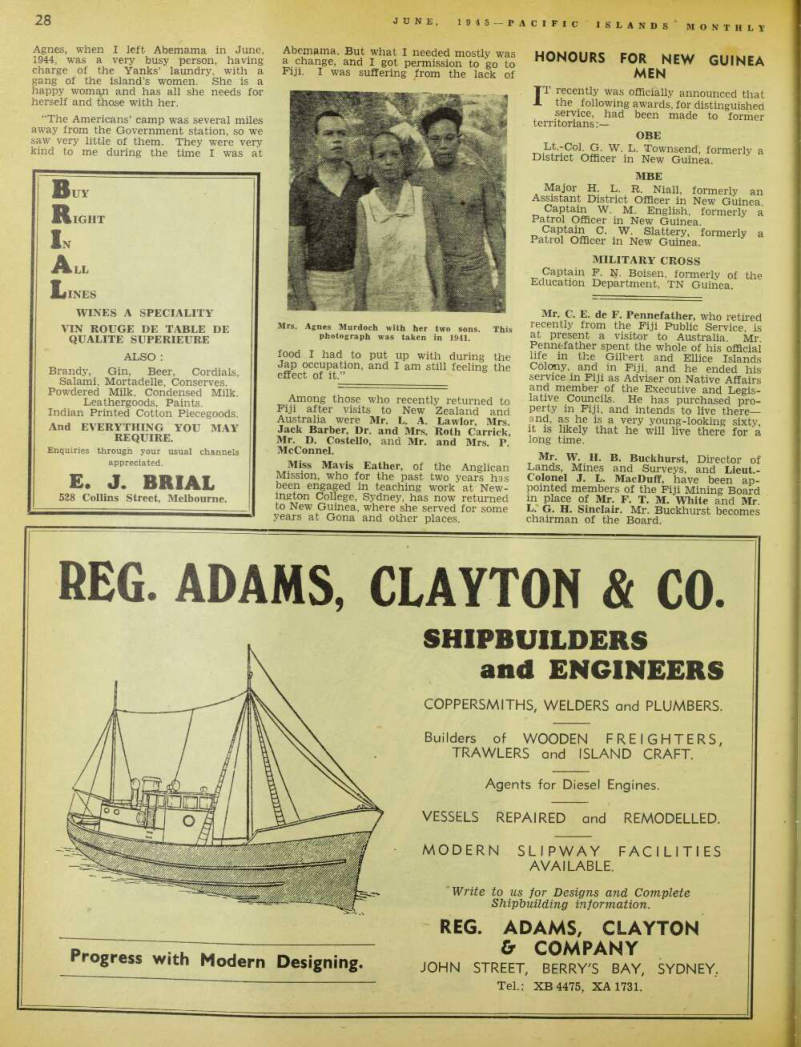
Agnes Murdoch is the daughter of an old-time trader, who married a Gilbertese woman. Agnes was sent to the United States to be educated. She eventually married a close relation of the King of Abemama, and her son is now the para mount chief. She now is an elderly woman, but still is held in high regard for her intelligence and charm of manner.
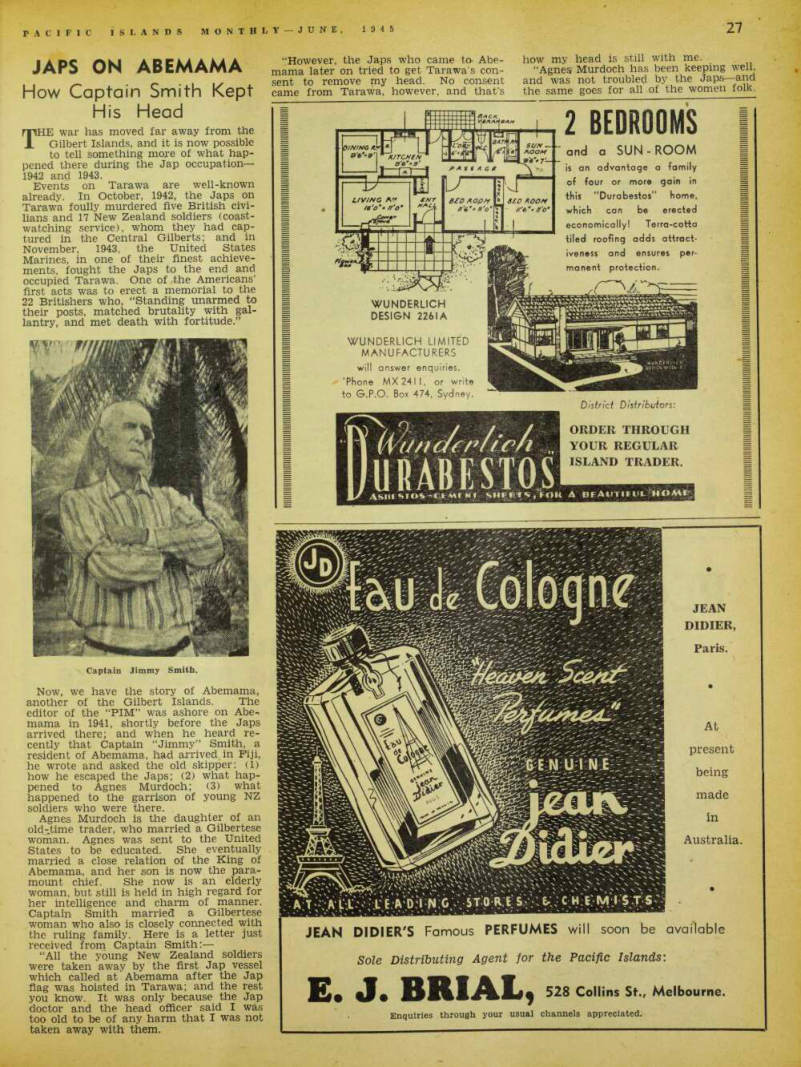
Captain Smith married a Gilbertese woman who also is closely connected with the ruling family. Here is a letter just received from Captain Smith: — “All the young New Zealand soldiers were taken away by the first Jap vessel which called at Abemama after the Jap flag was hoisted in Tarawa; and the rest you know. It was only because the Jap doctor and the head officer said I was too old to be of any harm that I was not taken away with them.
“However, the Japs who came to Abemama later on tried to get Tarawa’s consent to remove my head. No consent came from Tarawa, however, and that’s
how my head is still with me.
“Agnes Murdoch has been keeping well, and was not troubled by the Japs—-ana the same goes for all of the women folk.
Captain Jimmy Smith.
Agnes, when I left Abemama in June, 1944, was a very busy person, having charge of the Yanks’ laundry, with a gang of the island’s women. She is a happy woman and has all she needs for herself and those with her.
“The Americans’ camp was several miles away from the Government station, so we saw very little of them. They were very kind to me during the time I was at
Abemama. But what I needed mostly was a change, and I got permission to go to Fiji. I was suffering from the lack of
food I had to put up with during the Jap occupation, and I am still feeling the effect of it.”
Among those who recently returned to Fiji after visits to New Zealand and Australia were Mr. L. A. Lawlor, Mrs.
Jack Barber, Dr. and Mrs. Roth Carrick, Mr. D. Costello, and Mr. and Mrs. P McConnel.
Miss Mavis Father, of the Anglican Mission, who for the past two years has been engaged in teaching work at New ington College, Sydney, has now returned to New Guinea, where she served for some years at Gona and other places.
Mrs. Agnes Murdoch with her two sons. This photograph was taken in 1941.