Liquor and Souvenirs Now Chief Industry
p. 18 · Read in the full issue
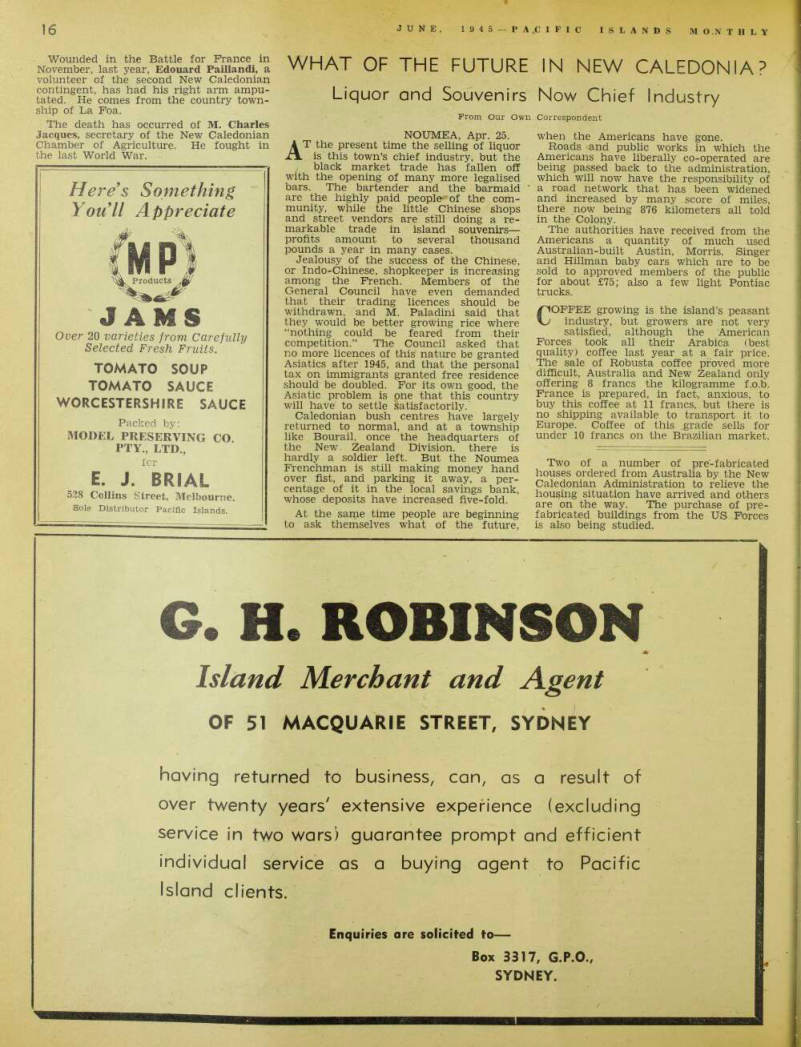
WHAT OF THE FUTURE IN NEW CALEDONIA?
From Our Own Correspondent
Noumea, Apr. 25.
AT the present time the selling of liquor is this town’s chief industry, but the black market trade has fallen off with the opening of many more legalised bars. The bartender and the barmaid are the highly paid people of the com munity, while the little Chinese shops and street vendors are still doing a re markable trade in island souvenirs— profits amount to several thousand pounds a year in many cases.
Jealousy of the success of the Chinese, or Indo-Chinese, shopkeeper is increasing among the French. Members of the General Council have even demanded that their trading licences should be withdrawn, and M. Paladini said that they would be better growing rice where “nothing could be feared from their competition.” The Council asked that no more licences of this nature be granted Asiatics after 1945, and that the personal tax on immigrants granted free residence should be doubled. For its own good, the Asiatic problem is one that this country will have to settle satisfactorily.
Caledonian bush centres have largely returned to normal, and at a township like Bourail, once the headquarters of the New Zealand Division, there is hardly a soldier left. But the Noumea Frenchman is still making money hand over fist, and parking it away, a per centage of it in the local savings bank, whose deposits have increased five-fold.
At the same time people are beginning to ask themselves what of the future,
when the Americans have gone.
Roads and public works in which the Americans have liberally co-operated are being passed back to the administration, which will now have the responsibility of a road network that has been widened and increased by many score of miles, there now being 876 kilometers all told in the Colony.
The authorities have received from the Americans a quantity of much used Australian-built Austin, Morris, Singer and Hillman baby cars which are to be sold to approved members of the public for about £75; also a few light Pontiac trucks.
COFFEE growing is the island’s peasant industry, but growers are not very satisfied, although the American Forces took all their Arabica (best quality) coffee last year at a fair price.
The sale of Robusta coffee proved more difficult, Australia and New Zealand only offering 8 francs the kilogramme f.o.b.
Prance is prepared, in fact, anxious, to buy this coffee at 11 francs, but there is no shipping available to transport it to Europe. Coffee of this .grade sells for under 10 francs on the Brazilian market.
Two of a number of pre-fabricated houses ordered from Australia by the New Caledonian Administration to relieve the housing situation have arrived and others are on the way. The purchase of pre fabricated buildings from the US Forces is also being studied.