"Forced March"
p. 14 · Read in the full issue
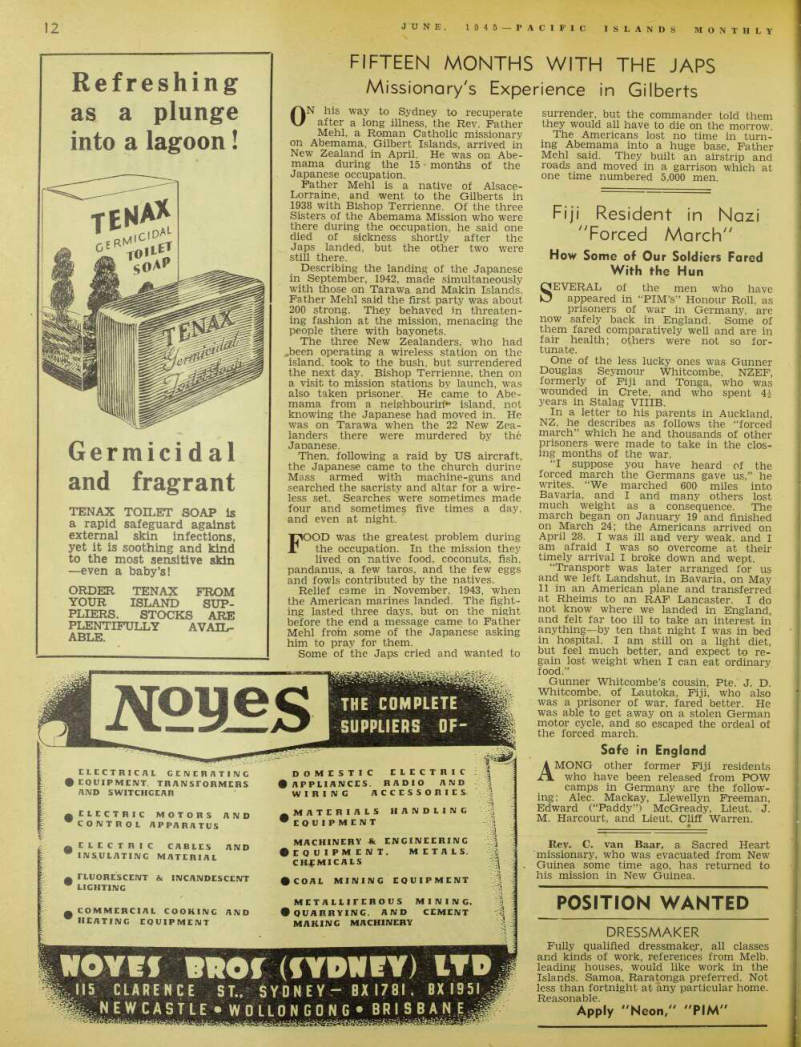
Fiji Resident in Nazi "Forced March"
How Some of Our Soldiers Fared With the Hun
SEVERAL of the men who have appeared in “PlM’s” Honour Roll, as prisoners of war in Germany, are now safely back in England. Some of them fared comparatively well and are in fair health; others were not so for tunate.
One of the less lucky ones was Gunner Douglas Seymour Whitcombe, NZEF, formerly of Fiji and Tonga, who was wounded in Crete, and who spent 4J years in Stalag VIIIB.
In a letter to his parents in Auckland, NZ, he describes as follows the “forced march” which he and thousands of other prisoners were made to take in the clos ing months of the war.
“I suppose you have heard of the forced march the Germans gave us,” he writes. “We marched 600 miles into Bavaria, and I and many others lost much weight as a consequence. The march began on January 19 and finished on March 24; the Americans arrived on April 28. I was ill and very weak, and I am afraid I was so overcome at their timely arrival I broke down and wept.
“Transport was later arranged for us and we left Landshut, in Bavaria, on May 11 in an American plane and transferred at Rheims to an RAF Lancaster. I do not know where we landed in England, and felt far too ill to take an interest in anything—by ten that night I was in bed in hospital. I am still on a light diet, but feel much better, and expect to re gain lost weight when I can eat ordinary food.”
Gunner Whitcombe’s cousin, Pte. J. D.
Whitcombe, of Lautoka, Fiji, who also was a prisoner of war, fared better. He was able to get away on a stolen German motor cycle, and so escaped the ordeal of the forced march.
Safe in England
AMONG other former Fiji residents who have been released from POW camps in Germany are the follow ing: Alec. Mackay, Llewellyn Freeman, Edward (“Paddy”) McGready, Lieut. J.
M. Harcourt, and Lieut. Cliff Warren.
Rev. C. van Baar, a Sacred Heart missionary, who was evacuated from New Guinea some time ago, has returned to his mission in New Guinea.