was™ Commandant,
pp. 5-6 · Read in the full issue
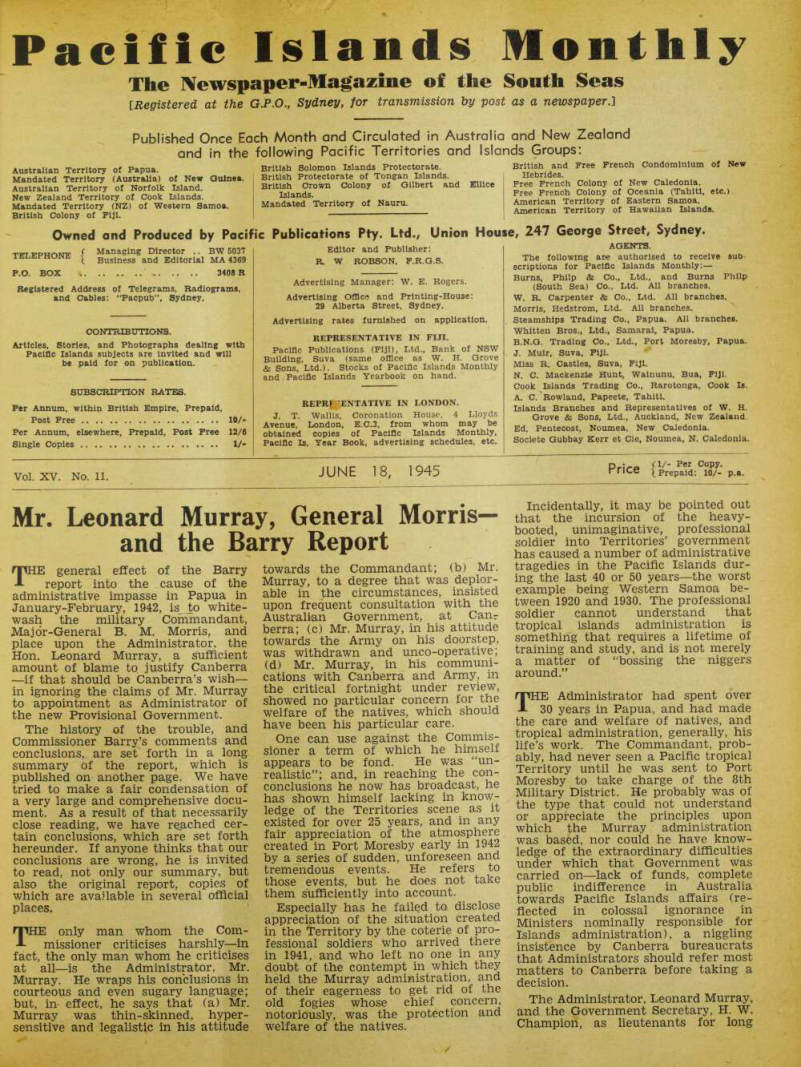
Mr. Leonard Murray, General Morris— and the Barry Report
rfiHE general effect of the Barry 1 report into the cause of the administrative impasse in Papua in Januarv-Februarv 1942 is to white-
Major-General B. M. Morris, and place upon the Administrator, the Hon. Leonard Murray, a sufficient amount of blame to justify Canberra —if that should be Canberra’s wish— in ignoring the claims of Mr. Murray to appointment as Administrator of the new Provisional Government.
TbJhiTrv ofthe treble and
The history of the trouble, and Commissioner Barry’s comments and conclusions, are set forth in a long summary of the report, which is published on another page. We have tried to make a fair condensation of a very large and comprehensive docu merit. As a result of that necessarily close reading, we have reached certain conclusions, which are set forth hereunder. If anyone thinks that our conclusions are wrong, he is invited to read, not only our summary, but also the original report, copies of which are available in several official places. rnHE only man whom the Commissioner criticises harshly—in fact, the only man whom he criticises at all—is the Administrator, Mr.
Murray. He wraps his conclusions in courteous and even sugary language; but, in effect, he says that (a) Mr.
Murray was thin-skinned, hypersensitive and legalistic in his attitude
towards the Commandant; (b) Mr.
Murray, to a degree that was deplor able in the circumstances, insisted upon frequent consultation with the Australian Government, at Can. berra; (c) Mr. Murray, in his attitude towards the Army on his doorstep, was withdrawn and unco-operative, (d) Mr. Murray, in his commum cations with Canberra and Army, m
foTthe
snowed no particular concern ioi uie welfare of the natives, which should have been his Particular care. ■ t th commis- One can use against- the Commas sioner a term of which he himself appears to be fond. He was un realistic ; and, in reaching the con conclusions he now has broadcast, he ledgei ol Territories scene.as it existed for over 25 years, and in any fair appreciation of the atmosphere great ed m and by a series of sudden, unforeseen and tremendous events. He refers to those events, but he does not take them sufficiently into account.
Especially has he failed to disclose appreciation of the situation created in the Territory by the coterie of pro fessional soldiers who arrived there in 1941, and who left no one in any doubt of the contempt in which tney held the Murray administration, and of their eagerness to get rid of the old fogies whose chief concern, notoriously, was the protection and welfare of the natives.
that 0 tL incursion y ot the heavy booted, unimaginative, professional soldier into Territories’ government has caused a number of administrative tragedies In the Pacific' dur mg the last 40 or 50 years the worst and 193Q S The professional tween 1920 and 1930. The professional soldier cannot ooderstand that tropical a lifettoe of something and it notrarelv tnaimng and study, md is not merely a matter of bossing the niggers around. rp HE Administrator had spent over ■ Parma 30 years in Papua, and had made the care and welfare of natives, and tropical administration, generally, his life > s wor k. The Commandant, prob ab had neyer geen & Pacific tropical Territory until he was sent to Port Moregbv to take charge of the Bth Mdit District He probably was of
tyWaTcouM Sot uSeSnd
Qr j. eciate the princi pi es upon , Murray administration wag baged nor could have know ledge of the extraordinary difficulties under which that Governme nt was carried on lack of f unds complete parried funds, complete towards Pacific Islands affairs (re flected in co iossal ignorance in Ministers nominally responsible for Islands administration), a niggling i ns i s t en ce by Canberra bureaucrats that Administrators should refer most matters to Canberra before taking a dec j s i on * .. . . T The Administrator, Leonard Murray, and the Government Secretary, H W.
Champion, as lieutenants for long
years of the famous Australian Administrator, Sir Hubert Murray, were most jealous of their govern ment, and especially were they concerned with all matters likely to affect the welfare of the natives. Not once, but a score of times, has Aus tralian commerce criticised the Murray regime for its readiness to place native interests before those of Europeans.
INTO this narrow little world, driven by the supreme need of defend ing Australia, came the Army set-up, quite properly expecting and demand ing that all considerations be sub verted to its most urgent requirements.
As Mr. Barry points out in biting language, this military organisation was bumble-footed, blundering, ill trained and ill-equipped. Even before Jap bombs fell on Moresby, stories were reaching Sydney of difficulties between the Army, and the civil administration, of whose opinions, laws and general procedure the newly-arrived military officers were clearly contemptuous.
Possibilities of trouble were fore seen before the administrative im passe occurred. The attitude of General Morris and his principal officers was not helpful or conciliatory —and the Administrator and his officials, probably resenting bitterly the Brass Hat attitude, naturally withdrew themselves as far as their duty permitted. As the Japanese in vasion approached, the Administrator obviously had to depend almost wholly upon Canberra for infor mation and instructions. Canberra had the whole picture—the Adminis trator knew only what he could see and hear. And what he saw and heard must have given him little confidence in General Morris and his set-up—thousands of troops, arriving in Moresby without discipline and proper equipment; troops running amok and looting tho stores and private houses; Rabaul (for which Moresby Army headquarters were supposed to be responsible) aban doned to the Japanese; hundreds of civilians sacrificed there, because of official failure to use the available transport to get them away.
The Commandant probably was impatient with fhe Administrator’s failure to make quick, clear decisions, and (with typical Army confidence in the propriety of its own judgment!) was sure that the only thing to do was t ° , shl P Murray and his crowd out of the Territory.” Mr. Barry has clearly seen the Commandant’s view point m relation to the Administrator, fhw p ?w nt s has approved of every rvv>2 g Tvyr that u General Morris did in Port Moresby. There is no word of adverse criticism.
Mr ; , Barr y apparently failed to
refaUon viSwpotat in
qWtt k 1 t 0 th ? Commandant—prob ably because of his lack of knowledge ground Papuan histor y and back
rpHE most serious charge made by -*• Mr. Barry against Mr. Murray is that he insisted on referring every thing to Canberra, for instructions.
If anyone was to be condemned for that course, it was not Mr. Murray, but the Canberra bureaucrats, who had instituted and most jealously guarded the system. As Mr. Murray saw it, he had to look for direction to Canberra, which presumably had the complete picture, and not to the local Commandant, who appeared to be surrounded with confusion and chaos.
At any time—and especially after the fall of Rabaul, when the Japs clearly were coming south—Canberra had only to send Mr. Murray a dozen clear words, informing him that in view of the urgency of the situation he now must take all instructions from the Commandant on the spot, and fit his remaining civil adminis tration into the military set-up, and there would have been no further difficulty.
But in all the day-to-day radio messages between Canberra and Port Moresby, examined by the Commis sioner and set out in his report (see our summary) there is not one word of instruction to the Administrator which may be construed in that way.
On the contrary, there are the most stupidly conflicting and confusing instructions issued from Melbourne and Canberra; and anyone reading those messages can only wonder, not that Mr. Murray was “unco-operative,” but that he did not go insane. “All hell was popping” around him in those critical days, the Commandant was hostile and anxious to get com plete control, and Canberra kept issuing conflicting orders.
All who read the Barry report will agree that if anyone is to be blamed for Moresby’s black fortnight, cul minating in the virtual deportation of the Administrator and his senior officers, it is the bureaucracy of the Army and the Canberra Departments, and the unfortunate people re sponsible for maintaining liaison between the two.
Mr. Murray’s attitude and conduct, officially, were strictly correct, in every particular. It is so easy for Mr. Barry, three years later, to say, “Why did you not take matters into your own hands? Why wait on Can berra?” If Mr. Barry were not so legalistic and unrealistic—terms which he applies to others—he would know that, if Mr. Murray had followed that course, he long ago would have been torn to pieces by Canberra, and delivered over as an official corpse to the Army. (Read the Memorandum of September, 1943, written by Aus tralia’s very own General Sir Thomas Blarney!) r IHE Commissioner’s charge that the Administrator appeared indif ferent, in those critical days, to the future welfare of the native people, supports our contention that his con clusions are legalistic and unreal.
Imagine anyone bringing such a charge against the man who was
associated for 30 years with his famous uncle, in developing the Murray policy of native administra tion, and who has so often been accused of cherishing too tender a regard for native welfare!
Obviously, the man who had de voted most of his official life to developing a policy of native adminis tration, and discussing the subject with Canberra, would not think it necessary, in that confused time, to re-state his views—he naturally would assume that Canberra, in dealing with the Army, would understand exactly the Territory’s requirements in relation to the natives. But be cause he did not set it all out in memoranda to Canberra and the Commandant, he is found guilty of lack of co-operation.