Giant Yams
pp. 39-40 · Read in the full issue
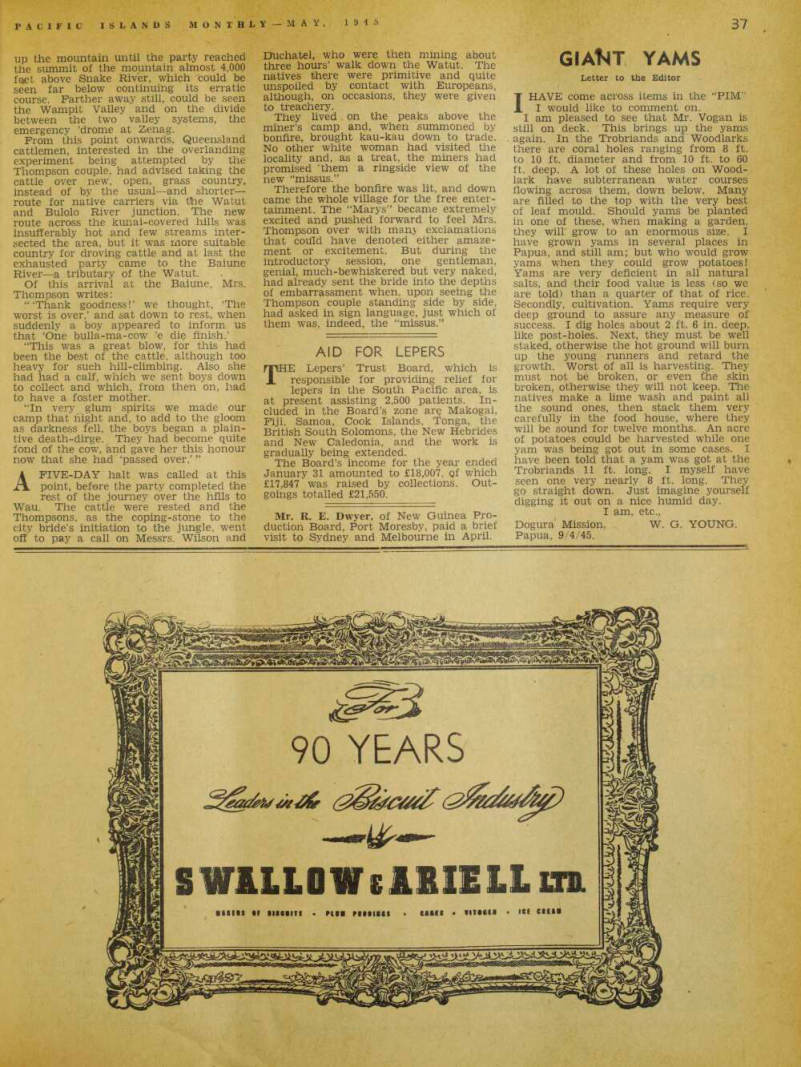
Letter to the Editor 1HAVE come across items in the “PIM' I would like to comment on.
I am pleased to see that Mr. Vogan is still on deck. This brings up the yams again. In the Trobriands and Woodlarks there are coral holes ranging from 8 ft. to 10 ft. diameter and from 10 ft. to 60 ft. deep. A lot of these holes on Wood lark have subterranean water courses flowing across them, down below. Many are filled to the top with the very best of leaf mould. Should yams be planted in one of these, when making a garden, they will grow to an enormous size, I have grown yams in several places in Papua, and still am; but who would grow yams when they could grow potatoes!
Yams are very deficient in all natural salts, and their food value is less (so we are told) than a quarter of that of rice.
Secondly, cultivation. Yams require very deep ground to assure any measure of success. I dig holes about 2 ft. 6 in. deep, like post-holes. Next, they must be well staked, otherwise the hot ground will burn up the young runners and retard the growth. Worst of all is harvesting. They must not be broken, or even the skin broken, otherwise they will not keep. The natives make a lime wash and paint all the sound ones, then stack them very carefully in the food house, where they will be sound for twelve months. An acre of potatoes could be harvested while one yam was being got out in some cases. I have been told that a yam was got at the Trobriands 11 ft. long. I myself have seen one very nearly 8 ft. long. They go straight down. Just imagine yourself digging it out on a nice humid day.
I am, etc.,
Dogura Mission,
W. G. Young.
Papua, 9/4/45.
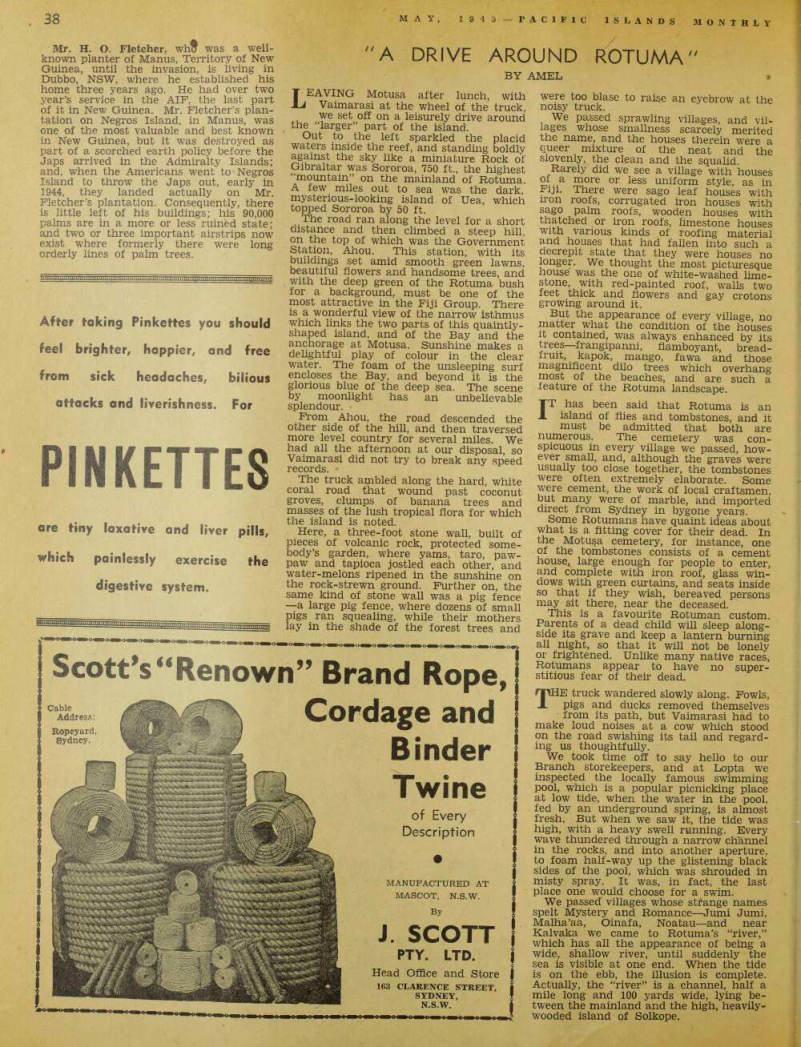
Mr. H. O. Fletcher, whs was a well known planter of Manus, Territory of New Guinea, until the invasion, is living in Dubbo, NSW, where he established his home three years ago. He had over two year’s service in the AIF, the last part of it in New Guinea. Mr. Fletcher’s plan tation on Negros Island, in Manus, was one of the most valuable and best known in New Guinea, but it was destroyed as part of a scorched earth policy before the Japs arrived in the Admiralty Islands; and, when the Americans went to Negros Island to throw the Japs out, early in 1944, they landed actually on Mr.
Fletcher’s plantation. Consequently, there is little left of his buildings; his 90,000 palms are in a more or less ruined state; and two or three important airstrips now exist where formerly there were long orderly lines of palm trees.