Papuan Pioneer
p. 14 · Read in the full issue
Passes
A. C. English Dead in Sydney
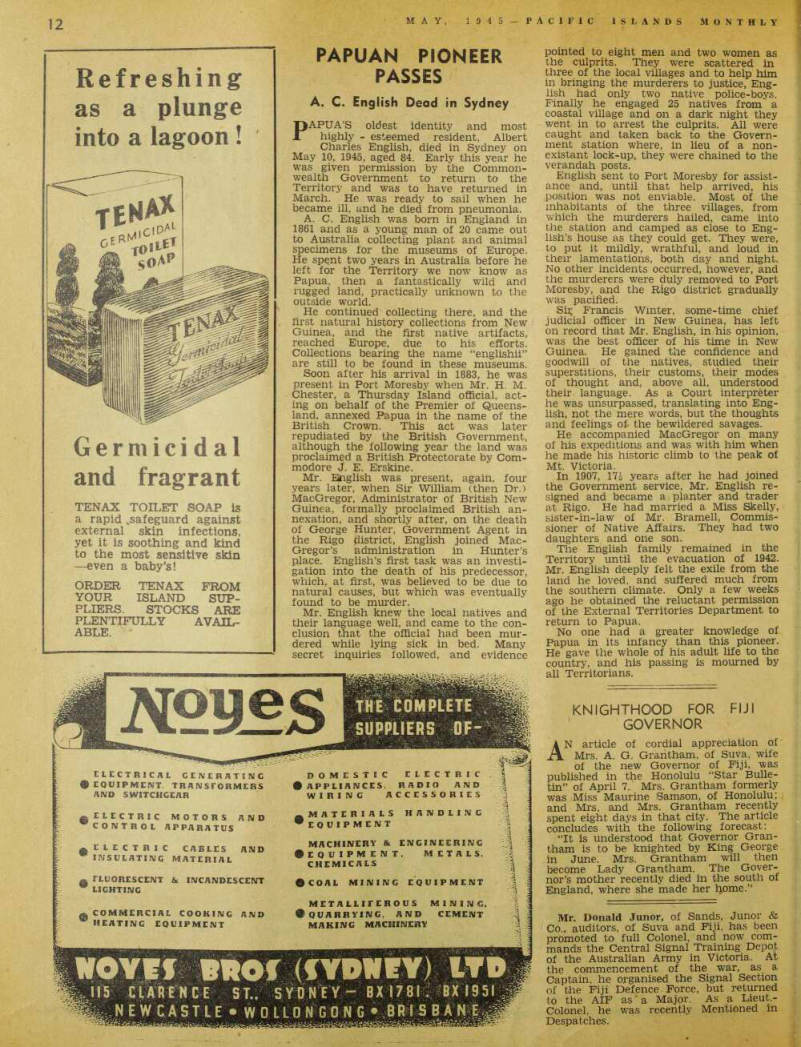
PAPUA’S oldest identity and most highly - esteemed resident, Albert Charles English, died in Sydney on May 10, 1945, aged 84. Early this year he was given permission by the Common wealth Government to return to the Territory and was to have returned in March. He was ready to sail when he became ill, and he died from pneumonia.
A. C. English was born in England in 1861 and as a young man of 20 came out to Australia collecting plant and animal specimens for the museums of Europe.
He spent two years in Australia before he left for the Territory we now know as Papua, then a fantastically wild and rugged land, practically unknown to the outside world.
He continued collecting there, and the first natural history collections from New Guinea, and the first native artifacts, reached Europe, due to his efforts.
Collections bearing the name “englishii” are still to be found in these museums.
Soon after his arrival in 1883, he was present in Port Moresby when Mr. H. M.
Chester, a Thursday Island official, act ing on behalf of the Premier of Queens land, annexed Papua in the name of the British Crown. This act was later repudiated by the British Government, although the following year the land was proclaimed a British Protectorate by Com modore J. E. Erskine.
Mr. English was present, again, four years later, when Sir William (then Dr.) MacGregor, Administrator of British New Guinea, formally proclaimed British an nexation, and shortly after, on the death of George Hunter, Government Agent in the Rigo district, English joined Mac- Gregor’s administration in Hunter’s place. English’s first task was an investi gation into the death of his predecessor, which, at first, was believed to be due to natural causes, but which was eventually found to be murder.
Mr. English knew the local natives and their language well, and came to the con clusion that the official had been mur dered while lying sick in bed. Many secret inquiries followed, and evidence
pointed to eight men and two women as the culprits. They were scattered in three of the local villages and to help him in bringing the murderers to justice, Eng lish had only two native police-boys.
Finally he engaged 25 natives from a coastal village and on a dark night they went in to arrest the culprits. All were caught and taken back to the Govern ment station where, in lieu of a non existant lock-up, they were chained to the verandah posts.
English sent to Port Moresby for assist ance and, until that help arrived, his position was not enviable. Most of the inhabitants of the three villages, from which the murderers hailed, came into the station and camped as close to Eng lish’s house as they could get. They were, to put it mildly, wrathful, and loud in their lamentations, both day and night.
No other incidents occurred, however, and the murderers were duly removed to Port Moresby, and the Rigo district gradually was pacified.
Sh; Francis Winter, some-time chief judicial officer in New Guinea, has left on record that Mr. English, in his opinion, was the best officer of his time in New Guinea. He gained the confidence and goodwill of the natives, studied their superstitions, their customs, their modes of thought and, above all, understood their language. As a Court interpreter he was unsurpassed, translating into Eng lish, not the mere words, but the thoughts and feelings of. the bewildered savages.
He accompanied MacGregor on many of his expeditions and was with him when he made his historic climb to the peak of Mt. Victoria.
In 1907, Hi years after he had joined the Government service, Mr. English re signed and became a planter and trader at Rigo. He had married a Miss Skelly, sister-in-law of Mr. Bramell, Commis sioner of Native Affairs. They had two daughters and one son.
The English family remained in the Territory until the evacuation of 1942.
Mr. English deeply felt the exile from the land he loved, and suffered much from the southern climate. Only a few weeks ago he obtained the reluctant permission of the External Territories Department to return to Papua.
No one had a greater knowledge of Papua in its infancy than this pioneer.
He gave the whole of his adult life to the country, and his passing is mourned by all Territorians.