No Provisional Government Yet
pp. 8-52 · Read in the full issue
ANGAU and Production Board Still Rule Papua and New Guinea
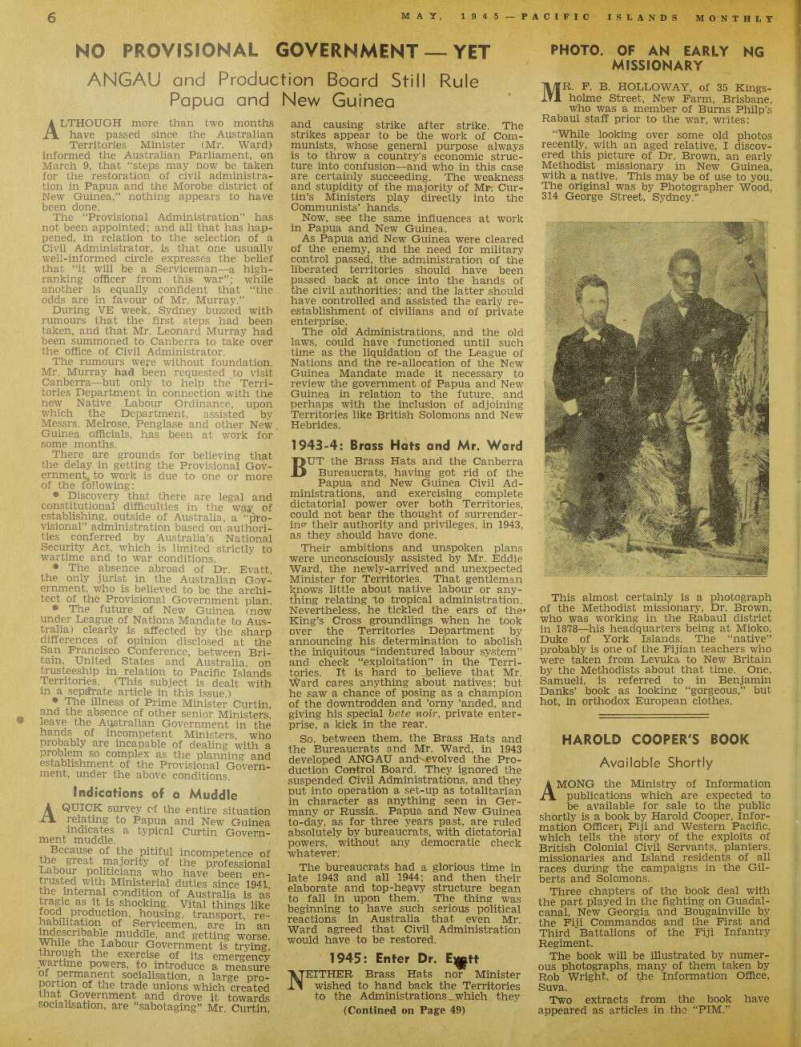
ALTHOUGH more than two months have passed since the Australian Territories Minister (Mr. Ward) informed the Australian Parliament, on March 9, that “steps may now be taken for the restoration of civil administra tion in Papua and the Morobe district of New Guinea,” nothing appears to have been done.
The “Provisional Administration” has not been appointed; and all that has hap pened, in relation to the selection of a Civil Administrator, is that one usually well-informed circle expresses the belief that “it will be a Serviceman —a high ranking officer from this war”; while another is equally confident that “the odds are in favour of Mr. Murray.”
During VE week, Sydney buzzed with rumours that the first steps had been taken, and that Mr. Leonard Murray had been summoned to Canberra to take over the office of Civil Administrator.
The rumours were without foundation.
Mr. Murray had been requested to visit Canberra—but only to help the Terri tories Department in connection with the new Native Labour Ordinance, upon which the Department, assisted by Messrs. Melrose, Penglase and other New „ Guinea officials, has been at work for some months.
There are grounds for believing that the delay in getting the Provisional Gov ernment, to work is due to one or more of the following: • Discovery that there are legal and constitutional difficulties in the way of establishing, outside of Australia, a i7pro visional” administration based on authori ties conferred by Australia’s National Security Act, which is limited strictly to wartime and to war conditions. • The absence abroad of Dr. Evatt, the only jurist in the Australian Gov ernment, who is believed to be the archi tect of the Provisional Government plan. • The future of New Guinea (now under League of Nations Mandate to Aus tralia) clearly is affected by the sharp differences of opinion disclosed at the San Francisco Conference, between Bri tain, United States and Australia, on trusteeship in relation to Pacific Islands Territories. (This subject is dealt with in a separate article in this issue) • The illness of Prime Minister Curtin, and the absence of other senior Ministers, leave the Australian Government in the hands of incompetent Ministers, who probably are incapable of dealing with a problem so complex as the planning and establishment of the Provisional Govern ment, under the above conditions.
Indications of a Muddle
A QUICK survey of the entire situation relating to Papua and New Guinea indicates a typical Curtin Govern ment muddle.
Because of the pitiful incompetence of the great majority of the professional Labour politicians who have been en trusted with Ministerial duties since 1941. the internal condition of Australia is as tragic as it is shocking. Vital things like food production, housing, transport, re habilitation of Servicemen, are in an muddle, and getting worse.
While the Labour Government is trying, through the exercise of its emergency wartime powers, to introduce a measure of permanent socialisation, a large pro porhon of the trade unions which created that Government and drove it towards socialisation, are “sabotaging” Mr Curtin
and causing strike after strike. The strikes appear to be the work of Com munists, whose general purpose always is to throw a country’s economic struc ture into confusion—and who in this case are certainly succeeding. The weakness and stupidity of the majority of Mr. Cur tin’s Ministers play directly into the Communists’ hands.
Now, see the same influences at work in Papua and New Guinea.
As Papua and New Guinea were cleared of the enemy, and the need for military control passed, the administration of the liberated territories should have been passed back at once into the hands of the civil authorities: and the latter should have controlled and assisted the early re establishment of civilians and of private enterprise.
The old Administrations, and the old laws, could have functioned until such time as the liquidation of the League of Nations and the re-allocation of the New Guinea Mandate made it necessary to review the government of Papua and New Guinea in relation to the future, and perhaps with the inclusion of adjoining Territories like British Solomons and New Hebrides.
1943-4: Brass Hats and Mr. Ward
BUT the Brass Hats and the Canberra Bureaucrats, having got rid of the Papua and New Guinea Civil Ad ministrations, and exercising complete dictatorial power over both Territories, could not bear the thought of surrender ing their authority and privileges, in 1943, as they should have done.
Their ambitions and unspoken plans were unconsciously assisted by Mr. Eddie Ward, the newly-arrived and unexpected Minister for Territories. That gentleman knows little about native labour or any thing relating to tropical administration.
Nevertheless, he tickled the ears of the* King’s Cross groundlings when he took over the Territories Department by announcing his determination to abolish the iniquitous “indentured labour system” and check “exploitation” in the Terri tories. It is hard to Jbelieve that Mr.
Ward cares anything about natives; but he saw a chance of posing as a champion of the downtrodden and ’orny ’anded, and giving his special hete non, private enter prise, a kick in the rear.
So, between them, the Brass Hats and the Bureaucrats and Mr. Ward, in 1943 developed ANGAU and evolved the Pro duction Control Board. They ignored the suspended Civil Administrations, and they put into operation a set-up as totalitarian in character as anything seen in Ger many or Russia. Papua and New Guinea to-day, as for three years past, are ruled absolutely by bureaucrats, with dictatorial powers, without any democratic check whatever.
The bureaucrats had a glorious time in late 1943 and all 1944; and then their elaborate and top-heavy structure began to fall in upon them. The thing was beginning to have such serious political reactions in Australia that even Mr.
Ward agreed that Civil Administration would have to be restored.
1945: Enter Dr. E^tt
NEITHER Brass Hats nor Minister wished to hand back the Territories to the Administrations which they
(Confined on Page 49)
had flouted, or to scrap ANGAU and all the trimmings.
They wanted to (a) keep out any kind of civil governmental control, (b) pre serve the Production Control Board machinery, (c) temporarily amalgamate the two territories, (d) control civilians and private enterprise. So they took their problem to Dr, Evatt.
That ingenious but impractical and academic planner, whose Anzac Pact (agreement with New Zealand for the disposal of various Pacific Territories) had a year before given such offence in London and New York, put a wet towel around his head, and produced the “Pro visional Government,” as by Mr. Ward in the Australian Parliament on March 9 (see March “PIM,” p. 5).
Nobody, except the planners and bureaucrats, liked the scheme: it carried too many of the earmarks of the Brass Hat and the Bureaucrat. Competent con stitutional lawyers have expressed the private opinion that, if it is based on the National Security Act, it will collapse.
Mr. Ward probably will go on with it.
The new Administrator may be an nounced any day. But, if Canberra .is wise—which it rarely is—it will heed the stosm signals already flying in certain directions, and scrap the plan, and carry on for the present with the old Adminis trations, concerning the legal status of which there can be no question.
Public Service Protest
A STRONGLY-WORDED circular to members of the Australian Parlia ment, in which Mr, A. W. Marshall, president of the Papuan Public Service Association, attacked the Provisional Gov ernment plan with timely and cogent argument, may have had some effect in delaying action under the plan.
Mr. Marshall declared that the Pro visional Government would be crippled by legal difficulties; that while it might secure a fusion of the public services, it would not achieve uniformity of law; that it made wholly inadequate provision for the care of natives, which should be its primary consideration; and that the interests of the public officers of the sus pended Papuan and New Guinea Admin istrations would be gravely prejudiced.
Mr. Marshall said that his Association wanted the Papuan staff to be returned to Papua in their rightful positions; the Papuan approach to the native problem to be continued; and the Administration to be controlled by Mr. Leonard Murray.
Still No Barry Report
A TrT , TT^TT _„ 7 . .
LTHOUGH Mr. Barry, KC, of Melbourne, under the authority of a Royal Commission (see page 6 of March “PIM”), lost no time in making, in Australia and Papua, his investigation into the circumstances surrounding the cessation of civil government in Papua in February, 1942, his report has not yet been published.
The inquiry was made in December and January, and the pommissioner reported soon afterwards to the Minister. It was stated in April that the report had gone before the Australian Cabinet.
The withholding of the report is grossly unfair to the Civil Administrator of Papua, Mr. Leonard Murray, who was placed by the Army Brass Hats in the position of a defendant, and is believed (the inquiry was held in private) to have faced a series of charges of non-co-operation, or something of the kind.
WI , , /n j* a •. j New Labour Ordinance Awaited WHETHER or not Mr. Ward abandons the Provisional Government plan, he
certainly will not give up his cherished intention of reforming the native labour system, ... , „ The publication of the new Native Labour .Ordinance is being awaited by Terntonans with considerable trepida tlon - VP® n , lts character depends then economic future. If certain woolly-pated theorists have been able to get the ear of the Canberra dictatorship, and the pew native labour set-up is to be shot through with socialistic idealism, there is future for the Territories. But if Can berra is wise enough to find the correct balance between the stone-age natives, who own the land, and the Europeans, who saved the land from the Japanese, then we may look forward to a develop menta. era m which both natives and Europeans will benefit greatly.
Mr. Ward probably is incapable of appreciating these facts: But the facts are that more harm has been done to the natives (in their culture, in their village organisation, in their attitude towards the Europeans and European ways of life) during the past three years, than in the
previous 50 years of “indentured labour” and “exploitation.”
The evil that has been done by the Army and by ANGAU in forcing the native communities to supply labour is beyond present computation.
After witnessing that system of forced labour, permitted by Canberra, we must admit the possibility that Mr. Ward, in his well-intentioned ignorance, may incorporate Government recruiting in his new Ordinance. The thing, in the view of all experienced men, is inconceivable —but quite possible under present con ditions.
Government recruiting, of course, would mean that the Government would form a labour pool, from which all labour needs would be supplied; and that officials, with the authority of the Government behind them, would go to the village head-men for recruits. To the native mind, the Government would become the employer, and the whole system would be compulsory. Under the old system, the labour contract was voluntary, and the native clearly understood that the Gov ernment official was there to check it, control it and police it in the interests of both employers and employed.
The Rev. H. J. E. Short and *Mrs. Short, of the LMS, are expecting to return to Papua in May,