Harry Russell
p. 48 · Read in the full issue
Sudden Death in Sydney
MR. HARRY RUSSELL, one of the best-known and best-loved residents of Eastern Papua, died very sud denly in Chatswood, Sydney, on March 18. The following appreciation of his life and character was written for us by Rev.
Chas. F. Rich, who spent many years as a missionary in Papua, and formed a close friendship with the Russell family.
The passing of Harry Russell breaks a link in the chain of Papuan relations that began when Sir William McGregor was Governor of British New Guinea. Harry’s uncle, Henry S. Russell, then was Chief Government Surveyor at Port Moresby, and his father, John S. Russell, was a senior magistrate and in charge, first, of the Government Station at Yule Island and, later, of a North-Eastern Division, in the very early, troublous days of the northern goldfields.
Like other white children in the Ter ritory, he quickly and accurately absorbed the native languages, becoming so pro ficient that he was often called into Court to act as interpreter for his father.
At 18 he entered the Papuan Service as a Cadet Clerk, in the Treasury, and in this same Department the whole of his Government service was spent.
After duty at Moresby and Woodlark Island, he became Collector of Customs at Samarai, and held this position until retirement.
Early Government service was broken into when he went overseas with the AIF, in World War I. Badly wounded in France, he was treated at various English hospitals and ultimately .was able to return to his duties in Papua.
After his retirement, and while resi dent in Sydney, Mr. Russell felt the urge to serve in World War 11, so he joined
again the Australian forces and was stationed at Cowra until declared medi cally unfit.
Mr. Russell, in 1925, was married to Miss Olive Inman, by Bishop Newton, in Samarai. This marriage linked two pioneer families. The bride’s father, Capt. W. A. Inman, sailed in the early passenger and mail service between Cook town and Papua. The Inman family had settled at this time on Samarai.
The above is the dry historical back ground to a most gracious and lovable personality. Harry’s life was character ised by his love of animals. Birds, beasts, and even the reptiles that repel the aver age man were his friends, because he was
their friend. Some of his colleagues in the Customs offices would have wished this attachment watered down a bit— especially when, opening a desk or drawer, they would find it tenanted by some of Harry’s friendly snakes.
As with the animals, so with the native people. For these, from his early days, Harry had a real regard, and this feeling deepened with the years. To him they were human beings, to be regarded and treated as such. Thus the natives came to know they had a sincere friend in this white man, and they responded with loyal and often loving service. As with the animals and the native people, so with the white folk. Harry always had a sympathetic, helpful word or act for any in need of these, while his bright disposition and sunny smile made contact with him an ever-happy memory.
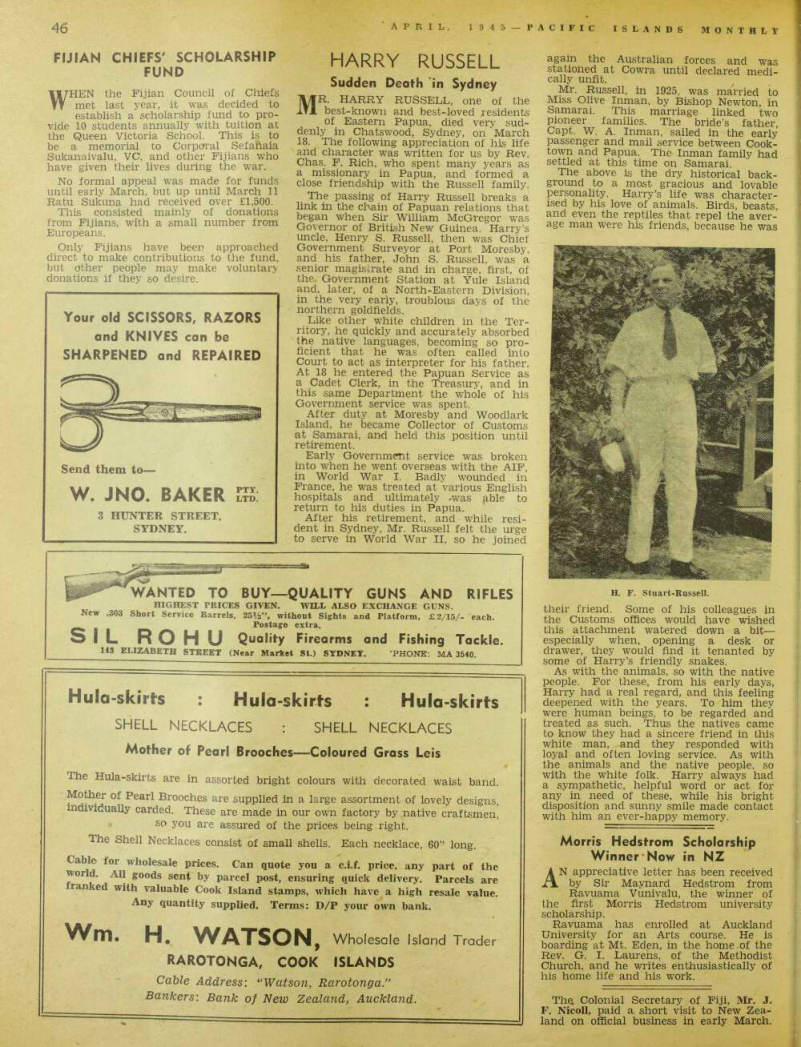
H. F. Stuart-Russell.