Tarawa
p. 13 · Read in the full issue
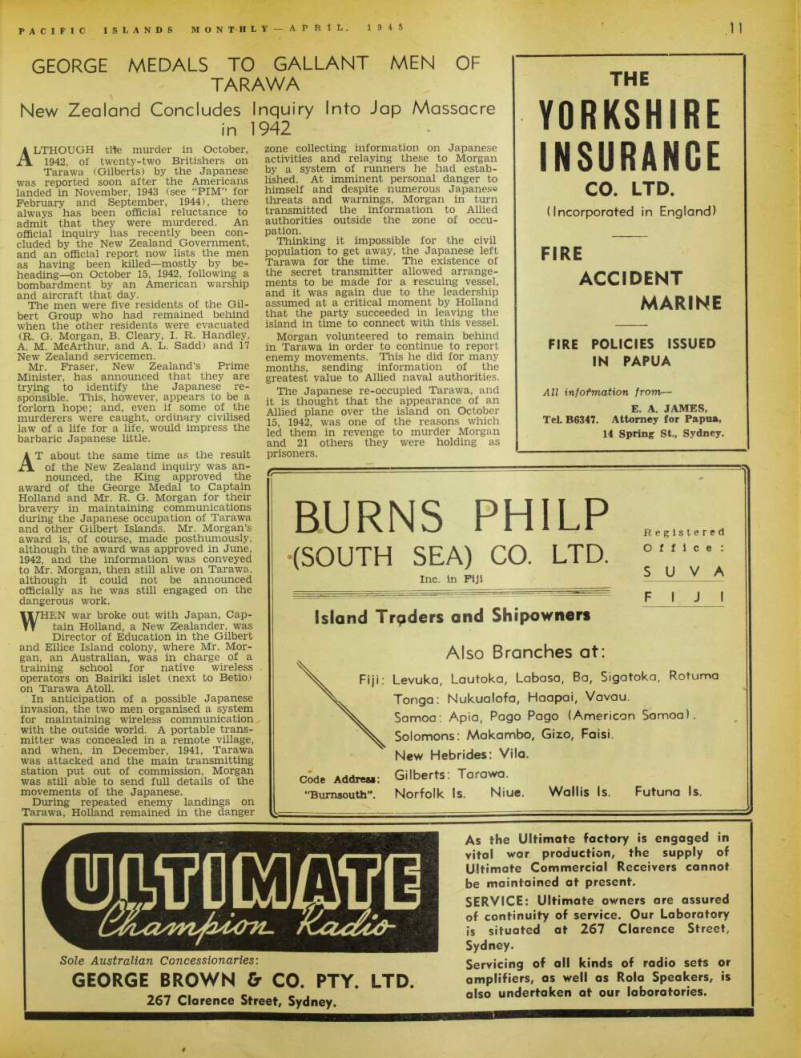
George Medals To Gallant Men Of
New Zealand Concludes Inquiry Into Jap Massacre in 1942
ALTHOUGH tile murder in October, 1942, of twenty-two Britishers on Tarawa (Gilberts) by the Japanese was reported soon after the Americans landed in November, 1943 (see “PIM” for February and September, 1944), there always has been official reluctance to admit that they were murdered. An official inquiry has recently been con cluded by the New Zealand Government, and an official report now lists the men as having been killed—mostly by be heading—on October 15, 1942, following a bombardment by an American warship and aircraft that day.
Hie men were five residents of the Gil bert Group who had remained behind when the other residents were evacuated (R. G. Morgan, B. Cleary, I. R. Handley, A. M. McArthur, and A. L. Sadd) and 17 New Zealand servicemen, Mr. Fraser, New Zealand’s Prime Minister, has announced that they are trying to identify the Japanese re sponsible. This, however, appears to be a forlorn hope; and, even if some of the murderers were caught, ordinary civilised law of a life for a life, would impress the barbaric Japanese little.
AT about the same time as the result of the New Zealand inquiry was an nounced, the King approved the award of the George Medal to Captain Holland and Mr. R. G. Morgan for their bravery in maintaining communications during the Japanese occupation of Tarawa and other Gilbert Islands. Mr. Morgan’s award is, of course, made posthumously, although the award was approved in June, 1942, and the information was conveyed to Mr. Morgan, then still alive on Tarawa, although it could not be announced officially as he was still engaged on the dangerous work.
WHEN war broke out with Japan, Cap tain Holland, a New Zealander, was Director of Education in the Gilbert and Ellice Island colony, where Mr. Mor gan, an Australian, was in charge of a training school for native wireless operators on Bairiki islet (next to Betio) on Tarawa Atoll.
In anticipation of a possible Japanese invasion, the two men organised a system for maintaining wireless communication with the outside world. A portable trans mitter was concealed in a remote village, and when, in December, 1941, Tarawa was attacked and the main transmitting station put out of commission, Morgan was still able to send full details of the movements of the Japanese.
During repeated enemy landings on Tarawa, Holland remained in the danger
zone collecting information on Japanese activities and relaying these to Morgan by a system of runners he had estab lished. At imminent personal danger to himself and despite numerous Japanese threats and warnings, Morgan in turn transmitted the information to Allied authorities outside the zone of occu pation.
Thinking it impossible for the civil population to get away, the Japanese left Tarawa for the time. The existence of the secret transmitter allowed arrange ments to be made for a rescuing vessel, and it was again due to the leadership assumed at a critical moment by Holland that the party succeeded in leaving the island in time to connect with this vessel.
Morgan volunteered to remain behind in Tarawa in order to continue to report enemy movements. This he did for many months, sending information of the greatest value to Allied naval authorities.
The Japanese re-occupied Tarawa, and it is thought that the appearance of an Allied plane over the island on October 15, 1942, was one of the reasons which led them in revenge to murder Morgan and 21 others they were holding as prisoners.