Australia's Glamour-Less War
pp. 8-9 · Read in the full issue
The Slow Liberation of New Guinea
THE Australian authorities recently supplied to the Australian news papers a long-overdue summary of the Australian “mopping-up” opera tions in New Guinea—where they are and what they achieving. The follow ing article and maps are based on some of this material, published on March 25 in Sydney Sun.
War on a considerable scale is in progress in three widely separated areas in New Guinea—in the Rabaul district, in Bougainville, and in the Sepik district of northern New Guinea.
Fighting as bitter as any that took place in the Solomons or on the Kokoda trail is in progress; but the news is blanketed by the far more im portant reports of what is happening in Europe and the North Pacific.
It is a savage and merciless war; but it is being fought without glamour, and it is almost forgotten.
The Australians are handicapped by the character of the country and the wet season. In their favour, on the other hand, is the fact that the com munications of the Japs with their northern bases have been cut for over a year.
IN the Mandated Territory of New Guinea are the following main districts:
Mainland Of New Guinea Divided
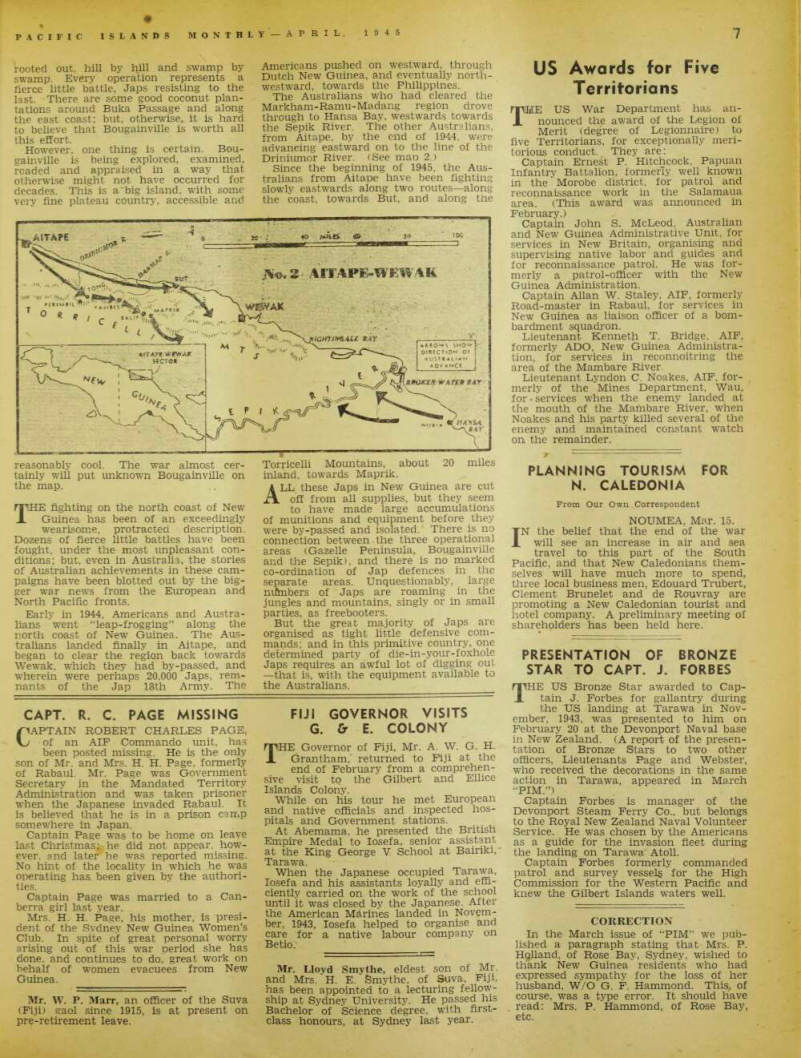
roughly into (a) the Morobe district (from Papua to the Markham River)— clear of Japs; (b) Huon Peninsula, east and north of the Markham River, to Madang—clear of Japs; _(c) North Coast, from Sepik River westwards to Dutch border (see map 2)— remnants of Japan ese 18th Army, perhaps 20,000 to 30,000 men, being cleared out.
Island Of New Britain (See Map
3).—All clear of Japs except extreme western end (Gazelle Peninsula), where it is believed that 40,000 enemy troops are centred on Rabaul.
Northern Solomon Islands Of
Bougainville And Buka (See Map
1).—Western coast clear of Japs, but from 10,000 to 15,000 on eastern and northern coasts and on Buka.
Island Of New Ireland.—Wholly
in Jap possession, and considerable num bers of enemy troops there.
Admiralty Islands (Manus).—
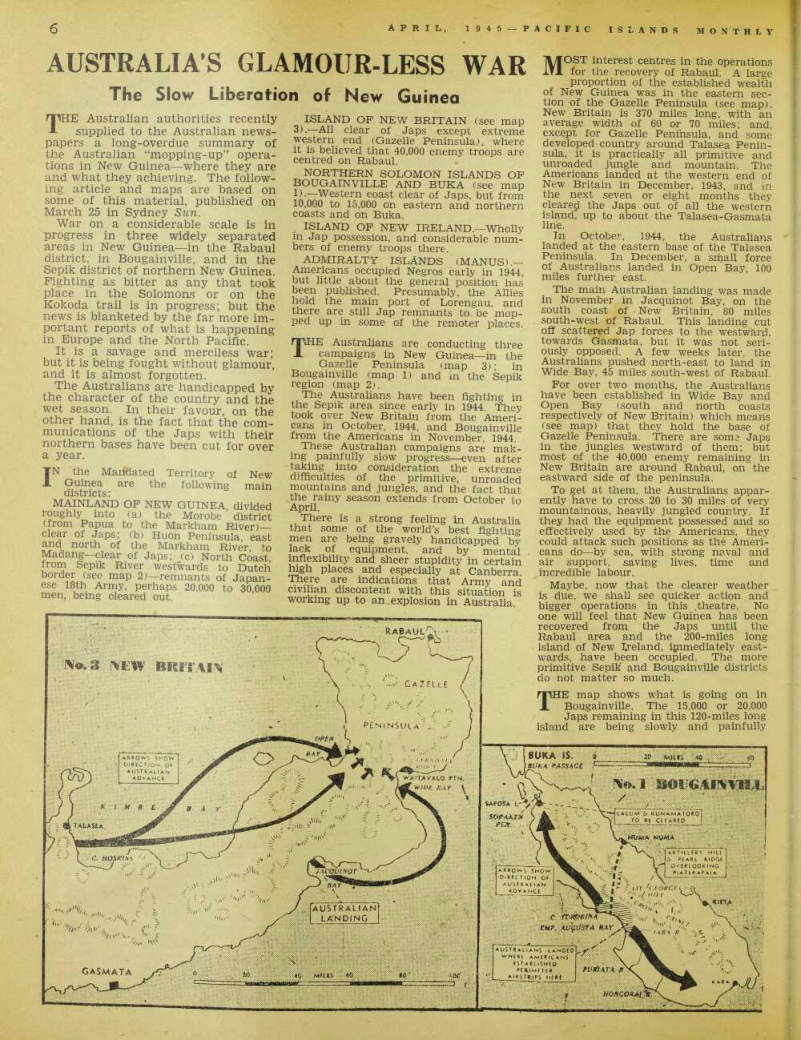
Americans occupied Negros early in 1944, but little about the general position has been published. Presumably, the Allies hold the main port of Lorengau, and there are still Jap remnants to be mop ped up in some of the remoter places. rE Australians are conducting three campaigns in New Guinea—in the Gazelle Peninsula (map 3); in Bougainville (map 1) and in the Sepik region (map 2).
The Australians have been fighting in the Sepik area since early in 1944. They took over New Britain from the Ameri cans in October, 1944, and Bougainville from the Americans in November, 1944.
These Australian campaigns are mak ing painfully slow progress—even after taking into consideration the extreme difficulties of the primitive, unroaded mountains and jungles, and the fact that the rainy season extends from October to April.
There is a strong feeling in Australia that some of the world’s best fighting men are being gravely handicapped by lack of equipment, and by mental inflexibility and sheer stupidity in certain high places and especially at Canberra There are indications that Army and civilian discontent with this situation is working up to an explosion in Australia
MOST interest centres in the operations for the recovery of Rabaul. A large proportion of the established wealth of New Guinea was in the eastern sec tion of the Gazelle Peninsula (see map).
New Britain is 370 miles long, with an average width of 60 or 70 miles; and, except for Gazelle Peninsula, and some developed country around Talasea Penin sula, it is practically all primitive and unroaded jungle and mountain. The Americans landed at the western end of New Britain in December, 1943, and in the next seven or eight months they clearest the Japs out of all the western island, up to about the Talasea-Gasmata line.
In October, 1944, the Australians landed at the eastern base of the Talasea Peninsula. In December, a small force of Australians landed in Open Bay, 100 miles further east.
The main Australian landing was made in November in Jacquinot Bay, on the south coast of New Britain, 80 miles south-west of Rabaul. This landing cut off scattered Jap forces to the westward, towards Gasmata, but it was not seri ously opposed. A few weeks later, the Australians pushed north-east to land in Wide Bay, 45 miles south-west of Rabaul.
For over two months, the Australians have been established in Wide Bay and Open Bay (south and north coasts respectively of New Britain) which means (see map) that they hold the base of Gazelle Peninsula. There are some Japs in the jungles westward of them; but most of the 40,000 enemy remaining in New Britain are around Rabaul, on the eastward side of the peninsula.
To get at them, the Australians appar ently have to cross 20 to 30 miles of very mountainous, heavily jungled country. If they had the equipment possessed and so effectively used by the Americans, they could attack such positions as the Ameri cans do —by sea, with strong naval and air support, saving lives, time and incredible labour.
Maybe, now that the clearer weather is due, we shall see quicker action and bigger operations in this .theatre. No one will feel that New Guinea has been recovered from the Japs until the Rabaul area and the 200-miles long island of New Ireland, immediately east wards, have been occupied. The more primitive Sepik and Bougainville districts do not matter so much. rE map shows what is going on in Bougainville. The 15,000 or 20,000 Japs remaining in this 120-miles long island are being slowly and painfully
rooted out. hill by hill and swamp by swamp. Every operation represents a fierce little battle, Japs resisting to the last. There are some good coconut plan tations around Buka Passage and along the east coast; but, otherwise, it is hard to believe that Bougainville is worth all this effort.
However, one thing is certain. Bou gainville is being explored, examined, rcaded and appraised in a way that otherwise might not have occurred for decades. This is a big island, with some very fine plateau country, accessible and
reasonably cool. The war almost cer tainly will put unknown Bougainville on the map.
THE fighting on the north coast of New Guinea has been of an exceedingly wearisome, protracted description.
Dozens of fierce little battles have been fought, under the most unpleasant con ditions; but, even in Australia, the stories of Australian achievements in these cam paigns have been blotted out by the big ger war news from the European and North Pacific fronts.
Early in 1944, Americans and Austra lians went “leap-frogging” along the north coast of New Guinea. The Aus tralians landed finally in Aitape, and began to clear the region back towards Wewak, which they had by-passed, and wherein were perhaps 20,000 Japs, rem nants of the Jap 18th Army. The
Americans pushed on westward through Dutch New Guinea, and eventually north westward, towards the Philippines, The Australians who had cleared the Markham-Ramu-Madang region drove through to Hansa Bay, westwards towards the Sepik River. The other Australians, from Aitape, by the end of 1944, were advancing eastward on to the line of the Driniumor River. (See man 2.) Since the beginning of 1945, the Aus tralians from Aitape have been fighting slowly eastwards along two routes—along the coast, towards But, and along the
Torricelli Mountains, about 20 miles inland, towards Maprik.
ALL these Japs in New Guinea are cut off from all supplies, but they seem to have made large accumulations of munitions and equipment before they were by-passed and isolated. There is no connection between the three operational areas (Gazelle Peninsula, Bougainville and the Sepik), and there is no marked co-ordination of Jap defences in the separate areas. Unquestionably, large mAnbers of Japs are roaming in the jungles and mountains, singly or in small parties, as freebooters.
But the great majority of Japs are organised as tight little defensive com mands: and in this primitive country, one determined party of die-in-your-foxhole Japs requires an awful lot of digging out —that is, with the equipment available to the Australians.