Mokogai
pp. 38-39 · Read in the full issue
The Story of Fiji's Model Leper Settlement
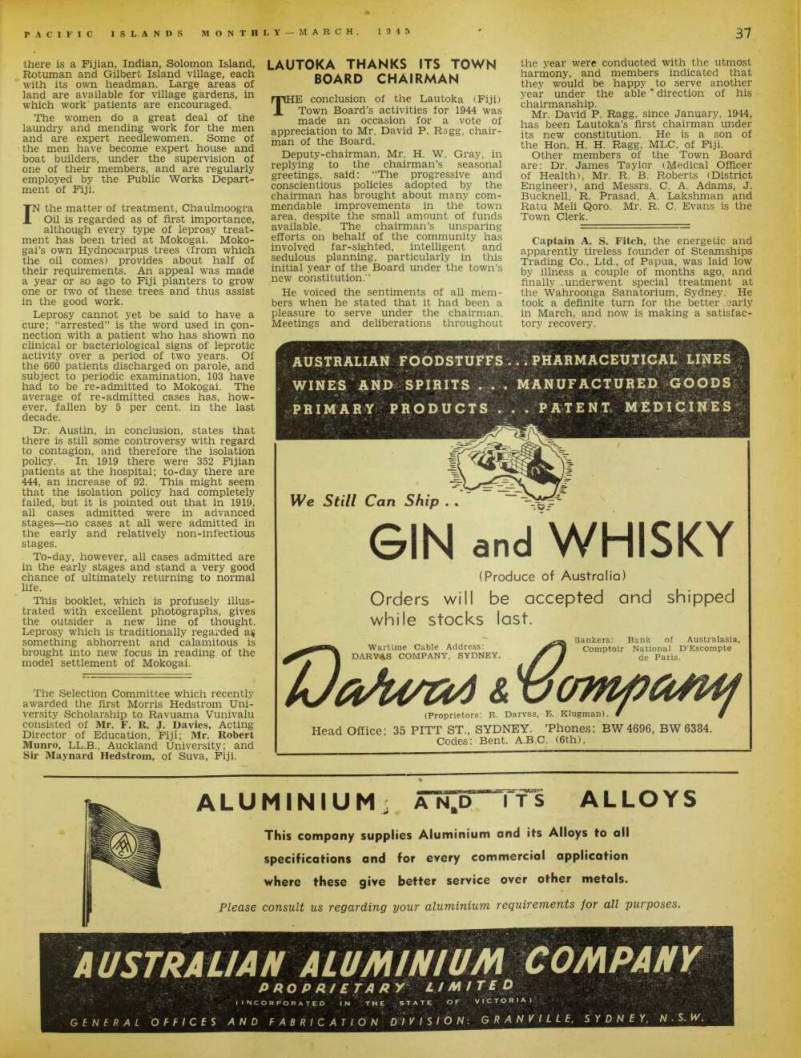
rIS map is a reproduction of the cover of a small booklet issued by the Information Office, Suva, Fiji, and written by Dr. C. J. Austin, Medical Superintendent of Mokogai Central Leper Hospital. It is, as the title indicates, the story of the Hospital since its inauguration in November, 1911.
Dr. Austin describes Mokogai as “noted for its beauty . . . the varying blues and green of the lagoon, the white of the surf contrasting with golden sands and the red roofs of the buildings enhancing the grace and colour of coconut and other tropical trees, provide a picture to stimulate the most jaded taste.”
Dr. Austin says that there is evidence from Fijian mythology and the language to indicate that leprosy was known in the Fijian islands long before the advent of Europeans or Asiatics. Mention was made of the disease by the earliest missionaries, and it was found after Cession that leprosy was a serious and increasing prob lem. Fijian chiefs, it is said, ascribed this increase to the Government’s action in forbidding the clubbing of advanced cases. A Lepers’ Ordinance was passed in 1899 and a station was established on the island of Beqa; this was later re moved to Mokogai, in 1911.
There were 44 patients at that time but as the years passed the numbers increased —not because the disease increased, but because other Territories arid islands were included in the scheme. There were 631 inmates at the end of 1943.
The staff to-dav consists 6f the Medical Superintendent, 16 Missionary Sisters of the Society of Mary and ten native Sisters to assist them. Apart from the general nursing in the hospital itself, the Sisters, each day, visit the hospital villages for inspection purposes: they also do the laboratory work, assist at operations and the more medical aspects of the clerical work of the settlement. They also control the patients’ rations and run the Co operative Store.
The lav staff includes a clerk, farm overseer. Public Works overseer, foreman mechanic. Captain of the “Mokogai.” a baker and a lorry driver, as well as Fijians and Indians working under the foregoing.
The main hosnital area is divided into a women’s and a men’s section; but the more able-bodied people live in villages—
there is a Fijian, Indian, Solomon Island, Rotuman and Gilbert Island village, each with its own headman. Large areas of land are available for village gardens, in which work patients are encouraged.
The women do a great deal of the laundry and mending work for the men and are expert needlewomen. Some of the men have become expert house and boat builders, under the supervision of one of their members, and are regularly employed by the Public Works Depart ment of Fiji.
IN the matter of treatment, Chaulmoogra Oil is regarded as of first importance, although every type of leprosy treat ment has been tried at Mokogai. Moko gai’s own Hydnocarpus trees (from which the oil comes) provides about half of their requirements. An appeal was made a year or so ago to Fiji planters to grow one or two of these trees and thus assist in the good work.
Leprosy cannot yet be said to have a cure; “arrested” is the word used in con nection with a patient who has shown no clinical or bacteriological signs of leprotic activity over a period of two years. Of the 660 patients discharged on parole, and subject to periodic examination, 103 have had to be re-admitted to Mokogai. The average of re-admitted cases has, how ever, fallen by 5 per cent, in the last decade.
Dr. Austin, in conclusion, states that there is still some controversy with regard to contagion, and therefore the isolation policy. In 1919 there were 352 Fijian patients at the hospital; to-day there are 444, an increase of 92. This might seem that the isolation policy had coihpletely failed, but it is pointed out that in 1919, all cases admitted were in advanced stages—no cases at all were admitted in the early and relatively non-infectious stages.
To-day, however, all cases admitted are in the early stages and stand a very good chance of ultimately returning to normal life.
This booklet, which is profusely illus trated with excellent photographs, gives the outsider a new line of thought.
Leprosy which is traditionally regarded a$ something abhorrent and calamitous is brought into new focus in reading of the model settlement of Mokogai.
The Selection Committee which recently awarded the first Morris Hedstrom Uni versity Scholarship to Ravuama Vunivalu consisted of Mr. F. R. J. Davies, Acting Director of Education, Fiji; Mr. Robert Munro, LL.B., Auckland University: and Sir Maynard Hedstrom, of Suva, Fiji.