Donald—The Generalissimo's "No-man"
pp. 24-26 · Read in the full issue
BORN in Australia in 1875, W. H.
Donald, adviser to Chiang Kai shek, is still going strong, although just recently released after three years in Los Banos internment camp on Luzon. He had previously been re ported rescued from Santo Tomas, Manila.
John Gunther in Inside Asia, des cribes him as “matchmaker to Chinese politicians, confidant of Generals, handyman of war-lords and the bottomless receptacle of more news, information, chit-chat and, above all, State secrets than any foreigner who ever lived in China.”
About 40 years ago, Donald was a reporter on the Sydney Daily Tele graph. One day he received a letter from the editor of a Hong Kong daily offering him a job and stating that £l2O expense money was being for warded to Sydney. Donald had never heard of the Hong Kong paper, or its editor, but his own editor, when con sulted, advised him to see if the money were there and, if so, to go if he wished.
The money was, and Donald did.
His new boss told him that a world cruising friend had been told off to keep his eye open for a newspaperman who did not drink and. if and when he was found, to cable him (the editor) in Hong Kong. It took seven years to find one such—Donald.
Donald later switched to the New York Herald, as their China corres pondent; but then he became fascin ated by the Chinese, and gave up
newspaper work, devoting himself to various of China’s causes. He had a special capacity for gaining the confidence of all manner of people, and early joined Sun Yat Sen’s re volution—he, in fact, wrote several of Sun’s first proclamations.
The Chinese Government Bureau of Economic Information, which he founded, paid his living expenses—his tastes in all things were very moderate. In 1928 he adopted Chang Hsueh-liang (the Young Marshal), son of a Manchurian war-lord, cured him of the dope habit, took him to Europe and arranged for a meeting between the Young Marshal and
Chiang Kai-shek, between whom no love was lost.
IN 1933, Donald bought a small yacht, intending to leave China, but he teamed up with the Chiangs in stead. He was devoted to Madame, and he told the Generalissimo exactly what he thought—about the one man who could. He has never learned one word of Chinese; refuses to eat Chinese food; does not care two hoots about Chinese customs or ritual and has been described as the greatest enemy of “face” in China.
He is full of vitality and good cheer —a ruddy man with thick glasses. A little stout now (or was, until his term of internment); has an amazing-
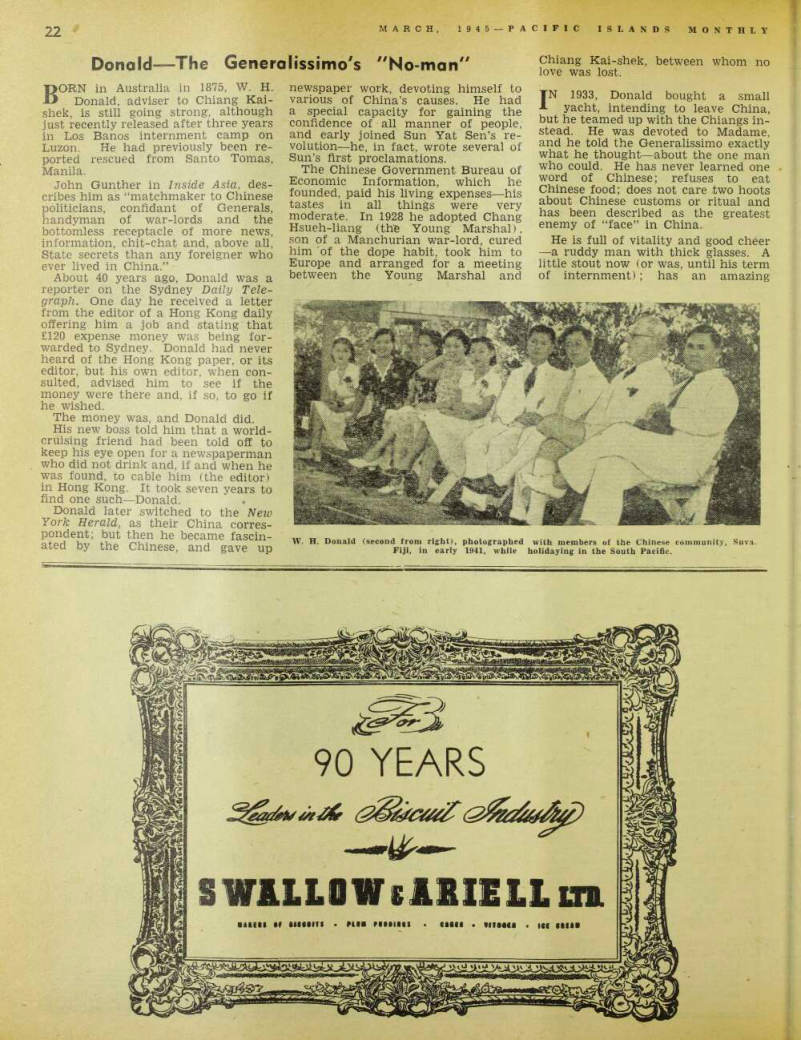
W. H. Donald (second from right), photographed with members of the Chinese community, Suva, Fiji, in early 1941, while holidaying in the South Pacific.
memory.and an even more amazing fund of stories.
Just before the outbreak of the Pacific war he had a holiday in the South Pacific Islands and New Zea land—he refused to stay in Australia because Australia was selling scrap iron to the Japs—and was in the Philippines on his way back to China when the Japs occupied the Archi pelago.
Even before the war the Japs had put a price on Donald’s head—they felt that he was responsible for getting British and American sym pathy for China. But they never succeeded in identifying him, although they suspected that he had fallen into their hands somewhere in the Philip pines. Although time after time they went to Los Banos looking for him. says Donald, the other internees held his identity in the strictest con fidence.
United nations censorship clamped down on all references to him—but only after a high-ranking Chinese official in London had let the cat out of the bag by stating publicly that Donald had been captured in the Philippines—but as far as was known was being tolerably well treated. Re latives in Sydney were warned that any efforts to try to trace him or communicate with him might cost him his life.
Little has yet been said of Donald’s future activities; but if ever the Chiang Kai-shek set-up needed a No man adviser of Donald’s calibre, that time certainly is now. On his release
Donald said that he was anxious to communicate with Madame Chiang; and that he was ready to do what ever she advised in order to help
China against Japan.
The final accounts for the successful carnival which was held at Nadi, Fiji, last December, in aid of war funds, showed net proceeds were £629.
The Fiji Information Office has recently begun publishing a news magazine for the people of the Gilbert and Ellice Islands. It has been called “Sail Ho”— because with these islanders the coming of news usually coincides with the arrival of a ship from the outside world.