Territorian Bitterness
pp. 20-21 · Read in the full issue
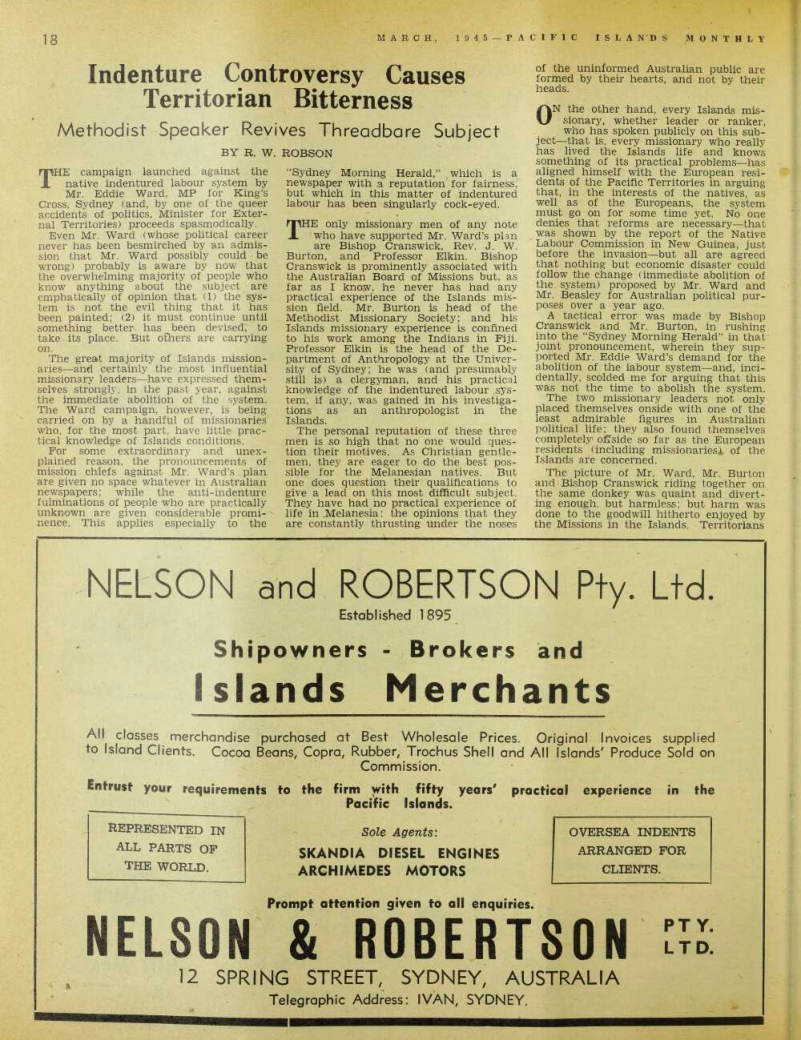
Indenture Controversy Causes Territorian Bitterness Methodist Speaker Revives Threadbare Subject
By R. W. Robson
THE campaign launched against the native indentured labour system by Mr. Eddie Ward, MP for King’s Cross, Sydney (and, by one of the queer accidents of politics, Minister for Exter nal Territories) proceeds spasmodically.
Even Mr. Ward (whose political career never has been besmirched by an admis sion that Mr. Ward possibly could be wrong) probably is aware by now that the overwhelming majority of people who know anything about the subject are emphatically of opinion that (1) the sys tem is not the evil thing that it has been painted; (2) it must continue until something better has been devised, to take its place. But others are carrying on.
The great majority of Islands mission aries—and certainly the most influential missionary leaders —have expressed them selves strongly, in the past year, against the immediate abolition of the system.
The Ward campaign, however, is being carried on by a handful of missionaries who, for the most part, have little prac tical knowledge of Islands conditions.
For some extraordinary and unex plained reason, the pronouncements of mission chiefs against Mr. Ward’s plan are given no space whatever in Australian newspapers; while the anti-in denture fulminations of people who are practically unknown are given considerable promi nence. This applies especially to the
“Sydney Morning Herald,” which is a newspaper with a reputation for fairness, but which in this matter of indentured labour has been singularly cock-eyed.
THE only missionary men of any note who have supported Mr. Ward’s plan are Bishop Cranswick, Rev. J. W.
Burton, and Professor Elkin. Bishop Cranswick is prominently associated with the Australian Board of Missions but, as far as I know, he never has had any practical experience of the Islands mis sion field. Mr. Burton is head of the Methodist Missionary Society; and his Islands missionary experience is confined to his work among the Indians in Fiji.
Professor Elkin is the head of the De partment of Anthropology at the Univer sity of Sydney; he was (and presumably still is) a clergyman, and his practical knowledge of the indentured labour sys tem, if any, was gained in his investiga tions as an anthropologist in the Islands.
The personal reputation of these three men is so high that no one would ques tion their motives. As Christian gentle men, they are eager to do the best pos sible for the Melanesian natives. But one does question their qualifications to give a lead on this most difficult subject.
They have had no practical experience of life in .Melanesia: the opinions that they are constantly thrusting under the noses
of the uninformed Australian public are formed by their hearts, and not by their heads.
ON the other hand, every Islands mis sionary, whether leader or ranker, who has spoken publicly on this sub ject—that is, every missionary who really has lived the Islands life and knows something of its practical problems—has aligned himself with the European resi dents of the Pacific Territories in arguing that, in the interests of the natives, as well as of the Europeans, the system must go on for some time yet. No one denies that reforms are necessary—that was shown by the report of the Native Labour Commission in New Guinea, just before the invasion—but all are agreed that nothing but economic disaster could follow the change (immediate abolition of the. system) proposed by Mr. Ward and Mr. Beasley for Australian political pur poses over a year ago.
A tactical error was made by Bishop Cranswick and Mr. Burton, in rushing into the “Sydney Morning Herald” in that joint pronouncement, wherein they sup ported Mr. Eddie Ward’s demand for the abolition of the labour system—and, inci dentally, scolded me for arguing that this was not the time to abolish the system.
The two missionary leaders not only placed themselves onside with one of the least admirable figures in Australian political life; they also found themselves completely offside so far as the European residents (including missionaries! of the Islands are concerned.
The picture of Mr. Ward, Mr. Burton and Bishop Cranswick riding together on the same donkey was quaint and divert ing enough, but harmless; but harm was done to the goodwill hitherto enjoyed by the Missions in the Islands. Territorians
will not readily forget the threat to their wellbeing, as represented in that incident.
The reverend gentlemen intended no harm, of course; what they did was done in blind ignorance of the practical facts of the situation. Territorian resentment probably will long continue against those missionaries whose chiefs urged a change so far-reaching and disturbing. rE trouble is that such a campaign, once started under such auspices, is carried on by well-meaning but ignorant people. The Methodist Mission ary Society, for example, recently held a “conference” in Sydney; and here is a paragraph from “Sydney Morning Her ald” report:— “The Rev. Percy Clark, addressing the annual meeting of the Women’s Auxiliary of Overseas Missions, said that the inden ture labour system was one of the main factors in the disintegration and de gradation of the Pacific natives.”
The Lord knows who Rev. Percy Clark is, and what are his qualifications to speak in such a way. I cannot find his name in any present-day list of Islands missionaries. Mr. Clark, known or un known, is entitled to express his opinions, of course; and the women he was addressing are entitled to listen to any speaker they please.
The trouble commences when a news paper like the “Herald” reports such utterances which, being divorced from any statement of facts and appearing as the opinion of one unknown man, are regarded by Islanders generally as utterly stupid and dangerous. Not one Terri torian who read that report is going to feel very well disposed towards Methodist missionaries in future.
THERE still is some fanaticism among rank-and-file missionaries. The strange folk who invaded the Islands in frock-coats and poke-bonnets a hun dred years ago, and drove the natives into trousers and Mother Hubbards, and compelled them to abandon perfectly natural social customs on the grounds that Anglo-Saxondom thought them sin ful —these people have their counter parts in certain of The missionaries who are sent into the Islands to-day—and especially in some of the mainland bodies which speak on behalf of missionaries.
Unintelligent and unadaptable, they persist in measuring their native charges according to European standards. They even try to make primitive natives accept sectarian differences and distinctions which, long ago, have been repudiated by thoughtful Europeans. They walk ever lastingly in the hope of a crusade —seeking some oppression or cruelty or dread ful sin concerning which they may unfurl a banner and scream a mediaeval chal lenge.
Their conduct suggests that they thought they had found such an object of crusade in the indentured labour sys tem. The Melanesian labourers were to be presented to the world as the chained and oppressed slaves of the heartless Europeans exploiting the Territories.
It was quite a good idea —Australian
public opinion, wholly uninstructed and ignorant, was quite prepared to believe it.
When I first protested against the cru sade, as being utterly stupid and unin formed. the ineffable Mr. Ward described me as “the mouthpiece of the capitalistic interests exploiting the Territories,” and Mr. Ward’s henchmen cheered, and the dear old missionary chiefs apparently endorsed that brilliant analysis.
However, much has happened since then. Territorians, to a man, and all the Islands missionaries who really know anything of the circumstances, have defended the system, and demanded its retention until something better can be devised to take its place.
That is the present stage of the con troversy; and that is where it should be left. If there is not to be a great deal more of misunderstanding and bitterness, the headquarters of the various mission ary bodies would be well advised to keep their Percy Clarkes off the controversial subject.
It was talked but, months ago. A solu tion which will represent a fair and decent compromise—and which will take care of the interests of both natives and of European employers—is on the way.