Navy Men
p. 10 · Read in the full issue
Decorations for Merchant Navy Men
ON January 23, at. a ceremonial parade in Fiji, two well-known members of the Central Pacific Merchant Navy, who are members of the Royal New Zea land Naval Reserve, Lieutenant G. J.
Webster and Lieutenant S. Page, were presented with the Bronze Star of the United States, for conspicuous service rendered by them in the attack and occu pation of Tarawa atoll, by the United States forces, in November, 1943.
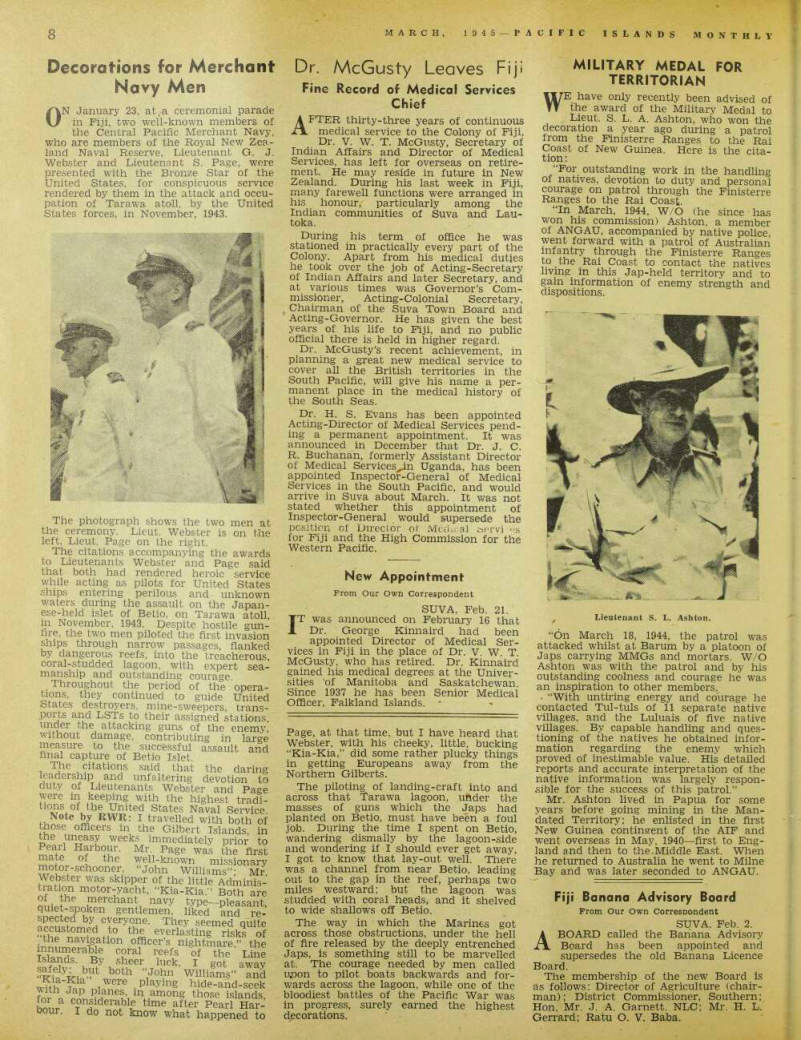
The photograph shows the two men at the ceremony. Lieut. Webster is on the left, Lieut. Page on the right.
The citations accompanying the awards to Lieutenants Webster and Page said that both had rendered heroic service while acting as pilots for United States ships entering perilous and unknown waters during the assault on the Japan ese-held islet of Betio, on Tarawa atoll, in November, 1943. Despite hostile gun fire, the two men piloted the first invasion ships through narrow passages, flanked by dangerous reefs, into the treacherous, coral-studded lagoon, with expert sea manship and outstanding courage Throughout the period of the opera tion5 ’ they continued to guide United States destroyers, mine-sweepers, trans ports and LSTs to their assigned stations, under the attacking guns of the enemy, without damage, contributing in large measure to the successful assault and final capture of Betio Islet.
The citations said that the daring leadership and unfaltering devotion to duty of Lieutenants Webster and Page were in keeping with the highest tradi tloT?S * 0f u th l» U^ ited States Naval Service.
N° te by RWR: I travelled with both of those officers in the Gilbert Islands, in the uneasy weeks immediately prior to Pearl Harbour. Mr Page was the first mate of the well-known missionary motor-schooner, “John Williams”; Mr Webster was skipper of the little Adminis tration motor-yacht, “Kia-Kia.” Both are nrHofw £ ierchan s: l nav y type—pleasant, quiet-spoken gentlemen, liked and re spected by everyone. They seemed quite accustomed to the everlasting risks of the navigation officer’s nightmare ” the T«S era^J e c 2 ral reefs of the' Line Islands. By sheer luck, I got away both ‘i John Williams” and i were playing hide-and-seek f^r h Q lr \ among those islands, hnuv c ? n J lderabl e time after Pearl Har bour, I do not know what happened to
Page, at that time, but I have heard that Webster, with his cheeky, little, bucking “Kia-Kia,” did some rather plucky things in getting Europeans away from the Northern Gilberts.
The piloting of landing-craft into and across that Tarawa lagoon, under the masses of guns which the Japs had planted on Betio, must have been a foul job. During the time I spent on Betio, wandering dismally by the lagoon-side and wondering if I should ever get away, I got to know that lay-out well. There was a channel from near Betio, leading out to the gap in the reef, perhaps two miles westward; but the lagoon was studded with coral heads, and it shelved to wide shallows off Betio.
The way in which the Marines got across those obstructions, under the hell of fire released by the deeply entrenched Japs, is something still to be marvelled at. The courage needed by men called upon to pilot boats backwards and for wards across the lagoon, while one of the bloodiest battles of the Pacific War was in progress, surely earned the highest decorations.