Tribute to Hitchcock, of
p. 48 · Read in the full issue
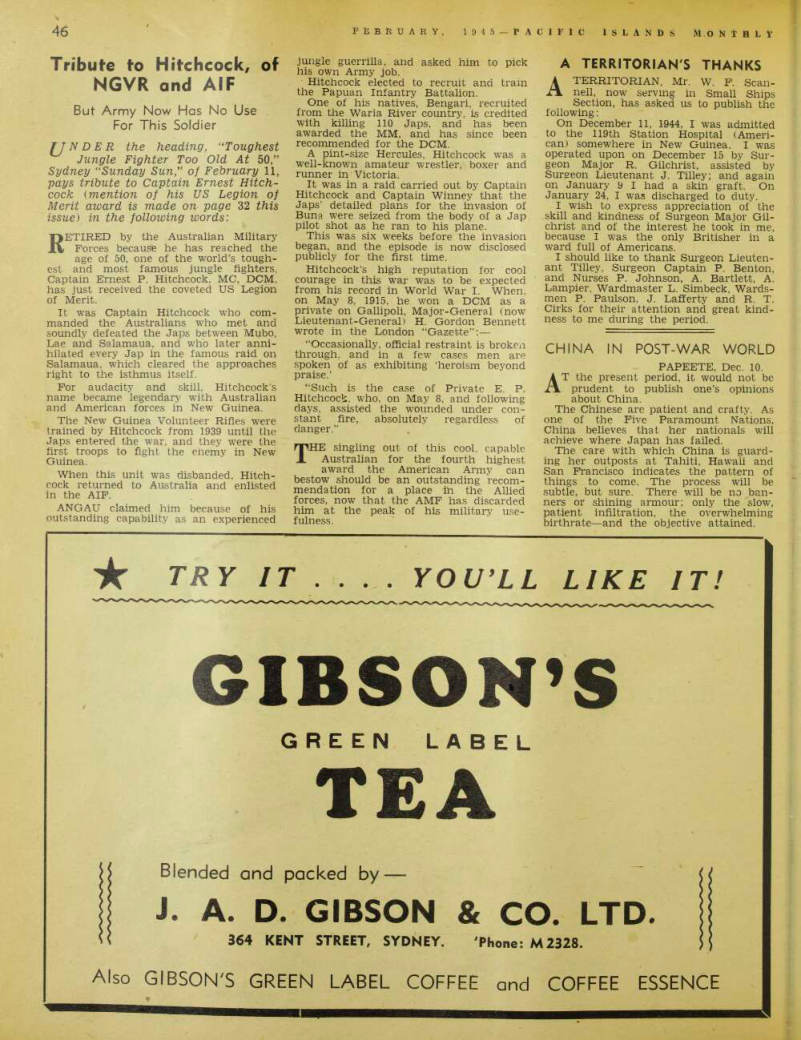
Ngvr And Aif
But Army Now Has No Use For This Soldier
TJ N D E R the heading, "Toughest Jungle Fighter Too Old At 50,”
Sydney “Sunday Sun” of February 11,
pays tribute to Captain Ernest Hitch cock (mention of his US Legion of Merit award is made on page 32 this issue) in the following words : RETIRED by the Australian Military Forces because he has reached the age of 50, one of the world’s tough est and most famous jungle fighters, Captain Ernest P. Hitchcock, MC, DCM. has just received the coveted US Legion of Merit.
It was Captain Hitchcock who com manded the Australians who met and soundly defeated the Japs between Mubo, Lae and Salamaua, and who later anni hilated every Jap in the famous raid on Salamaua. which cleared the approaches right to the isthmus itself.
For audacity and skill, Hitchcock's name becajne legendary with Australian and American forces in New Guinea.
The New Guinea Volunteer Rifles were trained by Hitchcock from 1939 until the Japs entered the war, and they were the first troops to fight the enemy in New Guinea.
When this unit was disbanded, Hitch cock returned to Australia and enlisted in the AIF.
ANGAU claimed him because of his outstanding capability as an experienced
jungle guerrilla, and asked him to pick his own Army job.
Hitchcock elected to recruit and train the Papuan Infantry Battalion.
One of his natives, Bengari, recruited from the Waria River country, is credited with killing 110 Japs, and has been awarded the MM, and has since been recommended for the DCM.
A pint-size Hercules, Hitchcock was a well-known amateur wrestler, boxer and runner in Victoria.
It was in a raid carried out by Captain Hitchcock and Captain Winney that the Japs' detailed plans for the invasion of Buna were seized from the body of a Jap pilot shot as he ran to his plane.
This was six weeks before the invasion began, and the episode is now disclosed publicly for the first time.
Hitchcock's high reputation for cool courage in this war was to be expected from his record in World War I. When, on May 8, 1915, he won a DCM as a private on Gallipoli, Major-General (now Lieutenant-General) H. Gordon Bennett wrote in the London “Gazette”: — “Occasionally, official restraint is broken through, and in a few cases men are spoken of as exhibiting ‘heroism beyond praise.’
“Such is the case of Private E. P.
Hitchcock, who, on May 8, and following days, assisted the wounded under con stant fire, absolutely regardless of danger.”
THE singling out of this cool, capable Australian for the fourth highest award the American Army can bestow should be an outstanding recom mendation for a place in the Allied forces, now that the AMF has discarded him at the peak of his military use fulness.