Prospects of Reopening
p. 14 · Read in the full issue
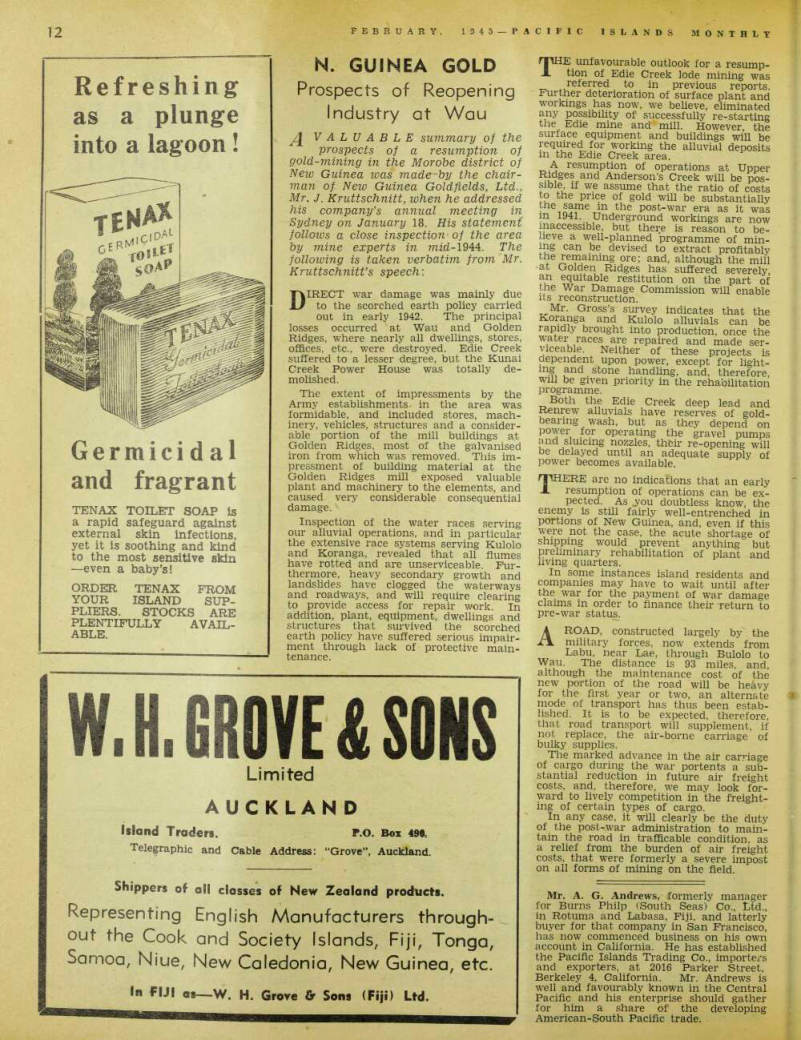
N. Guinea Gold
Prospects of Reopening Industry at Wau
VALUABLE summary of the prospects of a resumption of gold-mining in the Morobe district of New Guinea was made by the chair man of New Guinea Goldfields, Ltd., Mr. J. Kruttschnitt, when he addressed his company’s annual meeting in Sydney on January 18. His statement follows a close inspection of the area by mine experts in mid-1944. The following is taken verbatim from Mr.
Kruttschnitt’s speech :
DIRECT war damage was mainly due to the scorched earth policy carried out in early 1942. The principal losses occurred at Wau and Golden Ridges, where nearly all dwellings, stores, offices, etc., were destroyed. Edie Creek suffered to a lesser degree, but the Kunai Creek Power House was totally de molished.
The extent of impressments by the Army establishments in the area was formidable, and included stores, mach inery, vehicles, structures and a consider able portion of the mill buildings at Golden Ridges, most of the galvanised iron from which was removed. This im pressment of building material at the Golden Ridges mill exposed valuable plant and machinery to the elements, and caused very considerable consequential damage.
Inspection of the water races serving our alluvial operations, and in particular the extensive race systems serving Kulolo and Koranga, revealed that all flumes have rotted and are unserviceable. Fur thermore, heavy secondary growth and landslides have clogged the waterways and roadways, and will require clearing to provide access for repair work. In addition, plant, equipment, dwellings and structures that survived the scorched earth policy have suffered serious impair ment through lack of protective main tenance.
rpHE unfavourable outlook for a resump ± tion of Edie Creek lode mining was referred to in previous reports.
Further deterioration of surface plant and workings has now, we believe, eliminated any possibility of successfully re-starting the Edie mine and mill. However, the surface equipment and buildings will be required for working the alluvial deposits in the Edie Creek area.
A resumption of operations at Upper Ridges and Anderson’s Creek will be pos sible, if we assume that the ratio of costs to the price of gold will be substantially the same in the post-war era as it was in 1941. Underground workings are now inaccessible, but there is reason to be lieve a well-planned programme of min ing can be devised to extract profitably the remaining ore; and, although the mill at Golden Ridges has suffered severely, an equitable restitution on the part of the War Damage Commission will enable its reconstruction, Mr. Gross’s survey indicates that the Koranga and Kulolo alluvials can be rapidly brought into production, once the water races are repaired and made ser viceable. Neither of these projects is dependent upon power, except for light ln.f stone handling, and, therefore, will be given priority in the rehabilitation programme.
Both the Edie Creek deep lead and Renrew alluvials have reserves of gold bearing wash, but as they depend on power for operating the gravel pumps and sluicing nozzles, their re-opening will be delayed until an adequate supply of power becomes available. rERE are no indications that an early resumption of operations can be ex pected. As you doubtless know, the enemy is still fairly well-entrenched in portions of New Guinea, and, even if this were not the case, the acute shortage of shipping would prevent anything but preliminary rehabilitation of plant and living quarters.
In some instances island residents and companies may have to wait until after the war for the payment of war damage claims in order to finance their return to pre-war status.
A ROAD, constructed largely by the military forces, now extends from Labu, near Lae, through Bulolo to Wau. The distance is 93 miles, and, although the maintenance cost of the new portion of the road will be heavy for the first year or two, an alternate mode of transport has thus been estab lished. It is to be expected, therefore, that road transport will supplement, if not replace, the air-borne carriage of bulky supplies.
The marked advance in the air carnage of cargo during the war portents a sub stantial reduction in future air freight costs, and, therefore, we may look for ward to lively competition in the freight ing of certain types of cargo.
In any case, it will clearly be the duty of the post-war administration to main tain the road in trafficable condition, as a relief from the burden of air freight costs, that were formerly a severe impost on all forms of mining on the field.
Mr. A. G. Andrews, formerly manager for Burns Philp (South Seas) Co., Ltd., in Rotuma and Labasa, Fiji, and latterly buyer for that company in San Francisco, has now commenced business on his own account in California. He has established the Pacific Islands Trading Co., importers and exporters, at 2016 Parker Street, Berkeley 4, California. Mr. Andrews is well and favourably known in the Central Pacific and his enterprise should gather for him a share of the developing American-South Pacific trade.