Those Who Went “South!”
pp. 12-13 · Read in the full issue
in Shi ps
By Judy Tudor
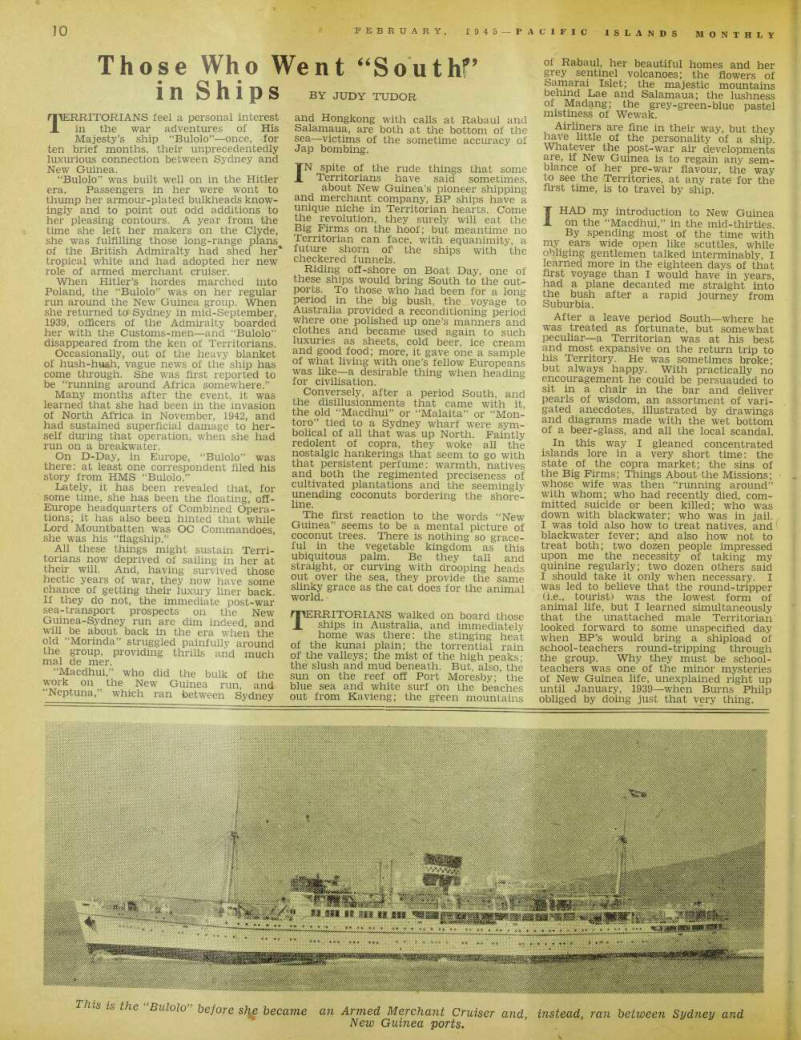
mERRITORIANS feel a personal interest J. in the war adventures of His Majesty’s ship “Bulolo” —once, for ten brief months, their unprecedentedly luxurious connection between Sydney and New Guinea.
“Bulolo” was built well on in the Hitler era. Passengers in her were wont to thump her armour-plated bulkheads know ingly and to point out odd additions to her pleasing contours. A year from the time she left her makers on the Clyde, she was fulfilling those long-range plans of the British Admiralty had shed her* tropical white and had adopted her new role of armed merchant cruiser.
When Hitler’s hordes marched into Poland, the “Bulolo” was on her regular run around the New Guinea group. When she returned to Sydney in mid-September, 1939, officers of the Admiralty boarded her with the Customs-men—and “Bulolo” disappeared from the ken of Territorians.
Occasionally, out of the heavy blanket of hush-hush, vague news of the ship has come through. She was first reported to be “running around Africa somewhere.”
Many months after the event, it was learned that she had been in the invasion of North Africa in November, 1942, and had sustained superficial damage to her self during that operation, when she had run on a breakwater.
On D-Day, in Europe, “Bulolo” was there: at least one correspondent filed his story from HMS “Bulolo.”
Lately, it has been revealed that, for some time, she has been the floating, off- Europe headquarters of Combined Opera tions; it has also been hinted that while Lord Mountbatten was OC Commandoes, she was his “flagship.”
All these things might sustain Terri torians now deprived of sailing in her at then will. And, having survived those hectic years of war, they now have some chance of getting their luxury liner back.
If they do not, the immediate post-war sea-transport prospects on the New Guinea-Sydney run are dim indeed, and will be about back in the era when the old “Morinda” struggled painfully around the group, providing thrills and much mal de mer.
“Macdhui,” who did the bulk of the work on the New Guinea run, and “Neptuna,” which ran between Sydney
ol Rabaul, her beautiful homes and her grey sentinel volcanoes; the flowers of Samarai Islet; the majestic mountains behind Lae and Salamaua; the lushness of Madang; the grey-green-blue pastel mistiness of Wewak.
Airliners are fine in their way, but they have little of the personality of a ship.
Whatever the post-war air developments are, if New Guinea is to regain any sem blance of her pre-war flavour, the way to see the Territories, at any rate for the first time, is to travel by ship.
I HAD my introduction to New Guinea on the “Macdhui,” in the mid-thirties.
By spending most of the time with my ears wide open like scuttles, while obliging gentlemen talked interminably, I learned more in the eighteen days of that first voyage than I would have in years, had a plane decanted me straight into the bush after a rapid journey from Suburbia.
After a leave period South—where he was treated as fortunate, but somewhat peculiar—a Territorian was at his best and most expansive on the return trip to his Territory. He was sometimes broke; but always happy. With practically no encouragement he could be persuauded to sit in a chair in the bar and deliver pearls of wisdom, an assortment of vari gated anecdotes, illustrated by drawings and diagrams made with the wet bottom of a beer-glass, and all the local scandal.
In this way I gleaned concentrated islands lore in a very short time; the state of the copra market; the sins of the Big Firms; Things About the Missions; whose wife was then “running around” with whom; who had recently died, com mitted suicide or been killed; who was down with blackwater; who was in jail.
I was told also how to treat natives, and blackwater fever; a*nd also how not to treat both; two dozen people impressed upon me the necessity of taking my quinine regularly; two dozen others said I should take it only when necessary. I was led to believe that the round-tripper (i.e., tourist) was the lowest form of animal life, but I learned simultaneously that the unattached male Territorian looked forward to some unspecified day when BP’s would bring a shipload of school-teachers round-tripping through the group. Why they must be school teachers was one of the minor mysteries of New Guinea life, unexplained right up until January, 1939 —when Burns Philp obliged by doing just that very thing.
and Hongkong with calls at Rabaul and Salamaua, are both at the bottom of the sea—victims of the sometime accuracy of
Jap bombing.
IN spite of the rude things that some Territorians have said sometimes, about New Guinea’s pioneer shipping and merchant company, BP ships have a unique niche in Territorian hearts. Come the revolution, they surely will eat the Big Firms on the hoof; but meantime no Territorian can face, with equanimity, a future shorn of the ships with the checkered funnels.
Riding off-shore on Boat Day, one of these ships would bring South to the out ports. To those who had been for a long period in the big bush, the voyage to Australia provided a reconditioning period where one polished up one’s manners and clothes and became used again to such luxuries as sheets, cold beer, ice cream and good food; more, it gave one a sample of what living with one’s fellow Europeans was like—a desirable thing when heading for civilisation.
Conversely, after a period South, and the disillusionments that came with it, the old “Macdhui” or “Malaita” or “Mon toro” tied to a Sydney wharf were sym bolical of all that was up North. Faintly redolent of copra, they woke all the nostalgic hankerings that seem to go with that persistent perfume: warmth, natives and both the regimented preciseness of cultivated plantations and the seemingly unending coconuts bordering the shore line.
The first reaction to the words “New Guinea” seems to be a mental picture of coconut trees. There is nothing so grace ful in the vegetable kingdom as this übiquitous palm. Be they tall and straight, or curving with drooping heads out over the sea, they provide the same slinky grace as the cat does for the animal world. mERRITORIANS walked on board those X ships in Australia, and immediately home was there: the stinging heat of the kunai plain; the torrential rain of the valleys; the mist of the high peaks; the slush and mud beneath. But, also, the sun on the reef off Port Moresby; the blue sea and white surf on the beaches out from Kavieng; the green mountains
is the Bulolo before stye became an Armed Merchant Cruiser and, instead, ran between Sydney and New Guinea ports.
Apart from a ready-cut education in New Guinea ways provided by the pas sengers, I could see for myself what role that ship played in the lives of many isolated residents—grocer, butcher, post man, the one social impetus that kept the outport revolving'hmtil the ship called again.
EACH one of those ships was an integral part of Island life. The “Malaita” was a “good little ship.” Some sort of inverted pride was taken in the fact that the “Montoro” was “lapun finish”; it was mysteriously said that she was “written down to £5 in the company’s books.” Everyone knew that the “bottom was full of concrete” from her various mishaps on reefs and in rivers, but that was thought to contribute to her sea worthiness. The “Macdhui,” in spite of her vibrations and spiral cavorting on anything greater than a ripple (and although she was not old) was affection ately known as “the. Old Mac.” Tears of blood were shed over her last moments in Port Moresby in mid-1942, when news reels of her sinking were shown to Terri torian audiences.
These ships brought all things to the Territories—from brides to bicycles and food, fashions and furnaces.
The “Bulolo” made her maiden voyage in November, 1938. Between then and the coming of World War 11, there was little time for her to grow into an Islands niche of her own. After years of complaint that BP’s cared nothing for the comfort of passengers, and that they were in terested in cargo to the exclusion of all else, strangely enough, the “Bulolo’s” modern luxury was accepted with some sort of suspicion.
“It’s not like an Island ship at all,” more than one hard-bitten Territorian complained from the enfolding softness of a chair in the streamlined bar, or while watching perambulating females disport themselves in the glass-sided swimming bath. “The whole place is cluttered up with round-trippers.”
After five years of war probably the pristine beauty of this interior decorator’s masterpfece is a bit rubbed and dull in places—and so are Territorians after three years of evacuation or Army. When the evacuation of Australia by Territorians occurs there will be no quibbling; a barge or a battleship will look equally good to them.
PROBABLY, too, as New Guineaites suspected, Burns Philp were not un mindful of the quickening pulse of Pacific tourism when they planned the “Bulolo.” But, whatever interest there was in the Pacific in pre-war days, it was insignificant in comparison with that which has been engendered since war broke our ocean wide open.
Thousands of American and Australian servicemen are buried there; and it will be strange indeed if the war graves of New Guinea do not receive as much
attention as the war graves of France received after World War I.
Whatever Territorians feel about round trippers and tourists, they had better pre pare themselves for periodic inundations of camera-carrying, perspiring gentlemen in new white suits, and ladies with sun shades, and flappers in cruise clothes.
Nothing short of constant bubonic plague in New Guinea is going to stop them.