Long Wait Before Normal Conditions
pp. 5-6 · Read in the full issue
Return
THE unexpected shape taken by this World War II has created an unforeseen problem for the people of the Territories of the Pacific—the problem of mopping-up. The war may be over officially long before the isolated fighting ceases.
We knew, when the Axis failed to smash us in 1941-42, that we should win the war. But we naturally assumed that the beaten invader, like beaten enemies all through history, would withdraw entirely from the regions in which he was beaten, and thus allow our civilians immediately to re-occupy the home-lands they had lost. For example, we planned confidently for the early return home of the people of Papua, New Guinea Mandated Territory, the British Solomons, etc.
But it has not worked out that way —neither in Europe nor in the Pacific, It is six months since the Germans ran from Eisenhower’s armies, and evacuated France and Belgium; yet it is a fact—not generally known— that very large German garrisons still hold certain Channel ports, on the north-west coast of France. There are 12,000 Germans still cooped up in Dunkirk. There are thousands of Germans still occupying the Channel Islands (British Territory). The enemy apparentlv still holds Crete, There are numerous German pockets in the Mediterranean islands; and in the Balkans, far behind the fighting front in Western Hungary, there is a
whole German army, fighting defen sively in the mountains,
Tmtt^Xt^Tt *
\ LTHOUGH no pronouncement evei 21. has been made, it appears clearly to be the strategy of the Big Three to break up the enemy, and destroy his ability to resist as a controlled fighting organisation, rather than to dissipate their strength in driving him back, step by step, along one clearly defined front.
It is sound strategy. Why waste men, and effort, and time, in besieg ing and attacking and overcoming fiercely resistant pockets of the enemy, and enemy fortresses, when our purpose can be achieved by by passing and isolating those pockets, holding them in the one place, and preventing them from taking any further part in the defence of their country?
For all practical purposes, they be come our prisoners as soon as we isolate them. Our guards are all around them. True, we are obliged to use a lot of guards, and our prisoners shoot at us whenever they can; but, as against that, we are not obliged to feed or house them, and we can reduce their numbers effec tively whenever the opportunity oc curs. And they are not part of the enemy’s defence organisation.
These enemy pockets are not en tirely shut off from communication with their headquarters. In Europe, a plane or a submarine gets through
occasionally; but, generally, their munitions are running out, and they slowly are being reduced to most desperate straits for food. When re sistance ceases in their home-lands they, of course, will collapse.
THE European situation is dupli cated, almost exactly, in the Pacific. General MacArthur and Admiral Nimitz, in their combined push from south-east to north-west, across the Western Pacific, have iso lated and, for all Japanese resistance purposes, paralysed, many Territories and islands. A quick survey over the Pacific shows a truly remarkable situation.
Between August, 1942, when the Americans and Australians struck at the Japs in the Solomons-Papua area, and February, 1945, when the Ameri cans recaptured Manila, the Pacific battle front was driven back about 2,500 miles, towards Tokio. If we re gard Indonesia (Philippines, Borneo and the Netherlands Indies) as sepa rating the Pacific Indian and Oceans, we can truthfully say that the whole of the Western and South-western Pacific, except the water immediately around Japan and China, have been recovered from the Japanese invasion.
All the Pacific, right up the line of Indonesia, is now dominated by the Allies, where for two years it was almost entirely at the mercy of the Japanese.
But this does not mean that the re gions referred to have been cleared of the Japanese. At a rough calculation, there are Japanese armies and garri sons, to the extent shown, in the following places, which Americans
and Australians have by-passed and isolated: Bougainville and Buka . 12,000 Rabaui end of New Britain and New Ire land 50,000 Aitape section of New Guinea mainland . . . 50,000 Dutch New Guinea . . . 20,000 Marshall Islands 5,000 Caroline Islands, includ ing Palau 20,000 All the Japs in that list, although isolated and militarily useless, retain some military formation, and fight as organised units. In addition, there are large numbers of Japs in isolated parts of those islands and territories,
who are skulking in the remoter jungles and mountains, living as in dividuals, who must be hunted down and cleared out before those regions can regain peace and security, VI/'E may add to that list the Philip y pines archipelago, with Jap forces estimated at 250,000 men.
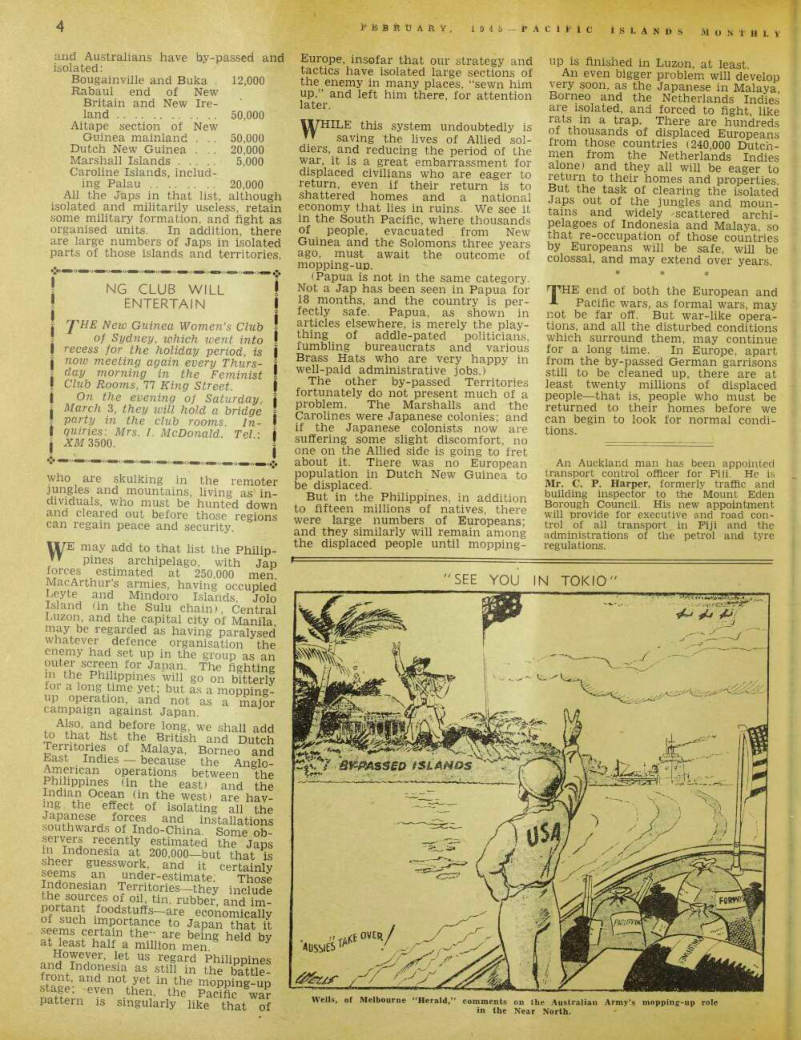
MacArthur’s armies, having occupied Leyte and Mindoro Islands, Jolo Island (in the Sulu chain), Central Luzon, and the capital city of Manila may be regarded as having paralysed whatever defence organisation the enemy had set up in the group as an outer screen for Janan. The fighting m the Philippines will go on bitterly for a long time yet; but as a mopping up operation, and not as a major campaign against Japan.
Also and before long, we shall add to that hst the British and Dutch Territories of Malaya, Borneo and Last Indies because the Anglo- Amencan operations between the Philippines (in the east) and the Indian Ocean (in the west) are hav ing the effect of isolating all the Japanese forces and installations southwards of Indo-China. Some ob servers recently estimated the Japs in Indonesia at 200,000—but that is sheer guesswork, and it certainly seems an under-estimate: Those Indonesian Territories—they include the sources of oil, tin, rubber, and im portant foodstuffs—are economically of such importance to Japan that it seems certain the- are being held by &t least half a million men nnrtT 6 * 81, let us regard Philippines and Indonesia as still in the battle front, and not yet in the mopping-up stage; even then, the Pacific wa? pattern is singularly like that of
Europe, insofar that our strategy and tactics have isolated large sections of the enemy in many places, “sewn him up,” and left him there, for attention later.
VI/niLE this system undoubtedly is V saving the lives of Allied sol diers, and reducing the period of the war, it is a great embarrassment for displaced civilians who are eager to return, even if their return is to shattered homes and a national economy that lies in ruins. We see it in the South Pacific, where thousands of people, evacuated from New Guinea and the Solomons three years ago, must await the outcome of mopping-up. (Papua is not in the same category.
Not a Jap has been seen in Papua for 18 months, and the country is per fectly safe. Papua, as shown in articles elsewhere, is merely the play thing of addle-pated politicians, fumbling bureaucrats and various Brass Hats who are very happy in well-paid administrative jobs.) The other by-passed Territories fortunately do not present much of a problem. The Marshalls and the Carolines were Japanese colonies; and if the Japanese colonists now are suffering some slight discomfort, no one on the Allied side is going to fret about it. There was no European population in Dutch New Guinea to be displaced.
But in the Philippines, in addition to fifteen millions of natives, there were large numbers of Europeans; and they similarly will remain among the displaced people until mopping
up is finished in Luzon, at least.
An even bigger problem will develop very soon, as the Japanese in Malaya Borneo and the Netherlands Indies are isolated, and forced to fight like f ats m a trap. There are hundreds of thousands of displaced Europeans from those countries (240,000 Dutch men from the Netherlands Indies alone) and they all will be eager to return to their homes and properties.
But the task of clearing the isolated Japs out of the jungles and moun tains and widely scattered archi pelagoes of Indonesia and Malaya, so that re-occupation of those countries by Europeans will be safe, will be colossal, and may extend over years. * * * THE end of both the European and Pacific wars, as formal wars, may not be far off. But war-like opera tions, and all the disturbed conditions which surround them, may continue for a long time. In Europe, apart from the by-passed German garrisons still to be cleaned up, there are at least twenty millions of displaced people—that is, people who must be returned to their homes before we can begin to look for normal condi tions.
An Auckland man has been appointed transport control officer for Fiji. He is Mr. C. P. Harper, formerly traffic and building inspector to the Mount Eden Borough Council. His new appointment will provide for executive and road con trol of all transport in Fiji and the administrations of the petrol and tyre regulations.