Prospects of Natural
pp. 48-49 · Read in the full issue
Rubber
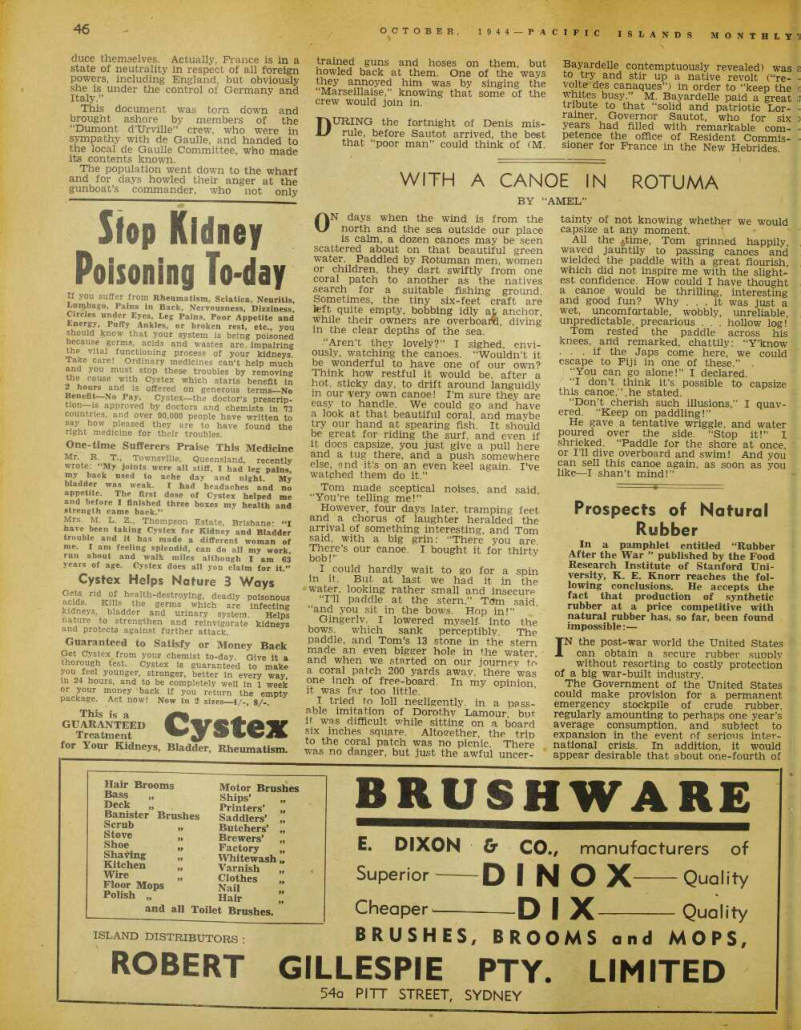
In a pamphlet entitled “Rubber After the War ” published by the Food Research Institute of Stanford Uni versity, K. E. Knorr reaches the fol lowing conclusions. He accepts the fact that production of synthetic rubber at a price competitive with natural rubber has, so far, been found impossible:— Fthe post-war world the United States can obtain a secure rubber supply without resorting to costly protection of a big war-built industry.
The Government of the United States could make provision for a permanent emergency stockpile of crude rubber, regularly amounting to perhaps one year’s average consumption, and subject to expansion in the event of serious inter national crisis. In addition, it would appear desirable that about one-fourth of
the synthetic-rubber manufacturing capa city now building be maintained in opera tion or ready for immediate operation.
An industry of such substantial size could be expanded easily in times of war emergency.
Perhaps the ingenuity of American chemists and engineers will. achieve the seemingly impossible and make any form and amount of subsidisation unnecessary.
If the effective price differential between natural and artificial rubber should be too greatly in favour of the former, it might be desirable to subsidise such a portion of the industry that would bring its totar output to the proportion indi cated. Such subsidisation should be dis criminate and direct, and not in the form of tariff or quota protection.
The foregoing discussion relates to prospective developments during a rela tively short period, perhaps a decade ahead. In the longer run, the consump tion of rubber might rise to prodigious heights, provided it is really cheap and its price does not fluctuate excessively.
For this reason, no post-war arrangement should be adopted that will drive rubber prices up or prevent their decline as a result of increasing efficiency of produc tion. Any form of indirect protection, by tariff or quotas, is in this sense restric tionist in effect.
For the same reason, the United States should refrain from becoming party to an international rubber regulation scheme that would operate in the interest of high cost producers of any type of rubber.
Rather, the United States would do well to use its great bargaining power to pre vent the establishment of any such international arrangement. There is scope for international rubber agree ments of less objectionable type.
For the same reason, finally, the United States should exercise increasing caution in promoting rubber-development schemes in Latin, America. Only such projects deserve help that promise cheap rubber without continued subsidisation in one form or other.
Decisions alone the lines indicated would be wise and beneficial to producers and consumers of rubber goods and, in the long run, to the producer of synthetic rubbers as well.