Natives
pp. 5-6 · Read in the full issue
This Talk Of "Exploitation" Of
N ON-RESIDENT students of Pacific affairs, such as directors of mission organisations, and anthro pologists, and other types of un practical academicians, continue to sing tunelessly, in solos and choruses, on the subject of indentured native labour in New Guinea. Elsewhere, we have referred to the Brisbane utterances of Professor Elkin, who is held in high regard as Sydney University’s anthropologist, but whose opinions on practical aspects of life in the Territories are treated with no re spect—to say the least of it—by Territorians.
From a friend in Melbourne, we have received a cutting from a Gee long newspaper, wherein are reported the aggressive utterances of a Rev. B.
R. Wyllie, when addressing the Gee long Rotary Club on the subject of native labour in New Guinea. Mr.
Wyllie, it appears, is Master of Wesley College, in the University of Sydney; and heaven alone knows what authority he has for discussing so complex a subject as native labour in the Territories. He is emphatic that “the fight is on”; that we are not to continue the policy of “allow ing other people to exploit the native and his lands”; and that “the alter native to the indenture system was the eventual withdrawal of the white planter from New Guinea and the substitution of brown plantations.”
There is much more of it; but it is the same kind of claptrap of which we have heard so much during the*
past six months. Mr. Wyllie and his opinions are quoted merely to show how uninformed shouting is liable to embarrass the people who eventually must carry on the government and economic affairs of the Territories.
THESE critics and lecturers assume knowledge and prescience which they do not possess. Not one man who really has lived in the Territories and understands their conditions of life supports Mr. Eddie Ward and his clamorous retinue of Bishops and Professors.
Territorians accept the indentured labour system for what it really is— a very necessary but temporary arrangement ta bridge the gap be tween the primitive savagery of the ignorant Melanesians, and the estab lishment, on their own lands, of a new generation of Melanesians, who may become peasant producers, and capable of holding their own against penetration by the highly “civilised,” land-grabbing people of other races.
If the professors were not so carried away by their Leftist hatred of private enterprise and profits, they would accept the logic of these facts: The Melanesian Territories must be held by Australia, for Australia’s own protection; they must be put into a condition of defence—they cannot be left undeveloped and occupied only by primitives, a temptation to every prowling, land-hungry nation; they must be developed by Europeans, with European capital, for the even
tual benefit of the native people; Europeans will not enter these Terri tories unless they go there for profit, and with some security; the Terri tories cannot be developed without a labour supply—either native, or im ported Asiatic; a properly controlled system of contract native labour will provide the labour needed, and at the same time train the natives (of whom there are over one million) so that they may themselves become peasant producers on their own land. When hundreds of thousands of natives have been trained to the point that they become peasant land-tillers, then Australia’s problem of defending this arc of Pacific islands will be partly solved, and the need for contract native labour will disappear. rn HE professors, of course, being A notoriously impractical, will argue that Government officials are Quite capable of doing the job in New Guinea—of changing the present million primitives into peasant pri mary producers, with a much higher standard of communal life. Of course they are—but at what a cost to the Australian taxpayer!
In the final analysis, the issue is one between Governmental training of the natives at Australia’s cost, with civilians excluded from the Terri tories; or carrying out the training of the natives under rigidly-controlled private enterprise, as in the past— the taxation of private enterprise pro viding sufficient funds to pay the costs of government and development.
Apart altogether from the rights or wrongs of the two systems, the Aus tralian taxpayer never would stand
for the first alternative: and he is quite right—there is no need for it.
But, to show the true character of the first alternative, we need go no further than Papua under present wartime conditions. Let those who are shouting about indentured labour and exploiters read the article on an other page, describing the operations of ANGAU in the Territories.
Although the present Administra tion has absolute power, and unlimited personnel and funds, and is supposed to be under the influence of a Minister with a passionate love for “Fuzzy-wuzzies,” the natives are be ing subjected to industrial conscrip tion in a manner never known under civilian administration while the economic organisation of the Terri tories is distinguished mostly for muddle and waste.
This is not surprising, of course.
This is what always happens when the industrial discipline imposed by private enterprise and the profit motive is displaced by an organisa tion of officials, who merely look to a Government for pay and privileges.
Dependence on profits, made under competition, enforces efficiency; re move that motive, and we always get higher costs and less efficiency. The proof of that may be seen in a thou sand places in Australia to-day, under wartime conditions and the pink Curtin Government.
TLTISSIONARIES, professors and so forth admired the work and wisdom of the later Sir Hubert Murray. In his lifetime, he was criti cised often because he usually fought against private enterprise and on be half of the natives and the mission aries. In 1931, Sir Hubert wrote a paper entitled “The Scientific Method as Applied to Native Labour Problems in Papua”; and it was reprinted in 1939, just before he died. These ex tracts from the pamphlet seem to answer all the charges made against the contract labour system; ' “"VTATIVE labour may be employed 11 either under indenture, or as free labour. With free labour, master and man are not subject to any statutory requirements or conditions; under a sys tem of indenture, almost all the rela tions between them are or may be limited and conditioned by regulation— the duration of service, the wages to be paid, the rations to be supplied, the hours of labour, the care of the sick, the return of the labourer to his home, and a hun dred and one other matters that may possibly arise. And a breach of the regulations is punished, in the case of the employer usually by fine, and in the case of the labourer, usually by imprison ment ...
"The indenture'system, with its pur suit of deserters and its imprisonment of those who break their contract, is really rather like slavery, and cannot, I think be accepted as a final settlement of the labour probiem. But it is a necessary institution, at the present stage of Papuan development, and its retention • for the present, can be fully justified’ noo only from the point of view of the employer, but also from that of the native , . .
“The strong and, at the same time, the weak point in the system is the fact that the remedy for breach of the regulations
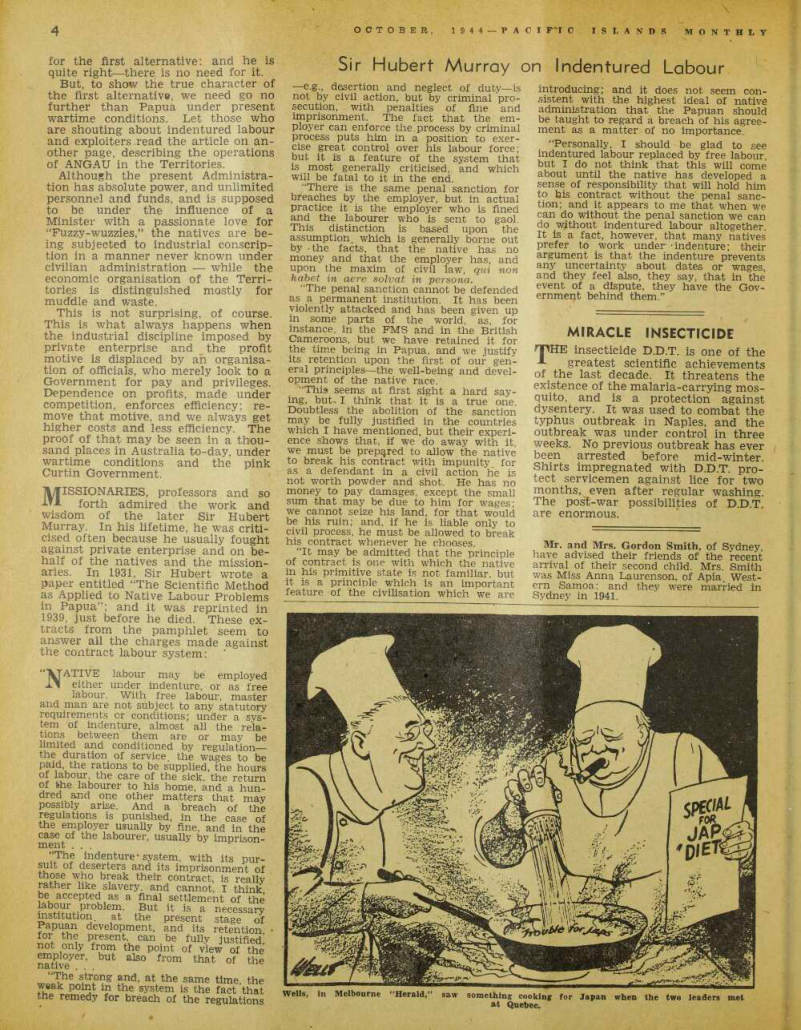
Wells, in Melbourne “Herald,” saw something cooking for Japan when the two leaders met at Quebec.