s ?ores-three lafee Government
pp. 39-40 · Read in the full issue
The Cook Islands—And The American
Occupation
By H. E. L. Priday
A ITUTAKI, in the Southern Cook Group, and Penrhyn, in the Northern Cooks, were occupied and developed by American garrisons in November, 1942, in order to provide staging points for land based aircraft on an alternate route from the United’ States to South-west Pacific and Australia, at a time when the primary line of communication was threatened by the Japs. It is reported that four and a half million dollars were spent on an air-base at Aitutaki. Rarotonga, the largest island and the administrative headquarters of the group, was by-passed. It was not at any time an American base.
Aitutaki is surrounded by a barrier reef so complete that only at one or two points can native boats and dories pass over at high tide. The total extent of the land is about seven square miles.
The main, island is generally triangular in shape but ends in a pronounced fishhook extension. It is in this low and partially swampy end that the trwo runways of the airport were constructed by New Zealand labour—one on the long finger of land curving along the reef on the eastern side of the island, the other across the island itself. Respectively, 6,000 and 5,000 feet long and 300 feet wide, they are surfaced with coral-sand-clay mixture brought up by drag-line from
is explained
by the necessity for filling in the salt water swamps and clearing the dense vegetation, including various types of palms, for the runways—work that re-
quired plenty of labour, energy and material.
The natives, who live principally along the western side of the island, had never dreamed of motor traffic, so the few exist ing trails had to be enlarged into pass able roads for small cars. The southern section of the island is nearly impene trable jungle, swampy in places, whose only elevation is a 60-foot hill, to the top of which a road was cut. Fortunately, it was found possible to pass round the southern end in a quarter-ton car by following the beach.
T>RIOR to the arrival of the Americans, JT the only landing on the island was the pier at Arutunga. Actually, only very small steamers were willing to anchor at the point shown on maps as Arutunga Anchorage, others preferring to sail up and down while unloading into barges. Many ship captains were cautious about approaching the reefs, so that long barge trips resulted, The main channel to the pier was widened and deepened, and yawls and barges were able to tie up.
Arnnnrt thp nipr thp isinnH’c
s ?ores-three lafee Government
warehouses two flfr sized Government office and a
whic” 1 taken' at
headquarters lor the American force, Dynamite was used to blast out toral heads in the magnificent lagoon formed on the east side by the reef running far out from the shore. This lagoon provides
When writing to advertisers, please mention this journal.
shelter for native boats during storm periods.
The Transportation Corps utilised native boatmen in order to avoid coral heads known to the natives alone. In this lagoon two seaplane runways were prepared, each 10,000 feet long, empty oils drums being used at first as marker buoys. Channels had to be blasted out to service the seaplanes, and a mine yawl was used to go out to them. A crash boat was available on the beach for planes in trouble, but was not used for seaplanes, as it could not operate safely inside the reef.
The native population of Aitutaki is about 2,000; they are intelligent and hard-working Maoris, but entirely un familiar with the modern world—or were, until the Americans came. The latter found them and other Cook Islanders in tensely loyal to the British Crown.
The normal white population is only six men, two women and four children.
American pre-war notions of a South Seas’ island—lagoon, swaying palm trees, moonlight nights of dream-like serenity, an ideal climate, and girls lovely even by Hollywood standards—-all came to life here. Even without the filariasis peril, the policy of six-monthly rotation for the garrison would have been justified, for the rumour began to circulate round the Pacific that, like Tennyson’s mariners, there were some here who were beginning to think no longer of returning home after the war.
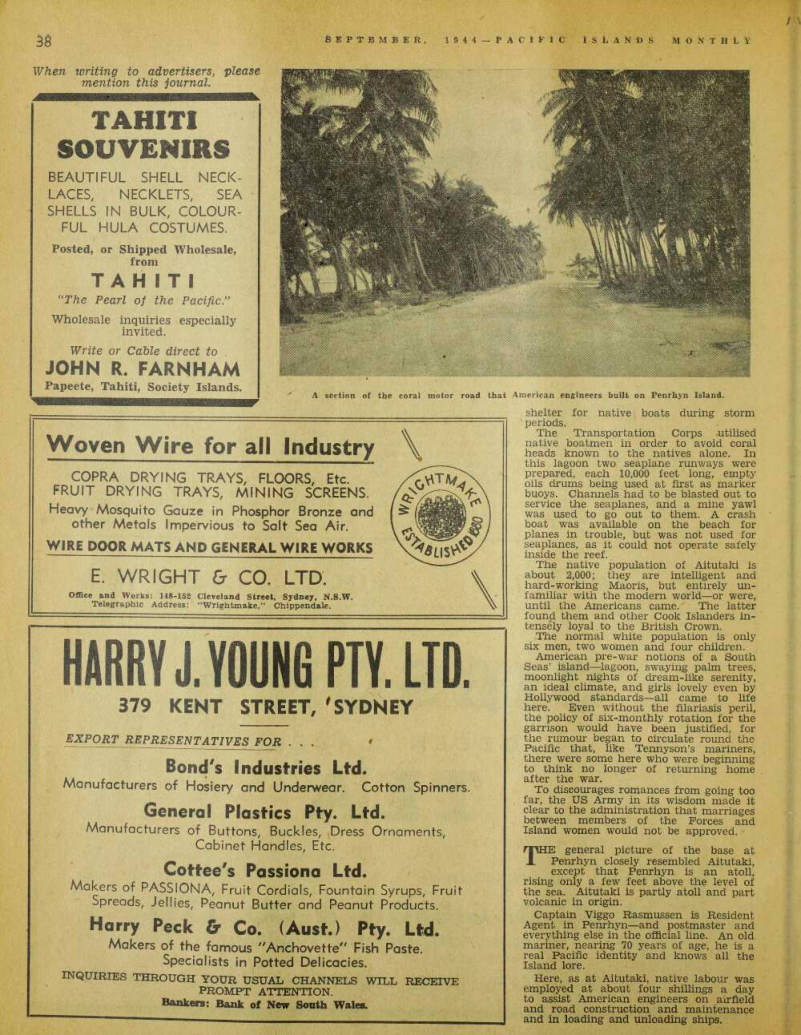
To discourages romances from going too far, the US Army in its wisdom made it clear to the administration that marriages between members of the Forces and Island women would not be approved. rE general picture of the base at Penrhyn closely resembled Aitutaki, except that Penrhyn is an atoll, rising only a few feet above the level of the sea. Aitutaki is partly atoll and part volcanic in origin.
Captain Viggo Rasmussen is Resident Agent in Penrhyn—and postmaster and everything else in the official line. An old mariner, nearing 70 years of age, he is a real Pacific identity and knows all the Island lore.
Here, as at Aitutaki, native labour was employed at about four shillings a day to assist American engineers on airfield and road construction and maintenance and in loading and unloading ships.
A section of the coral motor road that American engineers built on Penrhyn Island.