Late-But In Company
p. 12 · Read in the full issue
Arrival of New Resident Commissioner in Tarawa
By Harold Cooper
FTU3E arrival of a new Resident Com- J- missioner in the Gilbert and Ellice Islands Colony is usually an occasion for a stately ceremony of welcome Ther« was no such ceremony for Colonel Vivian Fox-Strangways’. His welcome, at his present headquarters at Tarawa, was a handshake from a battle-stained Marine officer whose words of greeting were almost drowned by the rattle of Jap machine-gun fire. y Colonel Fox-Strahgways was appointed Resident Commissioner of the G. & E Islands Colony as long ago as 1941, on promotion from Nigeria, but there was destined to be a long delay before he his new duties. By the time' he leached Suva, the headquarters of the Western Pacific High Commission, the Japs were in partial occupation of the Gilberts and the invasion of the Ellice Group was expected momentarily.
The majority of the European civil ser w^ h S d^ b u en with drawn, and Adminis rf™ n + had b ? en re duced to such skeleton proportions that even the Resident Com missioner was supernumerary to estab lishment. For a time Fox-Strangways was employed on a special mission in the Solomons, where he did what he could to organise a small defence force. That mis sion completed, he obtained permission to for. *1 Aus traha and join the RAAF, and mon i lls he was a humble air monwealth. 6 at 3 Station ln the Com ‘ an m % ent message from Suva that his presence was required there immediately, and an airman-trainee was flown at high speed from Melbourne, via Noumea, to Fiji. There the High Com missioner, Sir Philip Mitchell, told him ff ort A . was to be made to re estabiish the Administration in the Gil bert and Ellice Islands. that time was to set up headquarters in the Gilberts; but before nnl? 1 ?v, COl ? ld b £ fitted out for the Pur pose, the Japs had completed their occu-
pation of all but the most southerly mnge of that Group. 'i'he plan was accordingly changed and Fox-Srrangways went to Funafuti, in me Ellice Group arriving there a weeK before United states’ Marines and seabees landed to convert the island into an air and naval oase.
In the course of the next few months, the new Resident Commissioner man aged to make several tours of the Ellice Islands, despite the interest which Jap aircraft occasionally showed in his move ments (on one trip he took on the Lon ?,???. , Ml ?. sio^ ry Society's ship, “John Williams the old ship was heavily straffed, but fortunately suffered ornv minor damage). * LATE in 1943, Colonel Fox-Strangways was summoned to Pearl Harbour where he and other British officers gave what assistance they could in pre paring plans for the liberation of the .Gilberts. And when the Second Marine Division left on me voyage that was to end in the battle of Tarawa, Fox-Strang ways sailed with them.
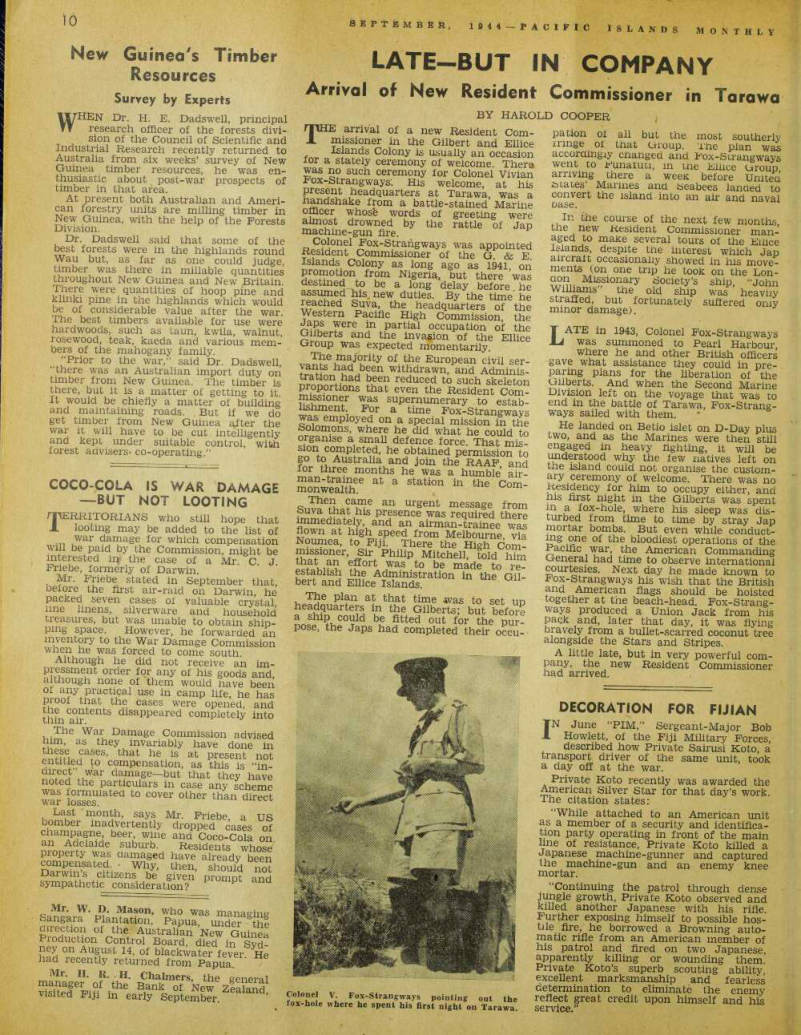
He landed on Betio islet on D-Day plus two, and as the Marines were then still engaged in heavy fighting, it will be understood why the few natives left on the island could not organise the custom ary ceremony of welcome. There was no Residency for him to occupy either, and his first night in the Gilberts was spent in a fox-hole, where his sleep was dis turbed from time to time by stray Jap mortar bombs. But even while conduct ing one of the bloodiest operations of the Pacific war, the American Commanding General had time to observe international courtesies. Next day he made known to Fox-Strangways his wish that the British and American flags should be hoisted together at the beach-head. Fox-Strang ways produced a Union Jack from his paqk and, later that day, it was flying bravely from a bullet-scarred coconut tree alongside the Stars and Stripes.
A little late, but in very powerful com pany, the new Resident Commissioner had arrived.
Colonel v. Fox-Strangways pointing out the fox-hole where he spent his first night on Tarawa.