Tuberculosis
p. 29 · Read in the full issue
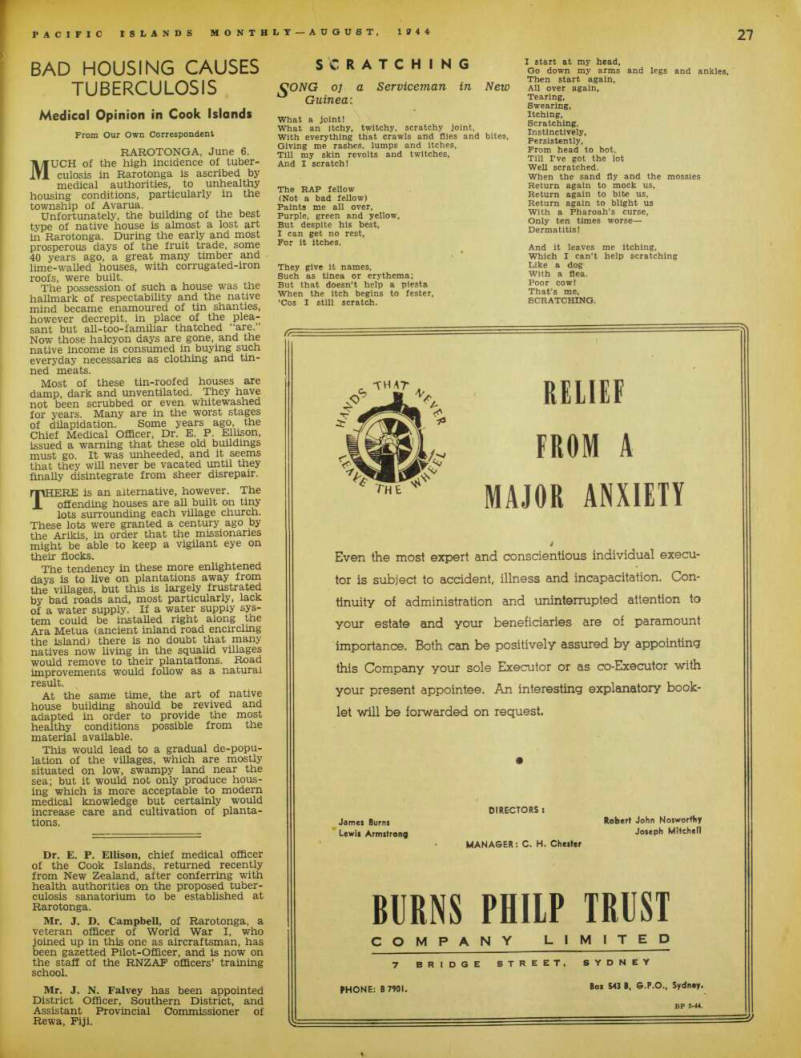
Bad Housing Causes
Medical Opinion in Cook Islands
From Our Own Correspondent
Rarotonga, June 6.
MUCH of the high incidence of tuber culosis in Rarotonga is ascribed by medical authorities, to unhealthy housing conditions, particularly in the township of Avarua.
Unfortunately, the building of the best type of native house is almost a lost art in Rarotonga. During the early and most prosperous days of the fruit trade, some 40 years ago, a great many timber and lime-walled houses, with corrugated-iron roofs, were built.
The possession of such a house was the hallmark of respectability and the native mind became enamoured of tin shanties, however decrepit, in place of the plea sant but all-too-familiar thatched “are.”
Now those halcyon days are gone, and the native income is consumed in buying such everyday necessaries as clothing and tin ned meats.
Most of these tin-roofed houses are damp, dark and unventilated. They have not been scrubbed or even whitewashed for years. Many are in the worst stages of dilapidation. Some years ago, the Chief Medical Officer, Dr. E. P. Ellison, issued a warning that these old buildings must go. It was unheeded, and it seems that they will never be vacated until they finally disintegrate from sheer disrepair. rERE is an alternative, however. The offending houses are all built on tiny lots surrounding each village church.
These lots were granted a century ago by the Arikis, in order that the missionaries might be able to keep a vigilant eye on their flocks.
The tendency in these more enlightened days is to live on plantations away from the villages, but this is largely frustrated by bad roads and, most particularly, lack of a water supply. If a water supply sys tem could be installed right along the Ara Metua (ancient inland road encircling the island) there is no doubt that many natives now living in the squalid villages would remove to their plantations. Road improvements would follow as a natural result.
At the same time, the art of native house building should be revived and adapted in order to provide the most healthy conditions possible from the material available.
This would lead to a gradual de-popu lation of the villages, which are mostly situated on low, swampy land near the sea; but it would not only produce hous ing which is more acceptable to modern medical knowledge but certainly would increase care and cultivation of planta tions.
Dr. E. P. Ellison, chief medical officer of the Cook Islands, returned recently from New Zealand, after conferring with health authorities on the proposed tuber culosis sanatorium to be established at Rarotonga.
Mr. J. D. Campbell, of Rarotonga, a veteran officer of World War I, who joined up in this one as aircraftsman, has been gazetted Pilot-Officer, and is now on the staff of the RNZAF officers’ training school.
Mr. J. N. Falvey has been appointed District Officer, Southern District, and Assistant Provincial Commissioner of Rewa, Fiji.