Reunion In
pp. 14-16 · Read in the full issue
New Guinea
And Old Memories Stirred
By Judy Tudor
VOU will be interested to know that right now Geko and Antananta are with me—as pleased to see me after almost five years, as I was to see them.
They have been in their village all that time, not wishing to work for anyone else, and have had a pretty tough time during the past two years. But they are quite happy now, and a lap-lap, razor blade, some soap and a rice diet will soon have them back in their old shape.
Have just been talking to P alt on, Weihe, Samer and Tangabo; they are with a cafrier line and we are all in Geko’s country. Palton is “hone-nothing”; these Wapi boys, too, have had a bad time, hut before long they will all fill out again.
The boys asked for you and other of our friends of the good old Ulahau days.
All the other boys are back in their villages.
I expect the old names bring back memories to you, as they do to me; particularly of the early days with just Geko, Antananta, Nausi, Palton, Tulawai, Amoni and old Magini. Magini is still going strong in his village. I’ll bet he is one of the “lapuns” now.
THAT, from a recent letter from a friend “somewhere in New Guinea,” indeed brought the memories flow ing back. Several times since I said good bye to the Ulahau-back-of-But, I have decided that sort of life will never again be for me; but it needs only mention of those names to start nostalgic hanker ings for the “big bush”; for the musty, fusty smell of the New Guinea jungle which, once smelled is never forgotten; even for the mud and the leeches, and a sac-sac house, and food from a tin and bread sour with -weevils.
Possibly only a strong dose of this hair of-the-dog-that-bit-me will cure my chronic troppo-itis; that my line of ter
ritory fills the hearts of few people to overflowing, I am well aware. But it is for the few that this story is fashioned.
Geko and Antananta came from coun try inland and south of Aitape; probably from what has been described by A. J.
Marshall as the land of the “whistling talk” people; “new” country that had had little contact with Europeans before the war and which we had not seen “Have you heard these two holding whistling conversations with each other?” th ®£ r ? aster asked us one night at dinner No, said we. “How come?”
Antananta was in another house fur up the hill; Geko was therefore called m and instructed to “sell the talk ” per whistle, to his confrere—to instruct him to bring down his master’s tobacco and pipe.
Geko immediately coy, made several attempts to whistle his message, but each time, under the battery of three pairs of .interested eyes, his lips unpuckered and parted in a wide grin. Finally he turned J . T n us and pottering around with some dishes on a side table, got his mes sage off. Nothing extraordinary about if clear but not piercing, rather like the aimless, unmelodious whistle of an engrossed child.
“Antananta must be psychic if he can make anything out of that,” I said; but in two or three minutes the monkey came running down the steps and matter-of factly placed his master’s pipe and tobacco tin on the table.
“Fashion belong me fella,” was their only explanation of this purely native form of “walkie-talkie” wireless.
Antananta, even in a land of “bone-nothing” people, was definitely skmnv; to describe him merely as thin would have been to paint too inade quate a picture. He came in to us from the beach with a line of 20 new recruits from Wapi; his master and Geko to fol low later. The Wapis, with gusto, intro duced themselves; but, onlv after thev had finished their clamour, did we notice this poor, thin, little creature, sitting huddled on a fallen tree, a brand-new white lap-lap hitched around incredibly narrow bins in honour of this meeting and a bush knife, his one prized posses sion. and lately given him by his new master, clutched convulsively in his hands. He and the exuberant Wapis were not one-talks, and he sat alone, half petrified with fear.
“You bov belong who’s’at?” we asked “Me boy belong Master Cus-Cus. Behind ’e come look ’im me,” he hastened to assure us.
“Call ’im name belong you?” we said “Anfawanta,” he replied, running all the syllables together into an unintelli gible mess.
We didn’t get it at all. “Call ’im one time more!”
“Antananta,” he tried again, somehow adding even greater length to the jaw breaking name.
“Name belong ’im ‘Antananta.’ Tm ’e bov belong Master Cus-Cus!” shrilled the Wapis in chorus.
“OK OK. Name belong ’im ‘Anta nanta.’ ” we said. “Anta-nanta. vou go along house-cook, one-time Nausi.”
Antananta needed no second bidding.
Still clutching the large knife, almost as thick through as he was himself, he scuttled into the sanctuary of the house cook; and, until his master appeared a few days later, could scarcely be per suaded to leave it, “Holy smoke!” we exclaimed. “Where on earth does Ted get them? Those pipe-stem legs . . . !”
NAUSI, too, was one of Master Cus- Cus’ waifs; a mission monkey, edu cated at But, but a pain in the neck
withal. Antananta, however, was of different metal and served with devotion.
A village stray, with no father, and a mother who had made another alliance, he had spent his childhood, according to Geko. kicked around from pillar to post.
The master who had befriended him, who had, above all, given him a huge bush knife of his own, became his chief inter est in life. His single-minded attach ment to Master Cus-Cus never wavered.
Geko was of sterner stuff: a round, well-covered lad ready for instant laugh ter; as intelligent as they come; a would-be sophisticate.
Geko had travelled with his master.
and had sojourned in Rabaul for a time, where he tried everything once and returned to the bush to tell about it.
Palton, described now as “bone-noth ing,” had been, even when he came to us straight from his village, anything but bone. He was short and thick-set, a typical boy of Wapi, with the surprising strength-for-size that made him, and his kind, such excellent carrying-boys for those hellish tracks that were our only link with the coast and the outside world; or equally, a good boss-boy in a mining team. Handsome of face, as natives go, placid of nature, totally different from his young brother, Tangabo: a man who “savvied fight.”
AND old Magini of the mutilated ear; the quintessence of all obstruction ists when in the mood —which was frequent—who, whinge how he may, was yet with us from the dark days on the Nagum River behind Boram. “Tch!
Tch! Tch!” and “me no like” were the most worked words in Magini’s vocabu lary. The men looked at him askance.
“A darned old pointer” was the kindest thing they ever had to say about him.
But Magini had his virtues and some times a great, un-native urge to be dif ferent. He could still travel faster than any other boy in the outfit, and to the last could whip over the range to Maprik ’drome to pick up mail, and cut hours off the time of the fastest monkey.
Unlike the others, he preferred to travel alone, and often after dark. Yells and yodels from the mountain-top above, at any hour of the night, would proclaim the fact that old Magini, come tambaran, come masali, or any other ghost of the darkness, had decided to make the round trip in one fell swdbp, instead of waiting until the next dawn to start back to camp.
WHEN the big earthquake came in 1936, Magini alone refused to be, at least outwardly, panicked.
It began on a still, sunny afternoon, when the men were away up the creek and Nausi on a message down the river, and I was making bread in the old house cook. In a split-second pause, every liv ing thing in the jungle ceased its clamour, and then the 'quake was there:
bubbling up from under my feet, throb bing all about me.
I fell out of the house-cook and grab bed the tree-stump near the door to steady myself, while the ground writhed beneath my feet like some huge beast in its death agonies: while the whole jungle undulated towards me in gigantic waves and branches and whole trees fell and added to the general din. I was too frightened to be aware of fear, and I clung on to my stump, only waiting.
Then the world gave a sickening lurch and all .was still once more, except for the soft swishing of the tree-tops. A hot wave of fright came up from somewhere near my toes and ended in my throat. My knees were weak, but I staggered off down the stream, compelled by blind instinct to try to escape or, at least, see my fellow-humans before I died.
The boys, who worked a few hundred yards below, were not there. Their shovels were thrown aside carelessly. I
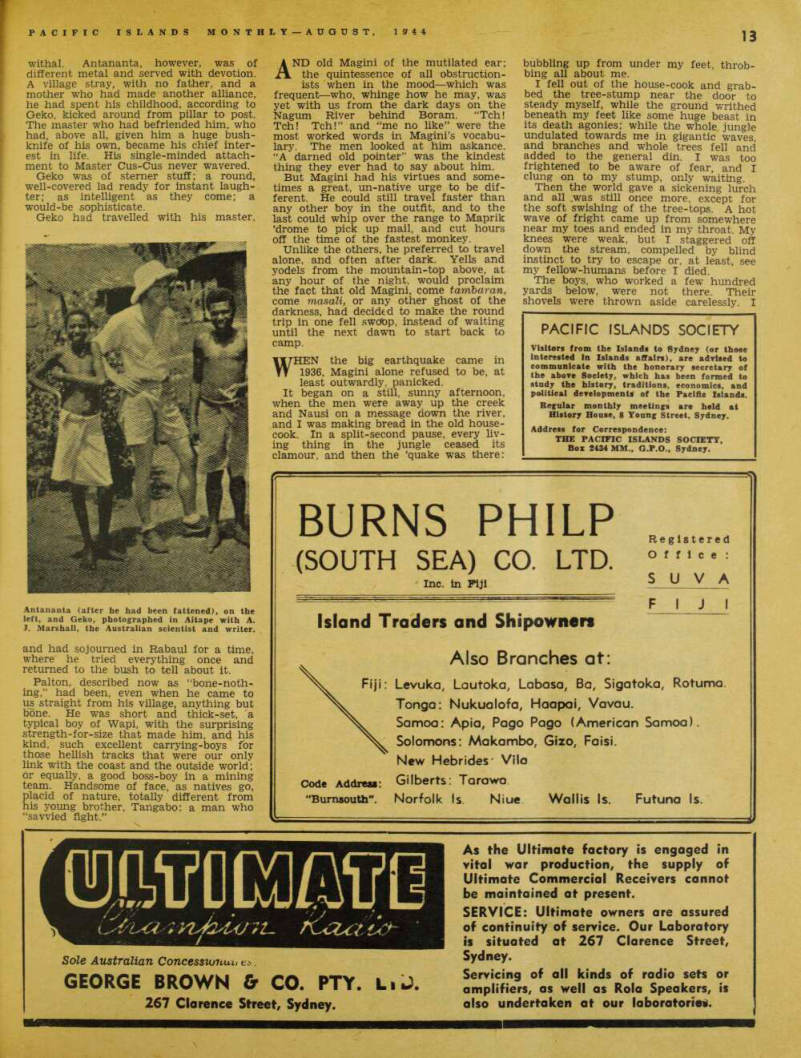
Antananta (after he had been fattened), on the left, and Geko, photographed in Aitape with A.
J. Marshall, the Australian scientist and writer.
yelled to them, and they came straggling out of the bush, looking even more scared than I felt, and yellow about the gills.
I sat down on the bank (so that they could not see my knees knocking) and told them off in straight English—my Pidgin had gone with the ’quake— demanding to know why, if they must run, they had run to the bush. “Big fella
guria! Big fella guria,” they chanted, by way of an answer.
But old Magini said: “Boy ’e got big fella fright. ’E like run-run-run too,” with the emphasis on the “too” and a sidelong look in my direction as if to say; “Just how come you here, lady, if you also did not run-run-run?” rAT night, the gurias were still roll ing up on a two or three-minute schedule, yet the men of our various establishments declared for bed and sleep notwithstanding.
But not for me! I, unfortunately, am cursed with an imagination; I had lived in earthquaky New Zealand; but, above all else, I had seen plenty of the local results of their infernal gurias: moun tains with huge slices taken neatly off their sides; valleys filled with a rubble of dead coconuts, trees and native houses; huge rivers blocked and turned into lakes. How, then, could anyone turn in and sleep peacefully in a grass hut, clinging to a mountain-side and sur rounded by tall, ridiculously small-rooted trees?
If trees did fall and kill me, I com forted myself sourly, or lopped off half my legs, then it would be someone else’s fault. I could picture myself maimed or dead and the gruesome details of the scene very easily on that grim night, with the darkness and rumble of the ’quakes without, and the dim light of the hurricane lantern within. I tried to read a two-months-old newspaper, but my mind kept returning to relish the fancied fury of my mother when she knew that her favourite daughter had been exposed to such a death, and so wantonly, by the male members of the concern.
The boys had been given permission to go to an open piece of ground down the river, and all but Magini had done so without hesitation. Magini stopped, for some weird reason of his own; but he did not sleep, either. At intervals throughout that night he let out loud whoops and yells to encourage himself; and I felt a great, un-British, un-white woman’s burdenish desire to go down and join him. At least we could have whooped together.