Stanley Greenland Retires
From Papuan Service
FOR Papuan residents, the evacuation period has been distinguished by the number of their high-ranking Government servants who have reached retirement. Latest to join the ranks of the retired is Mr. Stanley Greenland, who gave 30 years of service to the Territory, and who remained throughout, popular with white and brown residents.
He was appointed to the service in 1912, to serve under the then Government Secretary, the Hon. A. M. Campbell, who was reputed the strictest disciplinarian the Papuan service has ever known. With
Mr. Campbell, he travelled on tours of inspection as his secretary and general factotum, and under his tutelage learned his Papuan official alphabet.
Later, Mr. Greenland was Magistrate at loma, on the old German-British border and at Yule Island. In 1917 he was appointed to the Department of Native Affairs, Port Moresby, and until his recent retirement held administrative rank in that Department—as inspector, travelling inspector, chief inspector, act ing commissioner, etc. But interspersed between these positions, and under the direction of Sir Hubert Murray, he func tioned variously as Curator of Intestate Estates, Registrar-General, member of the Land Board, Papuan Government Agent in Sydney, and OC Headquarters Armed Native Constabulary. He was also a commissioned officer in the force now known as the Royal Papuan Constabu lary.
Mr. Greenwood, who insists that the Papuan service is only second to the Navy in traditional silence, could be persuaded to say only two things regarding his retirement: That far too much was heard about the old men of Papua these days, and far too little about the gallant women of the country; and that he had little claim to distinction other than being the uncle and god-father of that young naval officer, Lieut. R. T. G.
Greenland, who has made history as the commander of the “Human Torpedoes.”
In Mr. Greenland’s opinion, Lieut.
Greenland was able to achieve more for his country in a brief half-hour than he himself did in 30 years of life in
Papua. This opinion will hardly be endorsed by those who knew Mr. Green land of the Papuan service for three decades. Papua will be the poorer, when civil administration is resumed, for the loss of well-tried officers of his calibre, who learned to know Papua in her teeth ing stage, and in spite of her continued temperamental cussedness, grew a deep and abiding love for the land.
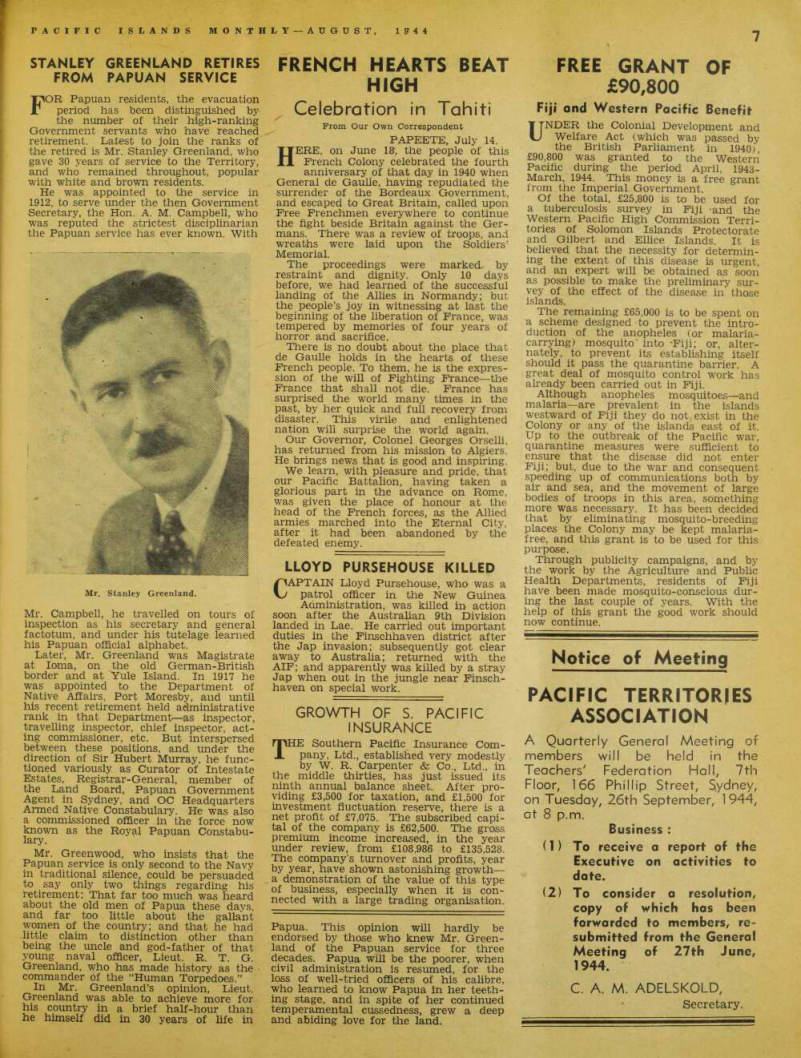
Mr. Stanley Greenland.