Coconut Plantations
pp. 28-29 · Read in the full issue
Discussion of Present Copra Prices and Probable Market Factors
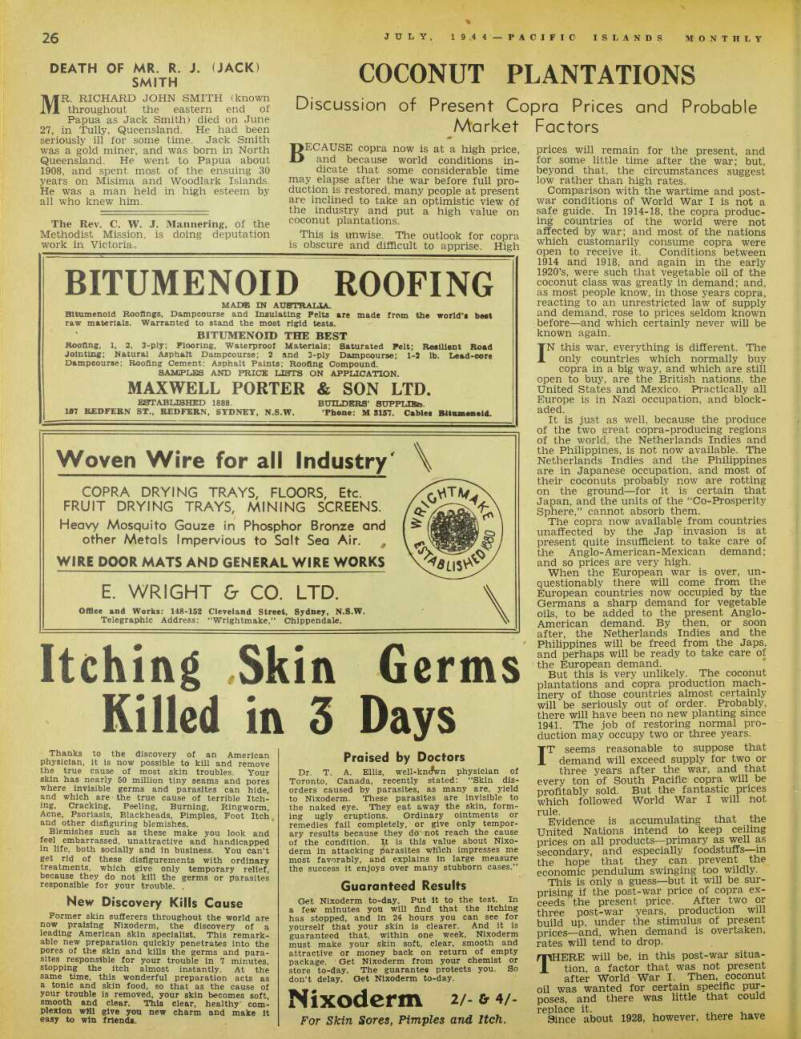
BECAUSE copra now is at a high price, and because world conditions in dicate that some considerable time may elapse after the war before full pro duction is restored, many people at present are inclined to take an optimistic view Of the industry and put a high value on coconut plantations.
This is unwise. The outlook for copra is obscure and difficult to apprise. High
prices will remain for the present, and for some little time after the war; but, beyond that, the circumstances suggest low rather than high rates.
Comparison with the wartime and post war conditions of World War I is not a safe guide. In 1914-18, the copra produc ing countries of the world were not affected by war; and most of the nations which customarily consume copra were open to receive it. Conditions between 1914 and 1918, and again in the early 1920’5, were such that vegetable oil of the coconut class was greatly in demand; and, as most people know, in those years copra, reacting to an unrestricted law of supply and demand, rose to prices seldom known before—and which certainly never will be known again.
IN this war, everything is different. The only countries which normally buy copra in a big way, and which are still open to buy, are the British nations, the United States and Mexico. Practically all Europe is in Nazi occupation, and block aded.
It is just as well, because the produce of the two great copra-producing regions of the world, the Netherlands Indies and the Philippines, is not now available. The Netherlands Indies and the Philippines are in Japanese occupation, and most of their coconuts probably now are rotting on the ground—for it is certain that Japan, and the units of the “Co-Prosperity Sphere,” cannot absorb them.
The copra now available from countries unaffected by the Jap invasion is at present quite insufficient to take care of the Anglo-American-Mexican demand; and so prices are very high.
When the European war is over, un questionably there will come from the European countries now occupied by the Germans a sharp demand for vegetable oils, to be added to the present Anglo- American demand. By then, or soon after, the Netherlands Indies and the Philippines will be freed from the Japs, and perhaps will be ready to take care of the European demand.
But this is very unlikely. The coconut plantations and copra production mach inery of those countries almost certainly will be seriously out of order. Probably, there will have been no new planting since 1941. The job of restoring normal pro duction may occupy two or three years.
IT seems reasonable to suppose that demand will exceed supply for two or three years after the war, and that every ton of South Pacific copra will be profitably sold. But the fantastic prices which followed World War I will not rule.
Evidence is accumulating that the United Nations intend to keep ceiling prices on all products—primary as well as secondary, and especially foodstuffs —in the hope that they can, prevent the economic pendulum swinging too wildly.
This is only a guess—but it will be sur prising if the post-war price of copra ex ceeds the present price. After two or three post-war years, production will build up, under the stimulus of present prices—and, when demand is overtaken, rates will tend to drop. rERE will be, in this post-war situa tion, a factor that was not present after World War I. Then, coconut oil was wanted for certain specific pur poses, and there was little that could replace it.
Since about 1928, however, there have
been half a dozen alternatives to coconut oil—and, notably, soya bean oil and whale oil. Everyone knew, for ten years before World War 11, how the international vegetable-oil combine (Unilever), played one commodity against the other, and kept all producers poor, and under its monopolistic thumb.
The new factor, which plays right into the hands of the ruthless Unilever, is the extended use of the processes of deodori sation and purification, so that certain oil-seeds which formerly could not com pete with coconut oil, now can compete.
Two seeds which now are freely used as a substitute for coconut oil are linseed and cottonseed.
The sudden shutting out of copra sup plies in 1942 was a great embarrassment to the United States; and America’s in dustrial chemists proceeded to make the most of all available substitutes. The cultivation of the soya bean and the ground nut (peanut) has been enormously extended —and the oil from either becomes an excellent substitute for coconut oil, with very little treatment.
Linseed oil came in for closer scrutiny, and it was found possible to get rid of certain qualities which formerly made it unsuitable as a foodstuff. Cottonseed oil, in 1939, already was on the way to becom ing a rival of the coconut. Now, these processes have been extended and deve loped, and coconut oil definitely is challenged, in 1944, by two new sub stances which come from oil-seeds pro duced on a huge scale. rpHE gioral is plain for anyone to read.
I Copra production, in the future, will not be a hit-or-miss affair, but must be a matter of close calculation, in re lation to the production costs of soya beans, palm kernels, linseed, cotton seed, whale oil, ground nuts, and so forth.
Many factors will enter the comparative
calculation—labour costs, transport costs, land costs are only a few of them.
If copra production, in the future, is to be a 100 per cent, economic proposition— that is, if its value as an industry is to be measured strictly against the production costs of other alternative substances — then it is possible to imagine the partial* disappearance of the coconut-growing industry. But if the United Nations in troduce —as they threaten to do —a' planned world economy, then they may allot to coconut-growing a guaranteed market and a definite place in the post war world.
There are very large sections of the Pacific Territories which are of little use other than for coconut-growing; and, apart from Europeans, there are millions of native peoples who, if they are to have any economic structure at all, must base their economy on copra production.
MANY millions of pounds are invested in tens of thousands of plantations in the South Pacific Islands. That investment appears safe now. and it should remain safe for a little while after the war. But, beyond that, the copra outlook is obscure.
Present plantation-owners should pro ceed with caution, while making the most of the immediate certain demand. Any immediate post-war tendency to rush in and plant up new coconut plantations, on the assumption that more than £8 per ton will be available when the trees begin to bear, should be sternly discouraged.
Mr. E. W. J. (Teddy) Mears, remem bered by all Papuan residents as the jovial master and engineer of the Administration vessel “Elevata,” is at present dangerously ill at Newmarket Private Hospital, Brisbane.