Nearly A Million!
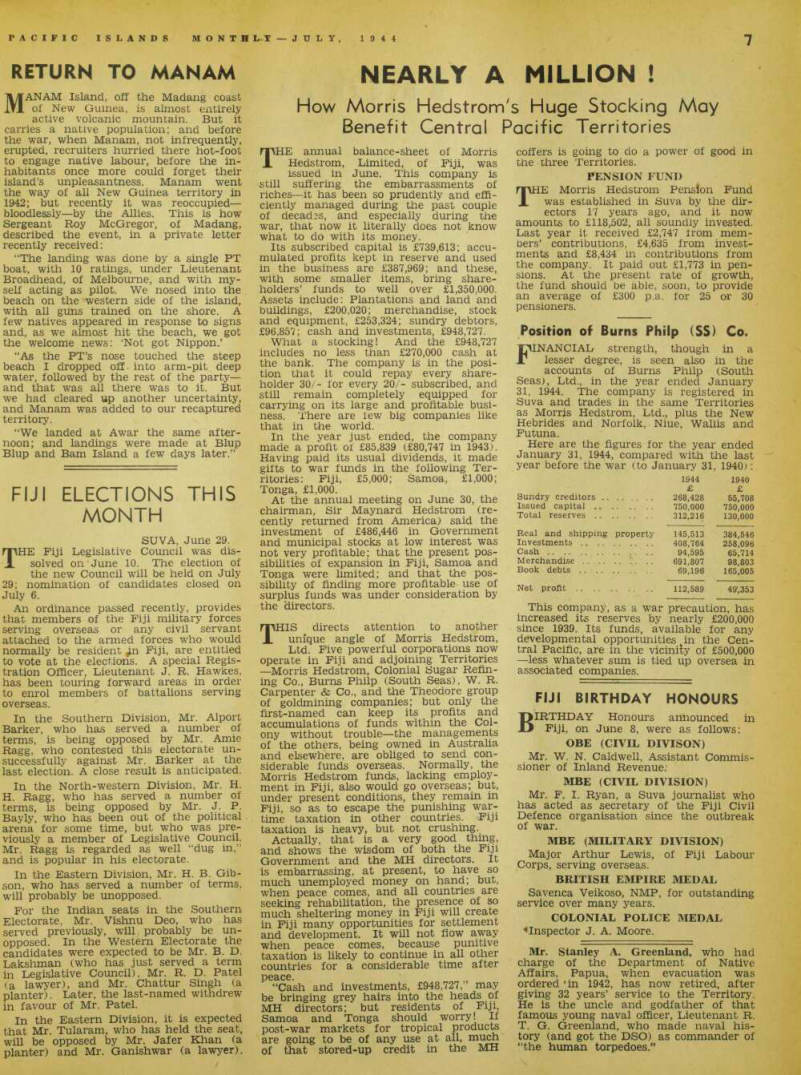
How Morris Hedstrom's Huge Stocking May Benefit Central Pacific Territories
THE annual balance-sheet of Morris Hedstrom, Limited, of Fiji, was issued in June. This company is still suffering the embarrassments of riches —it has been so prudently and effi ciently managed during the past couple of decad3s, and especially during the war, that now it literally does not know what to do with its money.
Its subscribed capital is £739,613; accu mulated profits kept in reserve and used in the business are £387,969; and these, with some smaller items, bring share holders’ funds to well over £1,350,000.
Assets include; Plantations and land and buildings, £200,020; merchandise, stock and equipment, £253,324; sundry debtors, £96,857; cash and investments, £948,727.
What a stocking! And the £948,727 includes no less than £270,000 cash at the bank. The company is in the posi tion that it could repay every share holder 30/- for every 20/- subscribed, and still remain completely equipped for carrying on its large and profitable busi ness. There are lew big companies like that in the world.
In the year just ended, the company made a profit of £85,839 (£80,747 in 1943).
Having paid its usual dividends, it made gifts to war funds in the following Ter ritories: Fiji, £5,000; Samoa, £1,000; Tonga, £l,OOO.
At the annual meeting on June 30, the chairman, Sir Maynard Hedstrom (re cently returned from America) said the investment of £486,446 in Government and municipal stocks at low interest was not very profitable; that the present pos sibilities of expansion in Fiji, Samoa and Tonga were limited; and that the pos sibility of finding more profitable use of surplus funds was under consideration by the directors.
THIS directs attention to another unique angle of Morris Hedstrom, Ltd. Five powerful corporations now operate in Fiji and adjoining Territories —Morris Hedstrom, Colonial Sugar Refin ing Co., Burns Philp (South Seas), W. R.
Carpenter & Co., and the Theodore group of goldmining companies; but only the first-named can keep its profits and accumulations of funds within the Col ony without trouble —the managements of the others, being owned in Australia and elsewhere, are obliged to send con siderable funds overseas. Normally, the Morris Hedstrom funds, lacking employ ment in Fiji, also would go overseas; but, under present conditions, they remain in Fiji, so as to escape the punishing war time taxation in other countries. Fiji taxation is heavy, but not crushing.
Actually, that is a very good thing, and shows the wisdom of both the Fiji Government and the MH directors. It is embarrassing, at present, to have so much unemployed money on hand; but, when peace comes, and all countries are seeking rehabilitation, the presence of so much sheltering money in Fiji will create in Fiji many opportunities for settlement and development. It will not flow away when peace comes, because punitive taxation is likely to cpntinue in all other countries for a considerable time after peace.
“Cash and investments, £948,727,” may be bringing grey hairs into the heads of MH directors; but residents of Fiji, Samoa and Tonga should worry! If post-war markets for tropical products are going to be of any use at all, much of that stored-up credit in the MH
coffers is going to do a power of good in the three Territories.
Pension Fund
rE Morris Hedstrom Pension Fund was established in Suva by the dir ectors 17 years ago, and it now amounts to £118,502, all soundly invested.
Last year it received £2,747 from mem bers’ contributions, £4,635 from invest ments and £8,434 in contributions from the company. It paid out £1,773 in pen sions. At the present rate of growth, the fund should be able, soon, to provide an average of £3OO p.a. for 25 or 30 pensioners.
Position of Burns Philp (SS) Co.
FINANCIAL strength, though in a lesser degree, is seen also in the accounts of Burns Philp (South Seas), Ltd., in the year ended January 31, 1944. The company is registered in Suva and trades in the same Territories as Morris Hedstrom, Ltd., plus the New Hebrides and Norfolk, Niue, Wallis and Futuna.
Here are the figures for the year ended January 31, 1944, compared with the last year before the war (to January 31, 1940):
This company, as a war precaution, has increased its reserves by nearly £200,000 since 1939. Its funds, available for any developmental opportunities in the Cen tral Pacific, are in the vicinity of £500,000 —less whatever sum is tied up oversea in associated companies.
Fiji Birthday Honours
BIRTHDAY Honours announced in Fiji, on June 8, were as follows:
Qbe (Civil Divison)
Mr. W. N. Caldwell, Assistant Commis sioner of Inland Revenue:
Mbe (Civil Division)
Mr. F. I. Ryan, a Suva journalist who has acted as secretary of the Fiji Civil Defence organisation since the outbreak of war.
Mbe (Military Division)
Major Arthur Lewis, of Fiji Labour Corps, serving overseas.
British Empire Medal
Savenca Veikoso, NMP, for outstanding service over many years.
Colonial Police Medal
♦Inspector J. A. Moore.
Mr. Stanley A. Greenland, who had charge of the Department of Native Affairs, Papua, when evacuation was ordered 'in 1942, has now retired, after giving 32 years’ service to the Territory.
He is the uncle and godfather of that famous young naval officer, Lieutenant R.
T. G. Greenland, who made naval his tory (and got the DSO) as commander of “the human torpedoes.”
1944 1940 £ £ Sundry creditors 268,428 55,708 Issued capital 750,000 750,000 Total reserves 312,216 130,000 Real and shipping property 145,513 384,546 Investments 408,764 258,096 Cash 94,595 65,714 Merchandise 691,807 98,803 Book debts 69,196 165,005 Net profit 112,589 49’,353