Se common destfny of the Axis*
pp. 5-6 · Read in the full issue
What Japan is Trying to Do With "Co-prosperity"
Sphere"
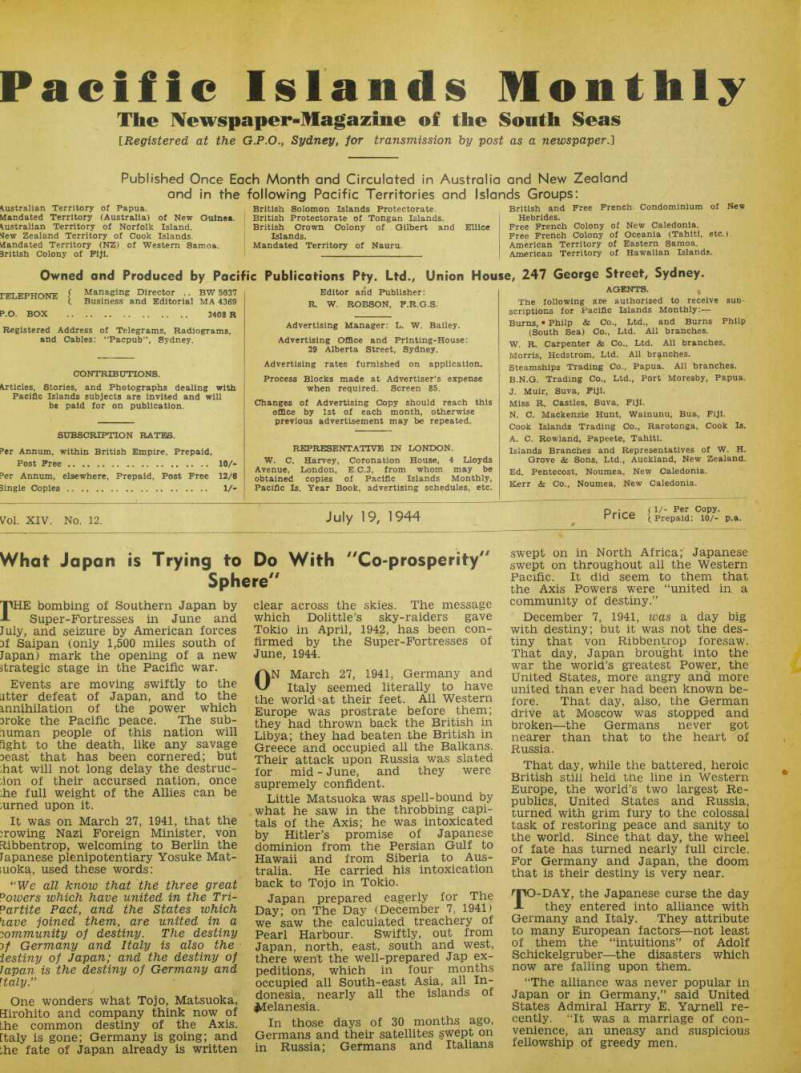
rHE bombing of Southern Japan by Super-Fortresses in June and July, and seizure by American forces 3f Saipan (only 1,500 miles south of Japan) mark the opening of a new strategic stage in the Pacific war. „ , .
Events are moving swiftly to the tter defeat of Japan, and to the annihilation of the power which Droke the Pacific peace. The subi urn an people of this nation will to the death, like any savage Deast that has been cornered; but ;hat will not long delay the destruc- ;ion of their accursed nation, once bp full weip-ht nf thp Allies can be turned unon it ' ’ It was on March 27, 1941, that the growing Nazi Foreign Minister, von Ribbentrop, welcoming to Berlin the Japanese plenipotentiary Yosuke Matmoka, used these words: “We all know that the three great °owers which have united in the Tri- Partite Pact, and the States which 'iave joined them, are united in a community of destiny. The destiny Germany and Italy is also the iestiny of Japan; and the destiny of Japan is the destiny of Germany and Italy!’ of A/TotcnntQ One wonder Matsuoka,
Se common destfny of the Axis*
rtaly is gone; Germany is going; and :he fate of Japan already is written
clear across the skies. The message which Dolittle’s sky-raiders gave Tokio in April, 1942, has been confirmed by the Super-Fortresses of June, 1944. . 07 IQAI rormnnv March 27, 1941, Germany and Lf Italy seemed literally to have the world at their feet. All Western Europe was prostrate before them; they had thrown back the British in Libya; they had beaten the British in Greece and occupied all the Balkans.
Their a ttack upon Russia was slated f or June and they were supremely confident su P remei y connaenu.
Little Matsuoka was spell-bound by what he saw in the throbbing capitals of the Axis; he was intoxicated by Hitler’s promise of Japanese dominion from the Persian Gulf to Hawaii and from Siberia to Australia. He carried his intoxication back to Tojo in Tokio.
Japan prepared eagerly for The Day; on The Day (December 7, 1941) we saw the calculated treachery of Pearl Harbour. Swiftly, out from Japan, north, east, south and west, there went the well-prepared Jap expeditions, which in four months occupied all South-east Asia, all Indonesia, nearly all the islands of Melanesia In those days of 30 months ago, Germans and their satellites swept on in Russia; Germans and Italians
swept on in North Africa; Japanese swept on throughout all the Western Pacific. It did seem to them that the Axis Powers were “united in a community of destiny.”
December 7, 1941, was a day big with destiny; but it was not the des tiny that von Ribbentrop foresaw.
That day, Japan brought into the war the world’s greatest Power, the United States, more angry and more united than ever had been known be fore. That day, also, the German drive at Moscow was stopped and broken —the Germans never got nearer than that to the heart of Russia.
That day, while the battered, heroic British still held the line in Western Europe, the world’s two largest Re publics, United States and Russia, turned with grim fury to the colossal task of restoring peace and sanity to the world. Since that day, the wheel of fate has turned nearly full circle.
For Germany and Japan, the doom that is their destiny is very near.
TO-DAY, the Japanese curse the day they entered into alliance with Germany and Italy. They attribute to many European factors—not least of them the “intuitions” of Adolf Schickelgruber—the disasters which now are falling upon them.
“The alliance was never popular in Japan or in Germany,” said United States Admiral Harry E. Yarnell re cently. “It was a marriage of con venience, an uneasy and suspicious fellowship of greedy men.
“The Japanese have felt the patron ising arrogance of the German military and diplomatic corps, and have been thoroughly aware of Ger man attempts to manipulate Japa nese policy for German ends. And Japan has been as cynical as Ger many in her utilisation of her Allies, and in her treatment of them when they are no longer useful to her.”
THOSE Super-Fprtress attacks are only the beginning of a power ful assault, to be unleashed presently against every girder of Japan’s in dustrial structure. The same relent less, unremitting and undiminishing air power which has been raining bombs from the skies over Germany, and demolishing German industrial production and transport, soon will be felt all over Japan.
Japan is more helpless than Ger many in meeting this attack on her industrial potential. From Japan’s islands it is impossible for her indus trialists to disperse their plants beyond the reach of our air power.
Manchuria, the only area to which Japan has brought any measure of industrialisation, affords no area for escape. Manchuria is less protected against air attack than Japan, and is within the range of our aircraft.
WHILE it is possible to foresee the defeat of the armed forces of Japan, it would be unwise to assume that the Allies will be welcomed as liberators in East and South-east Asia, and that the many Asiatic nations there will turn gladly from Japanese domination to co-operation with the United States, Great Britain and Nationalist China. The contrary may be the case.
Ever since Japan got possession of South-east Asia and Indonesia, over two years ago, she has been feverishly developing her “Greater East Asia Co-Prosperity Sphere”; and her ac complishments appear to have been considerable. On June 26, 1943, Wang Ching-Wei, puppet ruler of Japanese controlled China, described the “Sphere” as a League of Asiatic Countries based upon four principles: Political independence; military al liance for joint defence; economic collaboration; cultural interchange.
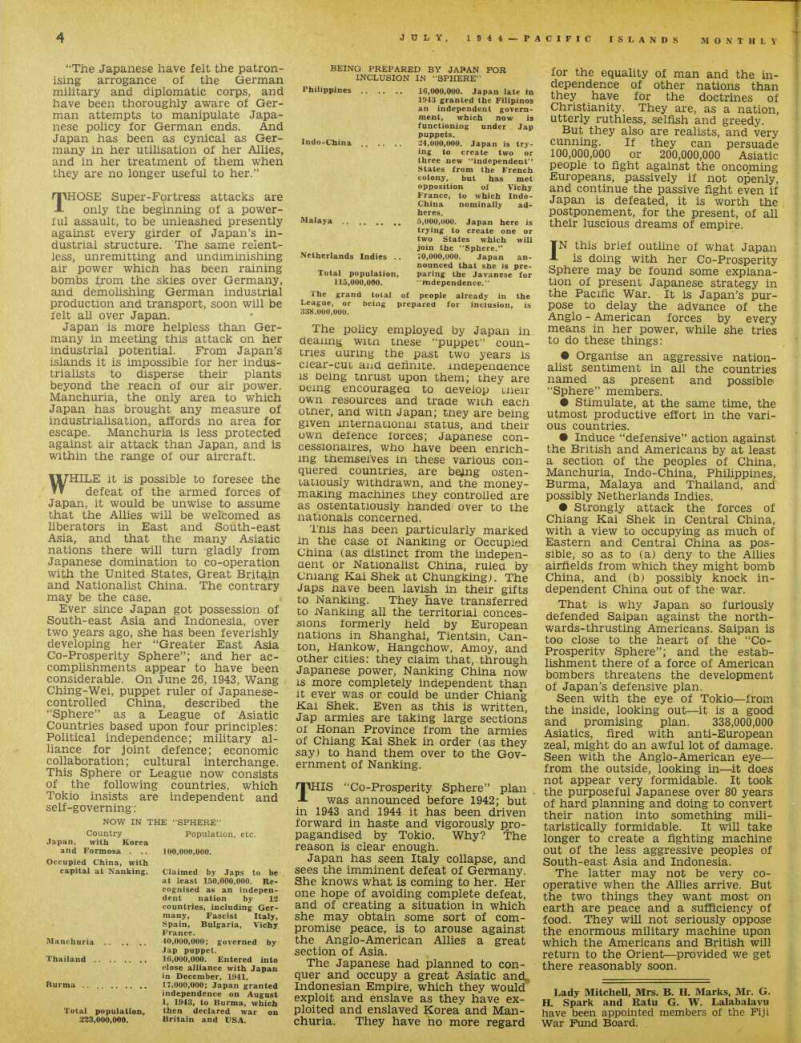
This Sphere or League now consists of the following countries, which Tokio insists are independent and self-governing:
Now In The “Sphere”
Country Population, etc.
Japan, with Korea and Formosa . .. 100,000,000, Occupied China, with capital at Nanking. Claimed by Japs to be at least 150,000,000. Re cognised as an indepen dent nation by 12 countries, including Ger many, Fascist Italy, Spain, Bulgaria, Vichy France.
Manchuria 40,000,000; governed by Jap puppet.
Thailand 16,000,000. Entered into close alliance with Japan in December, 1941.
Burma , 17,000,000; Japan granted independence on August 1, 1943, to Burma, which Total population, then declared war on 223,000,000. Britain and USA.
Being Prepared By Japan For
Inclusion In ‘•Sphere”
Philippines 16,000,000. Japan late in 1943 granted the Filipinos an independent govern ment, which now is functioning under Jap puppets.
Indo-China .. .. .. 24,000,000. Japan is try ing to create two or three new “independent”
States from the French colony, but has met opposition of Vichy France, to which Indo- China nominally ad heres.
Malaya 5,000,000. Japan here is trying to create one or two States which will join the “Sphere.”
Netherlands Indies .. <0,000,000. Japan an nounced that she is pre- Total population, paring the Javanese for 115,000,000. “independence.”
The grand total of people already in the League, or being prepared for inclusion, is 338.000,000.
The policy employed by Japan in dealing witn tnese “puppet” coun tries curing the past two years is clear-cut and definite, independence is being tnrust upon them; they are oemg encouraged to develop tneir own resources and trade with each otner, and with Japan; they are being given international status, and their own defence forces; Japanese con cessionaires, who have been enrich ing themselves in these various con quered countries, are befiig osten tatiously withdrawn, and the money making machines they controlled are as ostentatiously handed over to the nationals concerned.
I’fiis has been particularly marked in the case of Nanking or Occupied China (as distinct from the indepen dent or Nationalist China, ruled by Cniang Kai Shek at Chungking). The Japs nave been lavish in their gifts to Nanking. They have transferred to Nanking all the territorial conces sions formerly held by European nations in Shanghai, Tientsin, Can ton, Hankow, Hangchow, Amoy, and other cities: they claim that, through Japanese power, Nanking China now is more completely independent than it ever was or could be under Chiang Kai Shek. Even as this is written, Jap armies are taking large sections of Honan Province from the armies of Chiang Kai Shek in order (as they say) to hand them over to the Gov ernment of Nanking.
THIS “Co-Prosperity Sphere” plan was announced before 1942; but in 1943 and 1944 it has been driven forward in haste and vigorously pro pagandised by Tokio. Why? the reason is clear enough.
Japan has seen Italy collapse, and sees the imminent defeat of Germany.
She knows what is coming to her. Her one hope of avoiding complete defeat, and of creating a situation in which she may obtain some sort of com promise peace, is to arouse against the Anglo-American Allies a great section of Asia.
The Japanese had planned to con quer and occupy a great Asiatic and Indonesian Empire, which they would exploit and enslave as they have ex ploited and enslaved Korea and Man churia. They have no more regard
for the equality of man and the in dependence of other nations than they have for the doctrines of Christianity. They are, as a nation, utterly ruthless, selfish and greedy.
But they also are realists, and very cunning. If they can persuade 100,000,000 or 200,000,000 Asiatic people to fight against the oncoming Europeans, passively if not openly, and continue the passive fight even if Japan is defeated, it is worth the postponement, for the present, of all their luscious dreams of empire.
IN this brief outline of what Japan is doing with her Co-Prosperity Sphere may be found some explana tion of present Japanese strategy in the Pacific War. It is Japan’s pur pose to delay the advance of the Anglo - American forces by every means in her power, while she tries to do these things: • Organise an aggressive nation alist sentiment in all the countries named as present and possible* “Sphere” members. • Stimulate, at the same time, the utmost productive effort in the vari ous countries. • Induce “defensive” action against the British and Americans by at least a section of the peoples of China, Manchuria, Indo-China, Philippines, Burma, Malaya and Thailand, and possibly Netherlands Indies. • Strongly attack the forces of Chiang Kai Shek in Central China, with a view to occupying as much of Eastern and Central China as pos sible, so as to (a) deny to the Allies airfields from which they might bomb China, and (b) possibly knock in dependent China out of the war.
That is why Japan so furiously defended Saipan against the north wards-thrusting Americans. Saipan is too close to the heart of the “Co- Prosperity Sphere”; and the estab lishment there of a force of American bombers threatens the development of Japan’s defensive plan.
Seen with the eye of Tokio—from the inside, looking out—it is a good and promising plan. 338,000,000 Asiatics, fired with anti-European zeal, might do an awful lot of damage.
Seen with the Anglo-American eye— from the outside, looking in—it does not appear very formidable. It took the purposeful Japanese over 80 years of hard planning and doing to convert their nation into something mili taristically formidable. It will take longer to create a fighting machine out of the less aggressive peoples of South-east Asia and Indonesia.
The latter may not be very co operative when the Allies arrive. But the two things they want most on earth are peace and a sufficiency of food. They will not seriously oppose the enormous military machine upon which the Americans and British will return to the Orient—provided we get there reasonably soon.
Lady Mitchell, Mrs. B. H. Marks, Mr. G.
H. Spark and Ratu G. W. Lalabalavn have been appointed members of the Fiji War Fund Board.