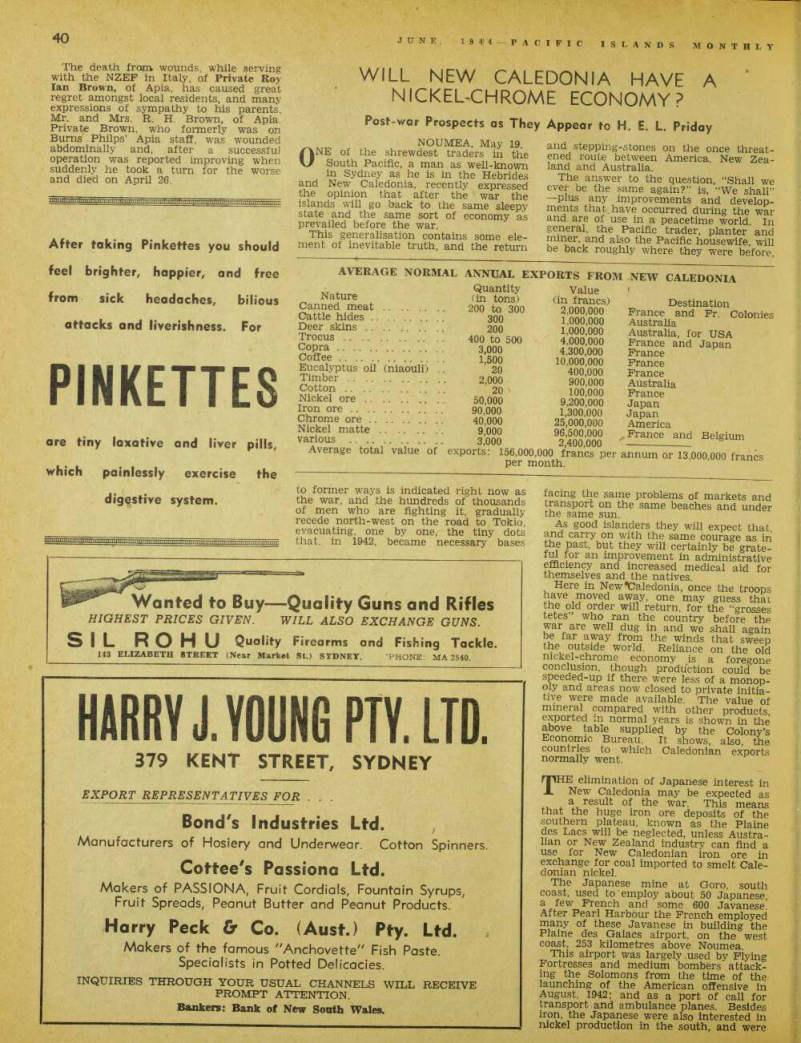
Average Normal Annual Exports From New Caledonia
pp. 42-43 · Read in the full issue
to former ways is indicated right now as the war, and the hundreds of thousands of men who are fighting it, gradually recede north-west on the road to Tokio, evacuating, one by one, the tiny dots that, in 1942, became necessary bases
facing the same problems of markets and transport on the same beaches and under the same sun.
As good islanders they will expect that, and carry on with the same courage as in the past, but they will certainly be grate ful f . or an improvement in administrative efficiency and increased medical aid for themselves and the natives.
Here in New •Caledonia, once the troops have moved away, one may guess that the old order will return, for the “grosses tetes who ran the country before the war are well dug in and we shall again be far away from the winds that sweep the outside world. Reliance on the old nickel-chrome economy is a foregone conclusion, though production could be speeded-up if there were less of a monop oly and areas now closed to private initia tive were made available. The value of mineral compared with other products exported in normal years is shown in the above table supplied by the Colony’s Economic Bureau. It shows, also, the countries to which Caledonian exports normally went.
THE elimination of Japanese interest in New Caledonia may be expected as , a result of the war. This means that the huge iron ore deposits of the southern plateau, known as the Plaine des Lacs will be neglected, unless Austra lian or New Zealand industry can find a use for New Caledonian iron ore in exchange for coal imported to smelt Cale donian nickel.
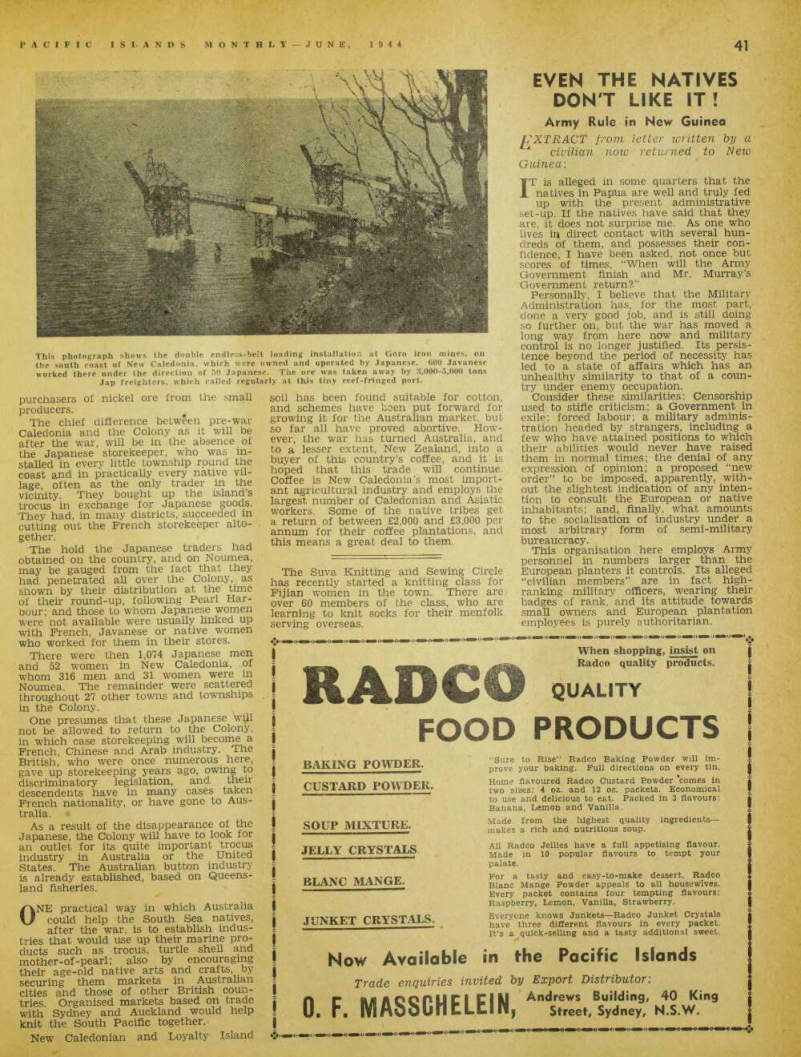
The Japanese mine at Goro, south coast, used to employ about 50 Japanese, a few French and some 600 Javanese.
After Pearl Harbour the French employed many of these Javanese in building the Plaine des Gaiacs airport, on the west coast, 253 kilometres above Noumea.
This airport was largely used by Flying Fortresses and medium bombers attack ing the Solomons from the time of the launching of the American offensive in August, 1942; and as a port of call for transport and ambulance planes. Besides iron, the Japanese were also interested in nickel production in the south, and were
Nature Canned meat Quantity (in tons) 200 to 300 Value (in francs) 2,000,000 1.000,000 1,000,000 4,000,000 4.300.000 10.000,000 400.000 900.000 100.000 9.200.000 1.300.000 25,000,000 96,500,000 o Ann nnn 1 Destination France and Fr. Colonies Australia Australia, for USA France and Japan Prance France France Australia France Japan Japan America y , France and Belgium Cattle hides Deer skins 300 L 200 400 to 500 3.000 1,500 20 2.000 20 50.000 90.000 40.000 9,000 a.nnn Trocus Copra Coffee Eucalyptus oil (niaouli) .
Timber Cotton Nickel ore Iron ore Chrome ore Nickel matte various Average total value of exports: 156,000,000 francs per annum or 13.000 000 francs per month.
purchasers of nickel ore from the small producers.
The chief difference between pre-war Caledonia and the Colony as it will be after the war, will be in the absence of the Japanese storekeeper, who was in stalled in every little township round the coast and in practically every native vil lage, often as the only trader in the vicinity. They bought up the island’s trocus in exchange for Japanese goods.
They had, in many districts, succeeded in cutting out the French storekeeper alto gether.
The hold the Japanese traders had obtained on the country, and on Noumea, may be gauged from the fact that they had penetrated all over the Colony, as shown by their distribution at the time of their round-up, following Pearl Har bour; and those to whom Japanese women were not available were usually linked up with French, Javanese or native women who worked for them in their stores.
There were then 1,074 Japanese men and 52 women in New Caledonia, of whom 316 men and 31 women were in Noumea. The remainder were scattered throughout 27 other towns and townships in the Colony.
One presumes that these Japanese will not be allowed to return to the Colony, in which case storekeeping will become a French, Chinese and Arab industry. The British, who were once numerous here, gave up storekeeping years ago, owing to discriminatory legislation, and then descendents have in many cases taken French nationality, or have gone to Aus tralia.
As a result of the disappearance of the Japanese, the Colony will have to look for an outlet for its quite important trocus industry in Australia or the United States. The Australian button industry is already established, based on Queens land fisheries.
ONE practical way in which Australia could help the South Sea natives, after the war, is to establish indus tries that would use up their marine pro ducts such as trocus, turtle shell and mother-of-pearl: also by encouraging their age-old native arts and crafts, by securing them markets in Australian cities and those of other British coun tries. Organised markets based on trade with Sydney and Auckland would help knit the South Pacific together.
New Caledonian and Loyalty Island
soil has been found suitable for cotton, and schemes have been put forward for growing it for the Australian market, but so far all have proved abortive. How ever, the war has turned Australia, and to a lesser extent, New Zealand, into a buyer of this country’s coffee, and it is hoped that this trade will continue.
Coffee is New Caledonia's most import ant agricultural industry and employs the largest number of Caledonian and Asiatic workers. Some of the native tribes get a return of between £2,000 and £3,000 per annum for their coffee plantations, and this means a great deal to them.
The Suva Knitting and Sewing Circle has recently started a knitting class for Fijian women in the town. There are over 60 members of the class, who are learning to knit socks for their menfolk serving overseas.
This photograph shows the double endless-belt loading installation at Goro iron mines, on the south coast of New Caledonia, which were owned and operated by Japanese. 600 Javanese worked there under the direction of 50 Japanese. The ore was taken away by 3,000-5,000 tons Jap freighters, which called regularly at this tiny reef-fringed port.