Theory of a Submerged Archipelago
pp. 34-37 · Read in the full issue
Life On Mysterious Easter Island
a great deal of data relating to Easter Island.
ON Easter Sunday, in 1722, the great Dutch navigator, Roggeveen, landed at Rapa-Nui, called Easter Island from that day. This remote, small, vol canic island, of about 34 miles circum ference, is among the most barren, yet the most remarkable islands known.
Easter is distant from Chile (to which country it belongs) by about 2,000 miles.
Its scanty flora is sub-tropical, and quite
world 6 any other island in the Ever since Captain Cook landed on the shores of Rapa-Nui, and beheld the hun dreds of huge, grey statues (representing the human-bust), set up on great stone terraces of basaltic prisms, and coral slabs, the world has marvelled at the tremendous work of some past race Despite the efforts of scientific investi gators, who have, from time to time, en deavoured to delve into the mysteries, its glyphs and its extraordinary carvings of stone and wood, its meaning remains undeciphered.
Easter Island is believed to be all that remains of an archipelago, which was submerged at the time of the great earth quake which submerged Tuaniki Island, with all its inhabitants. At this time several islands, large and small, including Ocean Island, and two in the Tonga Group (Late and Niuafou) were reported to have submerged, to the west of Easter Island.
At the time of the great earthquake of Callao, in 1687, which “pitchforked” ships at sea, as far away as 12° 30’ deg. south much of the land, which extended be tween Easter Island and the Carolines, disappeared. To-day, a long line of mountain and volcano-tops extends from the south-east to the north-west of this landless area of the Pacific Ocean.
Captain Cook, on his second voyage to the South Seas, took along with him in the “Resolution,” an artist, William Hodges. Hodges, at Tahiti, and at Easter Island, faithfully depicted, on canvas, striking pictures of the great stone statues, arrayed on the “Ahu,” or raised basalt-slab-terraces. These pictures be came the property of the Admiralty, and later were in the Maritime Museum, London.
Entertainments, differing from those of other Polynesian peoples, were provided on occasions, and to these entertainments —which followed the great “Paina” feasts of Easter Island—came Chiefs and Arikhs in the big, ocean-going, double-pontooned canoes. Polynesian visitors of rank, accompanied by servitors of humble birth, came to “Rapa-Nui” to attend the con ciliatory feasts to the living, and to join the “Rongo-Rongo” ceremony, given by the Easter Island priests, in honour of the dead. Each great statue represents one of the kings, priests, or rulers, whose soul, ages ago, “jumped” the “osonga” or jumping-off-stone, on its final journey westward.
A NOTABLE' feature of these entertain ments was a marionnette show.
Carved wooden puppets, “Moai-kava kava” (which were supposed to be able to talk) were manipulated in life-like man ner, to twist and turn. Each was fitted with a bole of hardwood (Tuanavi) which revolved in a socket, representing an “Ahu” in miniature. The “Ahu” was about fourteen inches in length and could accommodate several puppet figures at one time. Each of the figures was fitted with a hat of red “Tufa.”
These curious puppets were known as the “Moai-kava-kava-te-Hotu-Matua.” To the right of the “Whare-Mato,” or enter tainment-house, where these puppet shows were given, a kind of enclosure was built in rushes. Within this enclosure, two priests attired in weird masks, half animal, half-bird, chanted the dirges of Easter Island.
Shark-skin drums, accompanied by boys with nose-flutes, kept up a
th^lMe'wood'e^tablets—“ltongo-Rongo."
glyphs and characters of the carvings of
Easter Island are by no means obscure, as to their meaning. rE “Spinning-dance” of Easter Island was both original and remarkable.
The dance commenced with the “Pehu.” Men and women took part, the women, with bare breasts and a length of peat-like, smoked kapa-bark around the loins, being seated on rush papa-mats.
White, sacred cowrie-shells adorned the ankles, and a branch of green leaves was used to slash the breast. The men acted a series of episodes: the landing of in vaders, the capture and taking of victims or prisoners. Meanwhile, the women wriggled, slashed their breasts with leaves, and sang songs of welcome to the visitors.
The spinning of tops of red clay (“Te- Makoi”) was performed by the young men. The tops were kept spinning as
the dancers themselves, whirled around, and this entertainment was given loud applause, as excited performers worked themselves up to almost a frenzy. The red clay from which the tops were made was found in the crater at Rano. This same red clay was used, together with “Lama” and “Lenga” as a pigment for the decoration of the Moai-kava-kava puppets and Tikis.
Feasting was followed by entertain ment, singing, and recitations of the sacred genealogies of priest-kings of far flung archipelagoes, whose “Puri-atua rest in the great grey statues, wearing the sacred Tiki-stone from the distant Pelew Islands, as an ornament, around the neck. The stone differs from the Tiki of the Maoris, and represents the great cart-wheel-like stone disks that the original architects of Easter hoped to carry over on giant rafts. But in this, they failed, for the immense stone disks, brought to Anakena Bay, could not be brought up to the Ahu-terraces on ac count of their great weight, and they now lie under the sea in Anakena Bay, alongside many of the great statues. All these monuments in stone are, or were, covered with marine-growths. mo Rapa-Nui or Easter Island came X the great double-pontooned, ocean going canoes, carrying up to one hundred and fifty warriors and chiefs, to the sacred Paina-feast of the gods. These sailed from the Carolines, the Pelew Islands, Rai’atea, and other distant parts of the Pacific.
One great canoe, stolen during a war in Tonga, sailed to Wallis Island, and eventually reached Easter Island at fes tival time. Native foods, almost unheard of to-day, were carried.
Old king Naisseline, of Nangony, told me of his experiences, when a boy: of
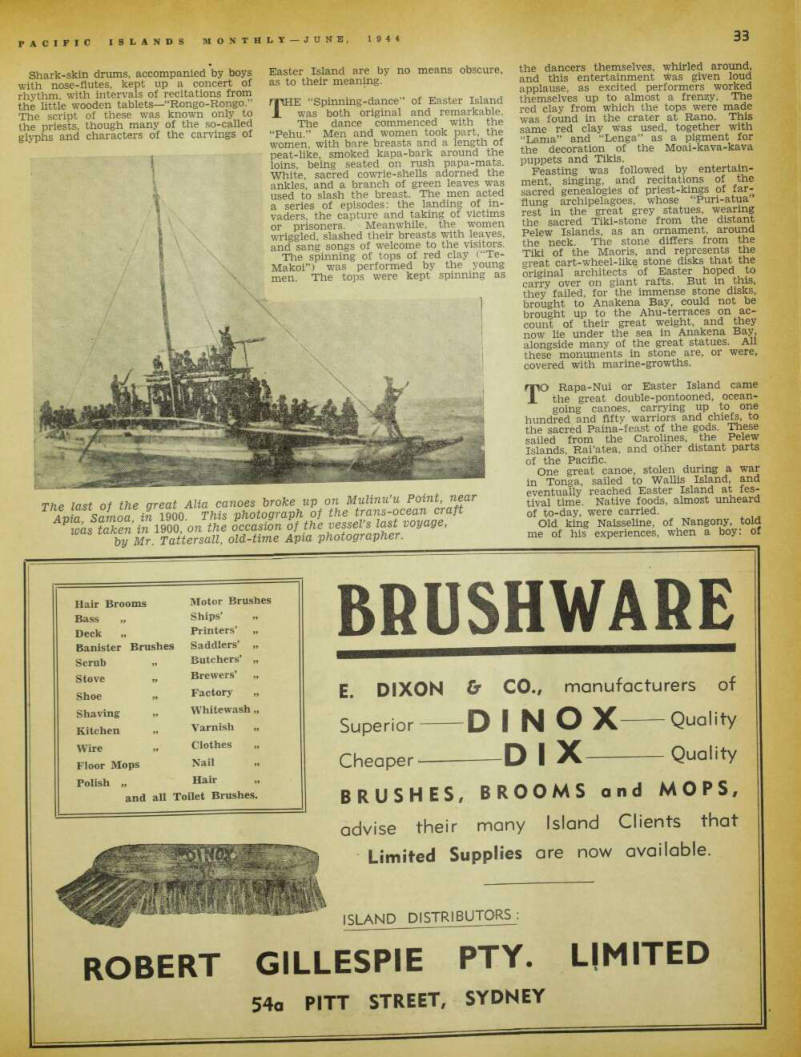
The last of the great Alia canoes broke up on Mulinu’u Point, near Avia Samoa in 1900 This photograph of the trans-ocean craft AP was taken in 1900, on the occasion of the vessel’s last voyage, by Mr Tattersall, old-time Apia photographer.
the Tufungas,” who alone might build these ocean-going canoes, and of his voy ages, as a hard-working youth, to the dis tant archipelagoes.
A great cargo of foodstuffs had to be
earned for, although there was plenty of Camote-roots or comeras, at Easter Popo,” in the form of rafts of twto hundred coconuts each, were strung to gether. These yielded, not only drink, but the needful “sua,” from the grated meat or kernel. This was strained through a bundle of fibre, and heated up m a “tanoa” or hardwood vessel, by put ting in stones, heated in a charcoal fire.
The sua” was made into a thick, creamy custard, by adding a handful of pia, or arrowroot. Thus a nourishing relish was made that was eaten with coconut or other food.
Bamboo-sections were filled with the jelly made from the large immature “niu vai,” or “drinking-nuts.” The soft, egg like pulp was heated with “talavy,” the sugar obtained by severing the flowering spathe of a dwarf coconut-palm, collect ing the “sua” in a shell, and boiling it down to a honey-like, thick syrup, which is added to the coconut jelly. The relish is then filled into the bamboo-jars ready for the voyage. Water, of course, was carried to some extent, filled into the largest of the coconut-shells, in plaited, basket-work carriers.
Shark-meat and live turtles formed the main articles of food on these long voy ages. Sharks were easily caught by the “ato” canoes, working in pairs, and troll ing a huge mop of silky banana-fibre, covering a giant hook. The big fish, split in half, sun-dried and sometimes smoked, would keep wholesome for many months.
The meat was generally wrapped up, like “long-pig” in sheaves of coconut-leaves.
At Rapa-Nui, as the visitors well knew, there would be a feast of the largest cray fish known in the waters of the Pacific.
The Easter Island natives had a rather cute method of capturing these great
three-feet-long creatures.
A piece of rock, to which a cord is tied, is taken in the left hand. A small spear, and a stick of some hardwood with a short section of strong fibre, ending in a
loop, is carried down by the diving native.
The crayfish has tough, projecting eyes and over one of the creature’s eyes the loop is twisted, and the prize captured and hauled up.
A STRANGE malignity seems to attend the scrutiny of these sacred statues of' Easter Island.” Rocks close to the hidden caves, at Cooks Bay, bear the sacred symbol of the “Komari” (Tabu).
It was in these caves that some twenty eight of the script-tablets had been hid den. These had evidently escaped the hut-to-hut search for “finds” made by Father Gaspar, who is said to have col lected for museums, with great profit to himself. Father Gaspar established a school at Vaihu, on the south coast, for young Easter Islanders; but, later, sent these students to work on his sugar plan tation, at Tahiti.
Maurata, the last king of Easter Island, left a son, Gregorio, in the care of the French missionaries. Maurata, and one other man, were conversant with the symbols and sacred glyphs and carvings of Easter Island. They recited from the “Rongo-Rongo,” from time to time.
“Tau” was the word used for reciting the tablets.
But there was no man able to record the translations of the script, even if it should be deciphered, at the time of the slave raids. King Maurata was forced on to a ship and carried off to Peru.
Cyraud, a French priest from Tahiti, examined the script on these tablets in 1864. He endeavoured to find a native of Easter who could decipher it, but those around him were commoners, and knew nothing of the hieroglyphs or the tablets.
It was too late. The sixty odd tablets, with their “glyphs,” still hold then secret.
ONE by one, as successive volcanic dis turbances occurred, the great statues on Easter Island have toppled over, under the weight of the huge red tur bans. The long, passive, carved faces, without the crowning-hat, and with rope like ears, stare into space; others lie buried in debris.
In the Marquesas, the chiefs in the Carolines and the men of Easter Island once cut their ear-lobes, to hang as rope like appendages, reaching to the shoulder.
In this manner are carved the ears of the great stone statues. These were Polynesians.
ON rocks and caves at Easter Island there are curious carvings of a strange animal. I learned that the local name for this mystic creature is “Te- Manaia.” Visitors to Easter Island have given scientific study to these sub jects, include Mr. and Mrs. Scoresby Routledge, and the late Professor Mac- Millan-Brown. The weird animal carving is described as akin to the “Tasmanian Devil” (now extinct).
The word “manaia” occurs in about seven of the dialects of Polynesia, and has a somewhat elastic meaning. In Samoa, the son of a high chief is a “manaia.” The Maori has two forms of manaia. One of these is a bestial type, and may be seen, carved as a humanised animal, with human-hand-like claws, on the now famous “Whata,” the food-store house of “Wi Tako.”
The Wi Tako “Whata,” according to Mr. W. J. Phillipps, cost £3,000 to build, and was exhibited in London, where this writer examined the remarkable figures and carvings thereon. The collective ex hibit of unique curios from Samoa and other parts, sent to the Wembley Ex hibition, afforded this writer, who had charge of the exhibit, a few months of opportunity to discuss Maori subjects, while seated in Wi Tako’s Whata.
rpHE men who carved those great stone X statues and rocks had no hard, greenstone adzes, as used by the Maoris. The adzes, or Toki, found at Easter Island, around the quarries, were of obsidian.
It may have happened that among the men who undertook this monumental work were some “tufungas,” or Maori craftsmen, who were skilled in this pecu liar manner of carving. The work of carving the “manaia” on the hard surface of rock, with such poor tools as were available (adzes of obsidian, or volcanic glass) was no easy task. There is little wonder that these patterns of “manaia” do not appear the same on rock, and carved from memory, as the examples of the “pare” or manaia,” cleverly carved of wood by the Maoris of New Zealand.
DURING a year I spent in Nangony (one of the Loyalty Group) the white-haired, battle-scarred, aged king Naisseline, gave me a legend, ob tained during his youth, and which has some bearing on Rapanui. Here is the legend: , Years ago, a great Tongan canoe sailed from Vavau to Wallis Island. There arose a dispute and trouble among the chiefs over some matter; and the “Alia-canoe,” with a fresh “Niu-Afa” (human head) on board, sailed for Savaii.
At the village of I’opo, on Savan, a great feast and Talolo was given in honour of one, Mui-Mui, a high chief. During the Talolo (dance of the Toupou), a loud noise was heard, and the sky was filled with fire and ashes.
Tofua, the great volcano on Savaii, had blown up.
Red hot lava poured over the country, and the Samoans fled, in terror. The chiefs rushed to the canoe and put 9ut to sea. Sailing for two moons, during which time many sharks were caught for food, the island of Raiatea was sighted.
At Raiatea, the head of Lima-malosi was buried. His body is said to be buried on a small islet off Manono (Samoa) and Lima-malosi was said to have a chest of solid bone. . .. .
There was a “Fono’ or council of Ariki’s and rulers from Motu Arenga, Kusaie, Ponape, and Lu. Priests and orators talked and talked during many days. Then it was decided that the Tikis on board one of the great rafts of Tomano-trees should be sailed to Pito
te-Henua,” Rapa-Nui—later, to be known as Easter Island.
The “Tikis” were not the “Moai” (the great statues of Easter Island) often re ferred to as “Tikis.” These were a small, red clay image, made by the inhabitants of Raiatea—but with the same type of long, passive face as the Easter statues.
These Tikis stood on maraes of stone, as guardians of the sacred dead.