This Was Rabaul
pp. 14-17 · Read in the full issue
But What of its Future Place in the South Pacific Scheme ?
By Judy Tudor
WHEN the Americans, between Decem ber, 1943, and April, 1944, landed on various parts of New Britain and islands off its coast, Territorians imagined that the days of the Sons of Heaven in Rabaul were numbered. But the new Pacific technique of by-passing has left Rabaul still in enemy hands while the full fury of the war has moved away north and west.
What the future, either immediate or post-war, holds for Rabaul, this scribe knoweth not. The town has been so well plastered by Allied air forces in recent months there is probably little of material worth there now; and, due to volcanic activity, the Administrative headquarters were already in the process of removal to Lae when the Jap invasion occurred.
But, whatever the township’s fate, it will be remembered by two generations of Territorians, not for. its headline-hitting propensities in the way of eruptions, wars and invasions, but for its less obtrusive qualities, that made it home for several hundred Europeans and a commercial and social Mecca for many more from Outports.
The European history of the Gazelle Peninsula dates no further back than the 70’s, but Rabaul seemed to have a tra dition that was full-flavoured and mature, so that it remains in the nos talgic memory of most Territorians as the very essence of New Guinea —be the new “official” capital where it may.
Superimposed on this old, traditional Rabaul, during the past decade, was a new structure —the modern, pretty bungalows that were replacing the old houses built by the Germans before 1914; the new public buildings; and a new generation of people, mostly clerical workers or technicians (imported from “South” by the Big Firms or the Ad ministration) who knew almost as little of New Guinea generally as their counter parts in Australia. In 1939, Rabaul had
existed long enough to have a past to be bewailed by an older generation.
If you lived in an Outport, Rabaul was the place where you sent your orders for tons of rice and bolts of Lap-lap and cases of meat for your boys; and every thing from a tooth-brush to a coffee pot for yourself. Or where, on the way “South,” you repaired the ravages of cockroach and mildew in your wardrobe; or on the way back, got a “Kong” to run you up a few pairs of khaki shorts and shirts, Outport Territorians professed a profound contempt for their more civi lised brethren who lived permanently in Rabaul’s pretty bungalows and hotels and enjoyed most of the amenities of civilisa tion, with few of its drawbacks. There was a good hospital, a primary school, movies, taxis, swimming baths, two freez ers where everything in the way of perishable European food could be bought,
a large native market where natives from surrounding districts gathered each day to sell the produce of their gardens, departmental stores and trafficable roads to various points on the Peninsula.
AFTER trying Finschhafen, Bogadjim, Madang and Kokopo as their Ad ministrative headquarters, the Ger mans made Rabaul their capital in 1910, and laid out the wide streets, planted the hundreds of shade trees that were a fea ture of the town, and started the Botanic Gardens that ran up into the deep val leys of the mountain range. The Aus tralians carried on from there.
Hibiscus of every hue, masses of purple or scarlet Bougainvillea, Frangipanni, brilliantly-coloured Crotons, grew in pro fusion around the bungalows and pro vided splotches of vivid colour on green lawns. Tennis courts, baseball and cricket fields, and swimming baths sup plied exercise and recreation. The social life of the town centred round the clubs and the three hotels—all well patronised.
Hotels in New Guinea usually performed the same social service for Territorians as the public-house does for the Lon doner.
But the modern structural trends seen in most quarters of Rabaul had not caught up with the “pubs” before World War II called a halt to building pro grammes. The old order, which set the super-sensitive round-tripper’s teeth on edge, was disappearing—but not fast enough to prevent one immediate pre war visitor from finding “copy” for a newspaper classic in Rabaul hotel bath rooms, and the beloved, übiquitous, New Guinea shower-bucket —a galvanised iron contraption under which you stand and pull a chain.
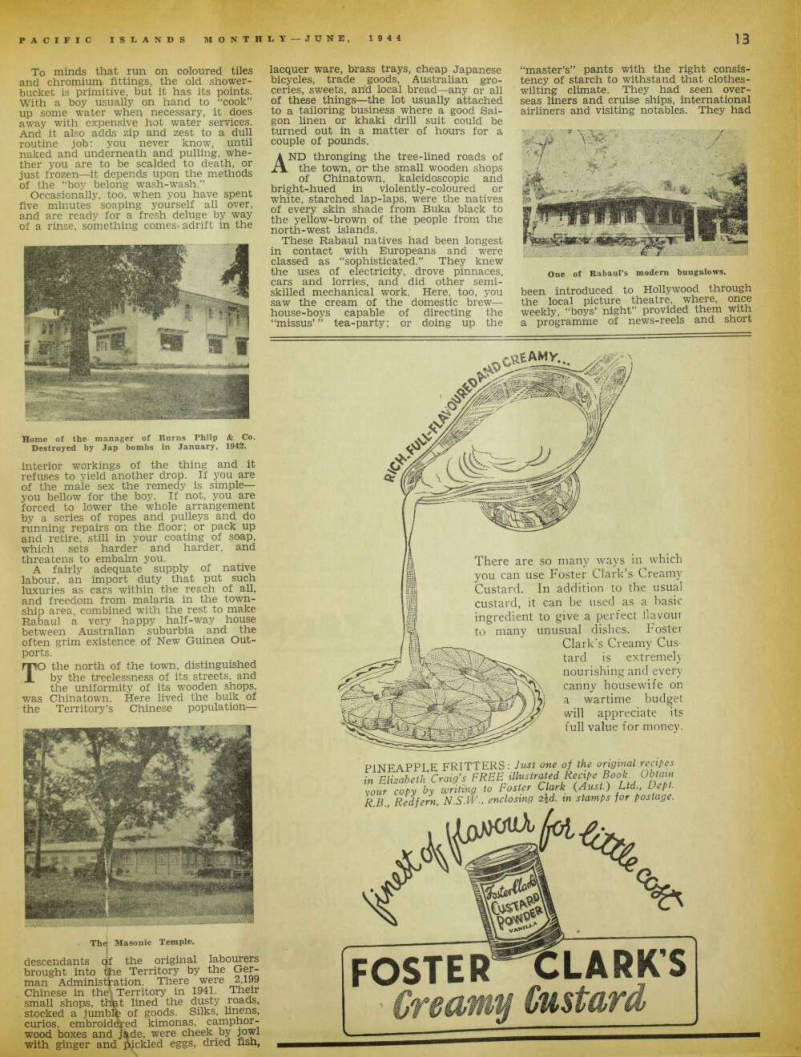
Rabaul Swimming Pool, completed 1939.
To minds that run on coloured tiles and chromium fittings, the old shower bucket is primitive, but it has its points.
With a boy usually on hand to “cook” up some water when necessary, it does away with expensive hot water services.
And it also adds zip and zest to a dull routine job: you never know, until naked and underneath and pulling, whe ther you are to be scalded to death, or just frozen —it depends upon the methods of the “boy belong wash-wash.”
Occasionally, too, when you have spent five minutes soaping yourself all over, and are ready for a fresh deluge by way of a rinse, something comes* adrift in the
interior workings of the thing and it refuses to yield another drop. If you are of the male sex the remedy is simple— you bellow for the boy. If not, you are forced to lower the whole arrangement by a series of ropes and pulleys and do running repairs on the floor; or pack up and retire, still in your coating of soap, which sets harder and harder, and threatens to embalm you.
A fairly adequate supply of native labour, an import duty that put such luxuries as cars within the reach of all, and freedom from malaria in the town ship area, combined with the rest to make Rabaul a very happy half-way house between Australian suburbia and the often grim existence of New Guinea Out ports.
TO the north of the town, distinguished by the treelessness of its streets, and the uniformity of its wooden shops, was Chinatown. Here lived the bulk of the Territory’s Chinese population —
descendants of the original labourers brought into the Territory by the Ger man Administration. There were 2,199 Chinese in the- Territory in 1941. Their small shops, tlmt lined the dusty roads, stocked a jumblfe of goods. Silks, linens, curios, embroidered kimonas, camphor wood boxes and jide, were cheek by jowl with ginger and pickled eggs, dried fish,
lacquer ware, brass trays, cheap Japanese bicycles, trade goods, Australian gro ceries, sweets, an’d local bread —any or all of these things—the lot usually attached to a tailoring business where a good Sai gon linen or khaki drill suit could be turned out in a matter of hours for a couple of pounds.
AND thronging the tree-lined roads of the town, or the small wooden shops of Chinatown, kaleidoscopic and bright-hued in violently-coloured or white, starched lap-laps, were the natives of every skin shade from Buka black to the yellow-brown of the people from the north-west islands.
These Rabaul natives had been longest in contact with Europeans and were classed as “sophisticated.” They knew the uses of electricity, drove pinnaces, cars and lorries, and did other semi skilled mechanical work. Here, too, you saw the cream of the domestic brew house-boys capable of directing the “missus’” tea-party; or doing up the
“master’s” pants with the right consis tency of starch to withstand that clothes wilting climate. They had seen over seas liners and cruise ships, international airliners and visiting notables. They had
been introduced to Hollywood through the local picture theatre, where, once weekly, “boys’ night” provided them with a programme of news-reels and short
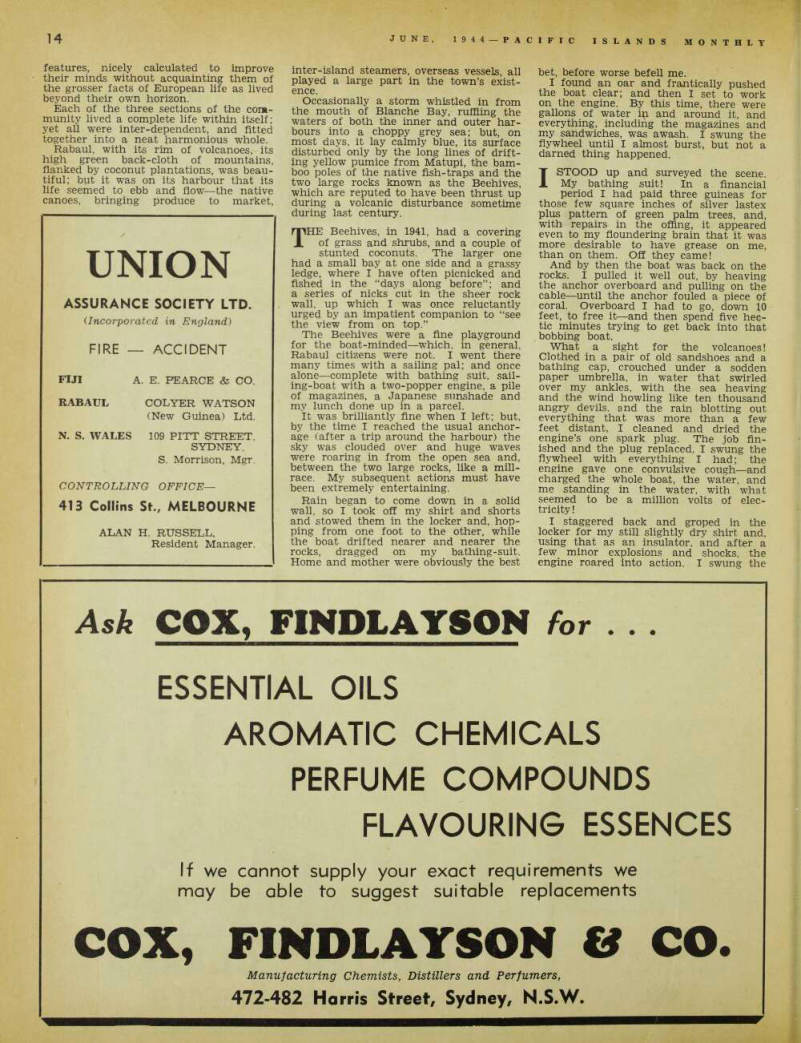
Home of the manager of Burns Philp & Co.
Destroyed by Jap bombs in January, 1942.
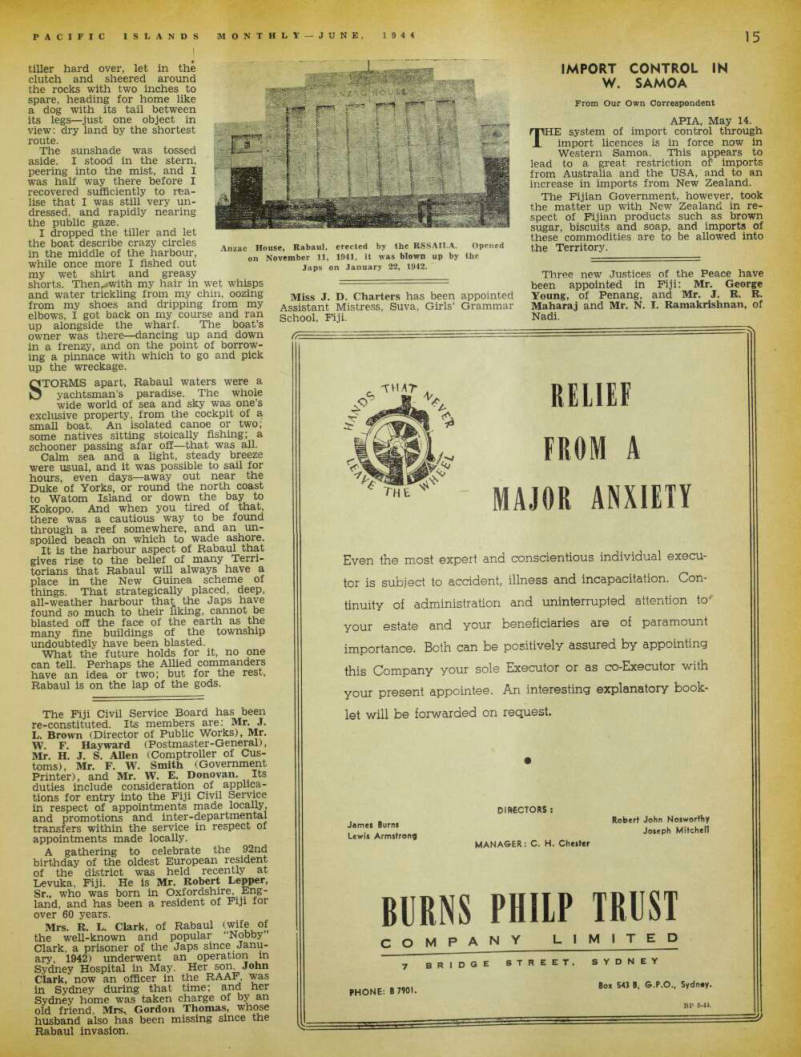
The Masonic Temple.
One of Rabaul’s modern bungalows.
features, nicely calculated to improve their minds without acquainting them of the grosser facts of European life as lived beyond their own horizon.
Each of the three sections of the com munity lived a complete life within itself; yet all were inter-dependent, and fitted together into a neat harmonious whole.
Rabaul, with its rim of volcanoes, its high green back-cloth of mountains, flanked by coconut plantations, was beau tiful; but it was on its harbour that its life seemed to ebb and flow—the native canoes, bringing produce to market,
inter-island steamers, overseas vessels, all played a large part in the town’s exist ence.
Occasionally a storm whistled in from the mouth of Blanche Bay, ruffling the waters of both the inner and outer har bours into a choppy grey sea; but, on most days, it lay calmly blue, its surface disturbed only by the long lines of drift ing yellow pumice from Matupi, the bam boo poles of the native fish-traps and the two large rocks known as the Beehives, which are reputed to have been thrust up during a volcanic disturbance sometime during last century.
THE Beehives, in 1941, had a covering of grass and shrubs, and a couple of stunted coconuts. The larger one had a small bay at one side and a grassy ledge, where I have often picnicked and fished in the “days along before”; and a series of nicks cut in the sheer rock wall, up which I was once reluctantly urged by an impatient companion to “see the view from on top.”
The Beehives were a fine playground for the boat-minded —which, in general, Rabaul citizens were not. I went there many times with a sailing pal; and once alone —complete with bathing suit, sail ing-boat with a two-popper engine, a pile of magazines, a Japanese sunshade and my lunch done up in a parcel.
It was brilliantly fine when I left; but, by the time I reached the usual anchor age (after a trip around the harbour) the sky was clouded over and huge waves were roaring in from the open sea and, between the two large rocks, like a mill race. My subsequent actions must have been extremely entertaining.
Rain began to come down in a solid wall, so I took off my shirt and shorts and stowed them in the locker and, hop ping from one foot to the other, while the boat drifted nearer and nearer the rocks, dragged on my bathing-suit.
Home and mother were obviously the best
bet, before worse befell me.
I found an oar and frantically pushed the boat clear; and then I set to work on the engine. By this time, there were gallons of water ip and around it, and everything, including the magazines and my sandwiches, was awash. I swung the flywheel until I almost burst, but not a darned thing happened. 1 STOOD up and surveyed the scene.
My bathing suit! In a financial period I had paid three guineas for those few square inches of silver lastex plus pattern of green palm trees, and, with repairs in the offing, it appeared even to my floundering brain that it was more desirable to have grease on me, than on them. Off they came!
And by then the boat was back on the rocks. I pulled it well out, by heaving the anchor overboard and pulling on the cable —until the anchor fouled a piece of coral. Overboard I had to go, down 10 feet, to free it—and then spend five hec tic minutes trying to get back into that bobbing boat.
What a sight for the volcanoes!
Clothed in a pair of old sandshoes and a bathing cap, crouched under a sodden paper umbrella, in water that swirled over my ankles, with the sea heaving and the wind howling like ten thousand angry devils, and the rain blotting out everything that was more than a few feet distant, I cleaned and dried the engine’s one spark plug. The job fin ished and the plug replaced, I swung the flywheel with everything I had; the engine gave one convulsive cough—and charged the whole boat, the water, and me standing in the water, with what seemed to be a million volts of elec tricity !
I staggered back and groped in the locker for my still slightly dry shirt and. using that as an insulator, and after a few minor explosions and shocks, the engine roared into action. I swung the
tiller hard over, let in the clutch and sheered around the rocks with two inches to spare, heading for home like a dog with its tail between its legs—just one object in view: dry land by the shortest route.
The sunshade was tossed aside. I stood in the stern, peering into the mist, and I was half way there before I recovered sufficiently to rea lise that I was still very un dressed, and rapidly nearing the public gaze.
I dropped the tiller and let the boat describe crazy circles in the middle of the harbour, while once more I fished out my wet shirt and greasy
shorts. my hair in wet whisps and water trickling from my chin, oozing from my shoes and dripping from my elbows, I got back on my course and ran up alongside the wharf. The boat’s owner was there —dancing up and down in a frenzy, and on the point of borrow ing a pinnace with which to go and pick up the wreckage.
STORMS apart, Rabaul waters were a yachtsman’s paradise. The whole wide world of sea and sky was one’s exclusive property, from the cockpit of a small boat. An isolated canoe or two; some natives sitting stoically fishing; a schooner passing afar off —that was all.
Calm sea and a light, steady breeze were usual, and it was possible to sail for hours, even days—away out near the Duke of Yorks, or round the north coast to Watom Island or down the bay to Kokopo. And when you tired of that, there was a cautious way to be found through a reef somewhere, and an un spoiled beach on which to wade ashore.
It is the harbour aspect of Rabaul that gives rise to the belief of many Terri torians that Rabaul will always have a place in the New Guinea scheme of things. That strategically placed, deep, all-weather harbour that the Japs have found so much to their liking, cannot be blasted off the face of the earth as the many fine buildings of the township undoubtedly have been blasted.
What the future holds for it, no one can tell. Perhaps the Allied commanders have an idea or two; but for the rest, Rabaul is on the lap of the gods.
The Fiji Civil Service Board has been re-constituted. Its members are: Mr. J.
L. Brown (Director of Public Works), Mr.
W. F. Hayward (Postmaster-General), Mr. H. J. S. Allen (Comptroller of Cus toms), Mr. F. W. Smith (Government Printer), and Mr. W. E. Donovan. Its duties include consideration of applica tions for entry into the Fiji Civil Service in respect of appointments made locally, and promotions and inter-departmental transfers within the service in respect of appointments made locally.
A gathering to celebrate the 92nd birthday of the oldest European resident of the district was held recently at Levuka. Fiji. He is Mr. Robert Lepper, Sr., who was born in Oxfordshire, Eng land, and has been a resident of Fiji for over 60 years.
Mrs. R. L. Clark, of Rabaul (wife of the well-known and popular “Nobby Clark, a prisoner of the Japs since Janu ary, 1942) underwent an operation in Sydney Hospital in May. Her son, John Clark, now an officer in the RAAF, was in Sydney during that time; and her Sydney home was taken charge of by an old friend, Mrs.. Gordon Thomas, whose husband also has been missing since the Rabaul invasion.
Miss J. D. Charters has been appointed Assistant Mistress, Suva, Girls’ Grammar School, Fiji.
Anzac House, Rabaul, erected by the RSSAILA. Opened on November 11, 1941, it was blown up by the Japs on January 22, 1942.