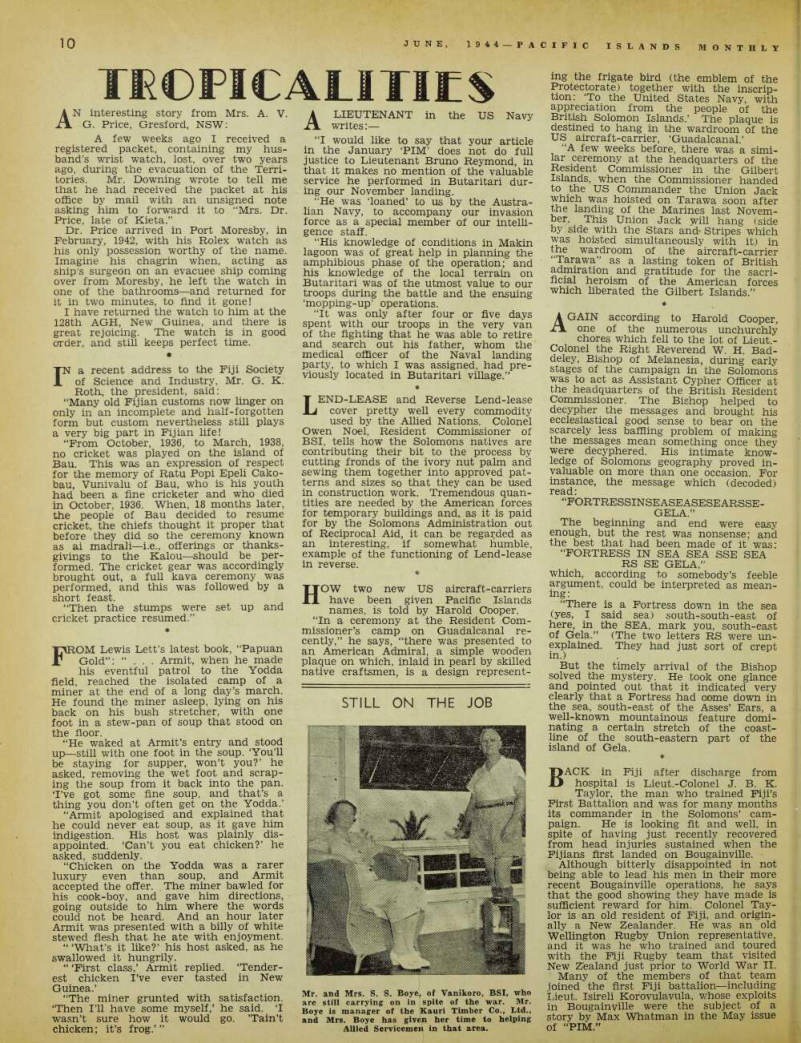
Still On The Job
p. 12 · Read in the full issue
mg the frigate bird (the emblem of the Protectorate) together with the inscrip tion; ‘To the United States Navy, with appreciation from the people of the British Solomon Islands.’ The plaque is destined to hang in the wardroom of the US aircraft-carrier, ‘Guadalcanal.’
“A few weeks before, there was a simi lar ceremony at the headquarters of the Resident Commissioner in the Gilbert Islands, when the Commissioner handed to the US Commander the Union Jack which was hoisted on Tarawa soon after the landing of the Marines last Novem ber. This Union Jack will hang (side by side with the Stars and- Stripes which was hoisted simultaneously with it) in the wardroom of the aircraft-carrier “Tarawa” as a lasting token of British admiration and gratitude for the sacri ficial heroism of the American forces which liberated the Gilbert Islands.” * AGAIN according to Harold Cooper, one of the numerous unchurchly chores which fell to the lot of Lieut.- Colonel the Right Reverend W. H. Bad deley, Bishop of Melanesia, during early stages of the campaign in the Solomons was to act as Assistant Cypher Officer at the headquarters of the British Resident Commissioner. The Bishop helped to decypher the messages and brought his ecclesiastical good sense to bear on the scarcely less baffling problem of making the messages mean something once they were decyphered. His intimate know ledge of Solomons geography proved in valuable on more than one occasion. For instance, the message which (decoded) read:
“Fortressinseaseasesearsse
Gela.”
The beginning and end were easy enough, but the rest was nonsense; and the best that had been made of it was:
“Fortress In Sea Sea Sse Sea
Rs Se Gela,”
which, according to somebody’s feeble argument, could be interpreted as mean ing: “There is a Portress down in the sea (yes, I said sea) south-south-east of here, in the SEA, mark you, south-east of Gela.” (The two letters RS were un explained. They had just sort of crept in.) But the timely arrival of the Bishop solved the mystery. He took one glance and pointed out that it indicated very clearly that a Fortress had come down in the sea, south-east of the Asses’ Ears, a well-known mountainous feature domi nating a certain stretch of the coast line of the south-eastern part of the island of Gela, * BACK in Fiji after discharge from hospital is Lieut.-Colonel J. B. K.
Taylor, the man who trained Fiji’s First Battalion and was for many months its commander in the Solomons’ cam paign. He is looking fit and well, in spite of having just recently recovered from head injuries sustained when the Fijians first landed on Bougainville.
Although bitterly disappointed in not being able to lead his men in their more recent Bougainville operations, he says that the good showing they have made is sufficient reward for him. Colonel Tay lor is an old resident of Fiji, and origin ally a New Zealander. He was an old Wellington Rugby Union representative, and it was he who trained and toured with the Fiji Rugby team that visited New Zealand just prior to World War 11.
Many of the members of that team joined the first Fiji battalion —including Lieut. Isireli Korovulavula, whose exploits in Bougainville were the subject <pf a story by Max Whatman in the May issue of “PIM.”
Mr, and Mrs. S. S. Boye, of Vanikoro, BSI, who are still carrying on in spite of the war. Mr.
Boye is manager of the Kauri Timber Co., Ltd., and Mrs. Boye has given her time to helping Allied Servicemen in that area.