Was Discourtesy
p. 11 · Read in the full issue
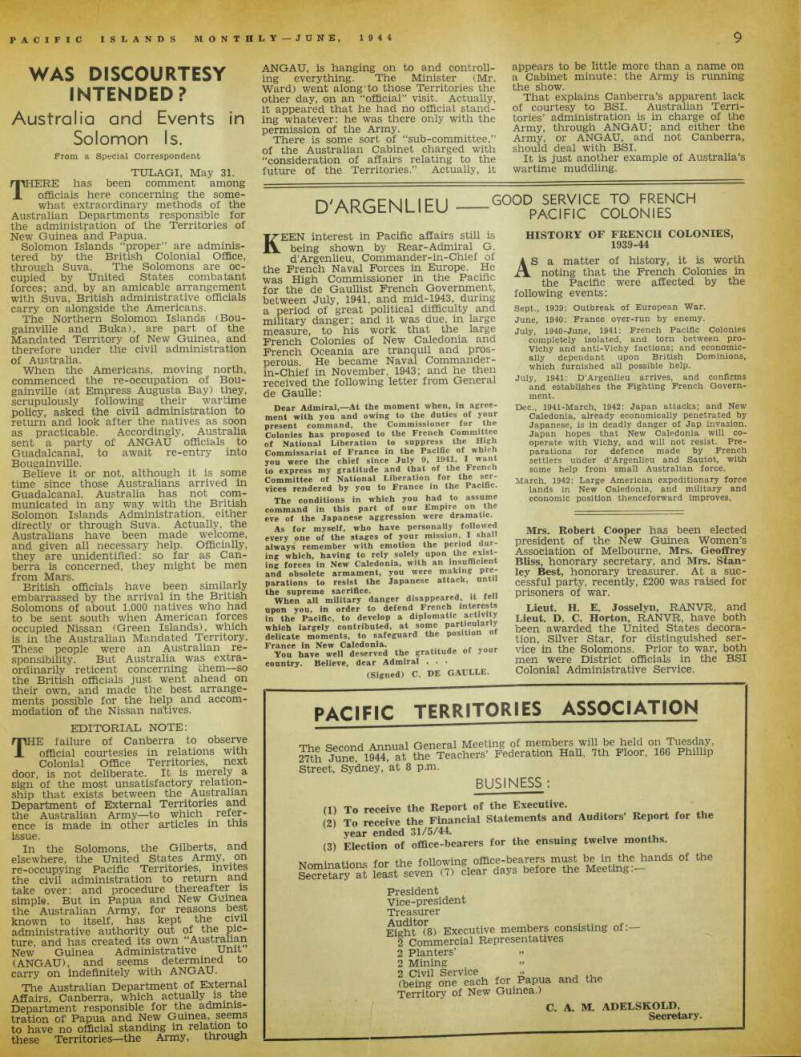
Intended?
Australia and Events in Solomon Is.
From a Special Correspondent
Tulagi, May 31.
rERE has been comment among officials here concerning the some what extraordinary methods of the Australian Departments responsible for the administration of the Territories of New Guinea and Papua.
Solomon Islands “proper” are adminis tered by the British Colonial Office, through Suva. The Solomons are oc cupied by United States combatant forces; and, by an amicable arrangement with Suva, British administrative officials carry on alongside the Americans.
The Northern Solomon Islands (Bou gainville and Buka), are part of the Mandated Territory of New Guinea, and therefore under the civil administration of Australia.
When the Americans, moving north, commenced the re-occupation of Bou gainville (at Empress Augusta Bay) they, scrupulously following their wartime policy, asked the civil administration to return and look after the natives as soon as practicable. Accordingly, Australia sent a party of ANGAU officials to Guadalcanal, to await re-entry into Bougainville.
Believe it or not, although it is some time since those Australians arrived in Guadalcanal, Australia has not com municated in any way with the British Solomon Islands Administration, either directly or through Suva. Actually, the Australians have been made welcome, and given all necessary help. Officially, they are unidentified: so far as Can berra is concerned, they might be men from Mars.
British officials have been similarly embarrassed by the arrival in the British Solomons of about 1,000 natives who had to be sent south when American forces occupied Nissan (Green Islands), which is in the Australian Mandated Territory.
These people were an Australian re sponsibility. But Australia was extra ordinarily reticent concerning them —so the British officials just went ahead on their own, and made the best arrange ments possible for the help and accom modation of the Nissan natives.
Editorial Note:
mHE failure of Canberra to observe X official courtesies in relations with Colonial Office Territories, next door, is not deliberate. It is merely a sign of the most unsatisfactory relation ship that exists between the Australian Department of External Territories and the Australian Army—to which refer ence is made in other articles in this issue.
In the Solomons, the Gilberts, and elsewhere, the United States Army, on re-occupying Pacific Territories, invites the civil administration to return and take over: and procedure thereafter is simple. But in Papua and New Guinea the Australian Army, for reasons best known to itself, has kept the civil administrative authority out of the pic ture, and has created its own “Australian New Guinea Administrative Unit (ANGAU), and seems determined to carry on indefinitely with ANGAU.
The Australian Department of External Affairs, Canberra, which actually is the Department responsible for the adminis tration of Papua and New Guinea seems to have no official standing in relation to these Territories —the Army, through
ANGAU, is hanging on to and controll ing everything. The Minister (Mr.
Ward) went along to those Territories the other day, on an “official” visit. Actually, it appeared that he had no official stand ing whatever: he was there only with the permission of the Army.
There is some sort of “sub-committee,” of the Australian Cabinet charged with “consideration of affairs relating to the future of the Territories.” Actually, it
appears to be little more than a name on a Cabinet minute: the Army is running the show.
That explains Canberra’s apparent lack of courtesy to BSI. Australian Terri tories’ administration is in charge of the Army, through ANGAU; and either the Army, or ANGAU, and not Canberra, should deal with BSI.
It is just another example of Australia’s wartime muddling.