The Invasion—As Seen From The Pacific
pp. 5-6 · Read in the full issue
THE last four weeks have been filled with great events. The Anglo- American Allies have successfully in vaded France, and have broken the German line in Italy and occupied Rome; Japanese armies in the South west Pacific and in Burma have been defeated; the Russians are poised for a new offensive in Eastern Europe.
We should know definitely, by the end of July, whether this global war is likely to end soon; or whether it will continue for a further period of years. The progress of the long awaited Western Invasion will give us the measure of events to come.
If, at* the end of July, the Invasion forces are as strong, aggressive and confident as they are to-day, there will be a reasonable possibility of the war in Europe ending in 1944. That should mean the end of the war against Japan in 1945; it certainly would mean the rapid reduction of the area in which the war against Japan is being fought, and the re turn of the rest of the Pacific world to something approaching peacetime conditions.
If the Invasion does not go well within the next few weeks, the Euro pean war probably will continue into 1945, thus creating, throughout the world, economic, social and political conditions which will be very, very dangerous. rpHE situation, at the moment, gives A ground for hope and sober con-* fidence. It probably will be found that the Invasion, originally, was timed for early May; but the all-out air blitz on Germany then was going so well, and achieving such remark
able results, that our leaders, in their wisdom, decided upon another month of “softening-up.” The extraordinary early success of the Invasion seems to have justified that decision. The complete failure of the Germans to stop the Allies on the beaches of Normandy, the lack of backbone in their resistance behind the beach heads, and their slowness in organis ing the counter-attack which is to drive the Allies back into the sea— these unexpected features of the Invasion could all be explained by the bombing of Germany’s industrial towns and the very complete smash ing of her transport systems.
It is far too soon for optimism. The Germans have not yet developed their counter-attack; and. when it comes, it will be terrific. It may be taken as certain that we shall suffer some grave disasters. But the out standing features of the Invasion, up to date, are encouraging. They are: • The marked supremacy of the Allies in the air, which enables them to cripple the enemy’s organisation for counter attack, and clears the way for our further advance. • The marked supremacy of the Allies on the sea, which has had three very notable results —(a) The inability of the enemy to attack the thousands of vessels we employed in the actual Invasion: (b) assurance of complete .and regular sup plies to our armies in France-; (c) the assistance of naval bombardment <a thing of supreme importance) m tne establishment of our bridge-heads. • The absence, up to date, of Mr.
Hitler’s “secret weapon.” • The enormous scale and proved efficiency of the Allied plans, which have permitted the Invasion to go ahead with
clockwork precision—and, apparently, to a time-table. • The high spirit and superb fighting qualities of all the Allied troops.
THERE probably will be two im portant new developments at a very early date. Another landing on the Atlantic coast by Anglo-American armies may be expected; and the Russians will launch their summer offensive against the Germans, in the Also, we may witness interesting events in the Mediterranean area.
The Anglo-American armies which defeated Kesselring in Italy, and now are pursuing his broken armies to wards Florence, are not going to sit idle. Their arrival in Northern Italy may be the signal for the landing of Allied forces on the Riviera coast of France. And something certainly will happen soon in the Balkans. It is not to be expected that the army of the Yugoslav Partisans, or the British armies in the Levant region, will take no part in this concentrated attack upon the Nazi empire.
There are three supremely critical operations in this final, all-in assault upon Germany—the actual Invasion; the German counter-attack to the Invasion; and the Russian summer offensive. One, the Invasion, is past; our armies, in great strength and with full equipment, are firmly estab lished on the Continent. The counter attack is due—and overdue. And the Russian offensive should come soon.
EVENTS in the Pacific necessarily wait upon events in Europe. If Germany is defeated in 1944, air. sea and land forces of enormous strength will be assembled quickly for the destruction of the Japanese bar • t
barians, and the restoration of peace and tranquility to countries which have known neither for very many years. For the people of the Pacific, like the people of Europe, have lived for more than a decade under the threat of war. Not only were all our peacetime activities affected by the growth of aggressive Nazi-dom in Europe—we were always conscious, .also, of the menace in the north, where a queer, half-crazy generation of Japanese emperor - worshippers were plotting and planning for world-domination.
Japan is contained, in this Pacific war, within a front which is shaped like a triangle, each side of -which is about 4,000 miles long. The top is in the far north, near the Kurile Islands.
The eastern side runs down to a point southwards of the eastern Caroline Islands. The southern front runs westwards from the Marshall and Caroline Islands, along the northern shores of New Guinea and the south western shores of the Netherlands Indies, into Burma. The western front runs from Burma, through Cen tral China, back to the Kurile Islands.
There are four operational areas on those vast fronts—the Central Pacific, where very powerful American sea and .air forces are giving the Jap bases in the Carolines and Marianas a terrific battering; the South-west Pacific, where General MacArthur’s forces are hammering the Japs on the northern coast of Dutch New Guinea; Burma, where the Japanese recently have been heavily defeated; and in China.
In the first three of these fighting areas, everything is going well. The Allies have complete air and sea ascendancy over the enemy, and un doubtedly he is taking a great beat ing. He has either been thrown out of or has abandoned his forces in the
Gilberts, the Marshalls, the Solomons the Bismarck Archipelago. Papua and New Guinea; his bases in the Nether lands Indies are being attacked from the air; his armies are being broken up in Burma; and his sea-borne traffic is being steadily wiped out |>UT the situation in China is not -O nearly so good The Japanese have put large and powerful armies into Honan Province, and they are taking possession of wide areas there, Their Pun»se is three-fold: To tha “■na inus deny to the Allies the only land area from which Japan may be bombed; to deprive China er ?* lie^v/ ood roducing areas and tSeTar “S her ° f war, and to get possession of the railw f y systeln there and use « for maintaining communications with South-east Asia, in place of the Jap systemaUcaUv 3 destroying' B Am ® S is the pacific *° Tf h f t , sses ln the
I l>a^| UCCeedS ’ Xt 35,°"
long the Pacific war considerably.
Yet ’ a ? th ? a S h has m ade rapid pro gress m the P ast six weeks > and the p^ 6 scor ® d many successes over tk® Chinese, it is almost entirely by the le « newspapers, supposed to present a plcture of the progress of in Europe, allowing y S an c °ncentration against Ja P an > Wlll effectively answer what uver success Japan may have in China. But if the war goes badly in Europe, the gravity of this develop “raid” Chma C ° Uld not be 6Xag ' gcidieu.
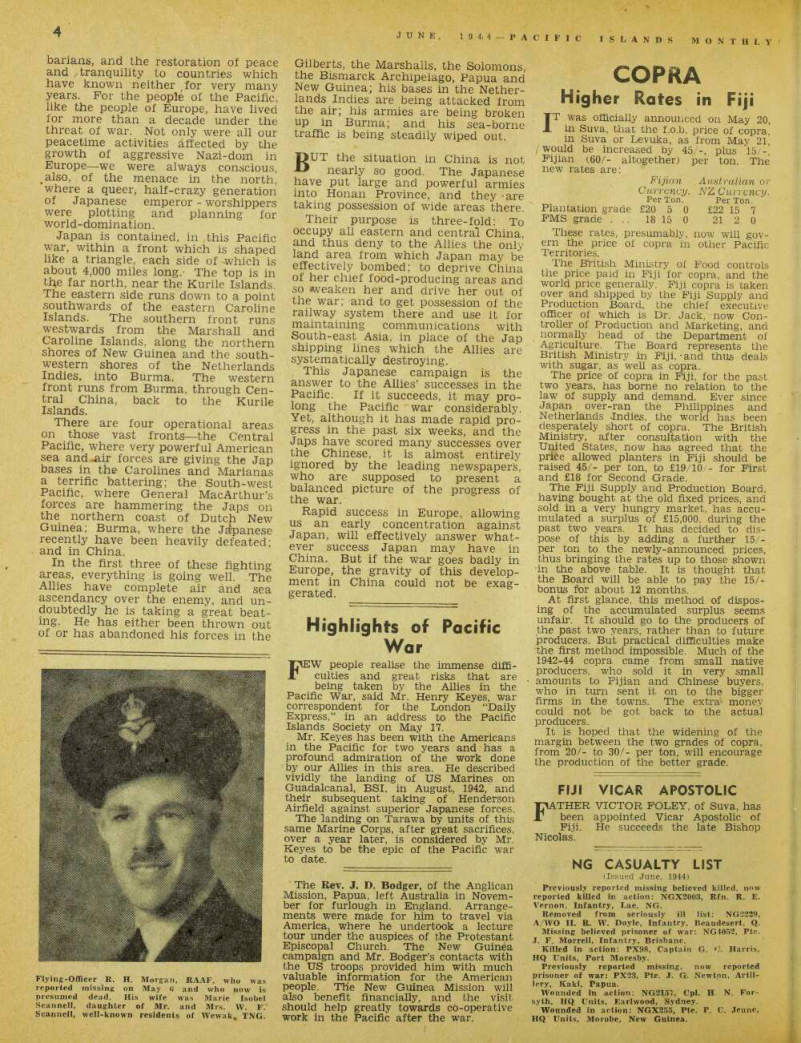
Flying-Officer R. H. Morgan, RAAF, who was reported missing on May « and who now is presumed dead. His wife was Marie Isobel Scannell, daughter of Mr. and Mrs. W. F.
Scannell, well-known residents of Wewak. TNG.