Macarthur-The Man Japan Fears
p. 47 · Read in the full issue
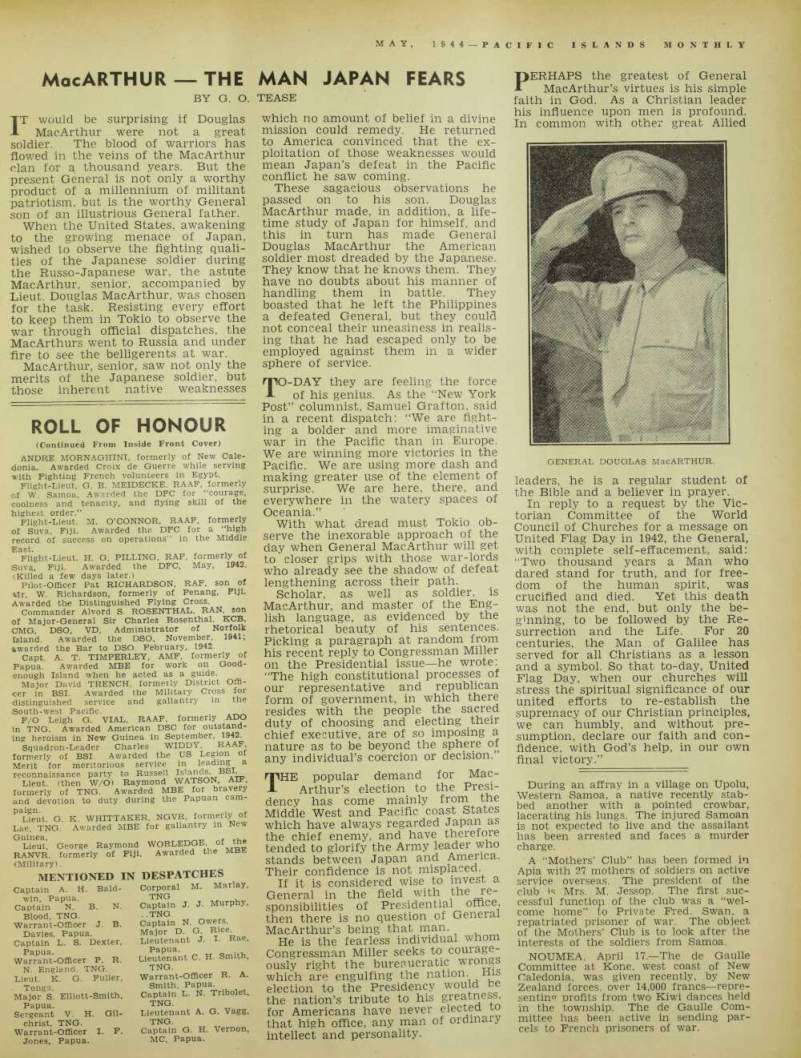
By G. O. Tease
IT would be surprising if Douglas MacArthur were not a great soldier. The blood of warriors has flowed in the veins of the MacArthur clan for a thousand years. But the present General is not only a worthy product of a millennium of militant patriotism, but is the worthy General son of an illustrious General father.
When the United States, awakening to the growing menace of Japan, wished to observe the fighting quali ties of the Japanese soldier during the Russo-Japanese war, the astute MacArthur, senior, accompanied by Lieut. Douglas MacArthur, was chosen for the task. Resisting every effort to keep them in Tokio to observe the war through official dispatches, the MacArthurs went to Russia and under fire to see the belligerents at war.
MacArthur, senior, saw not only the merits of the Japanese soldier, but those inherent native weaknesses
which no amount of belief in a divine mission could remedy. He returned to America convinced that the ex ploitation of those weaknesses would mean Japan’s defeat in the Pacific conflict he saw coming.
These sagacious observations he passed on to his son. Douglas MacArthur made, in addition, a life time study of Japan for himself, and this in turn has made General Douglas MacArthur the American soldier most dreaded by the Japanese.
They know that he knows them. They have no doubts about his manner of handling them in battle. They boasted that he left the Philippines a defeated General, but they could not conceal their uneasiness in realis ing that he had escaped only to be employed against them in a wider sphere of service. rpo-DAY they are feeling the force A of his genius. As the “New York Post” columnist, Samuel Grafton, said in a recent dispatch: “We are fight ing a bolder and more imaginative war in the Pacific than in Europe.
We are winning more victories in the Pacific. We are using more dash and making greater use of the element of surprise. We are here, there, and everywhere in the watery spaces of OcCQilliQj With what dread must Tokio ob serve the inexorable approach of the day when General MacArthur will get to closer grips with those war-lords who already see the shadow of defeat lengthening across their path.
Scholar, as well as soldier, is MacArthur, and master of the Eng lish language, as evidenced by the rhetorical beauty of his sentences.
Picking a paragraph at random from his recent reply to Congressman Miller on the Presidential issue—he wrote: “The high constitutional processes of our representative and republican form of government, in which there resides with the people the sacred duty of choosing and electing their chief executive, are of so imposing a nature as to be beyond the sphere of any individual’s coercion or decision.”
THE popular demand for Mac- Arthur’s election to the Presi dency has come mainly from the Middle West and Pacific coast States which have always regarded Japan as the chief enemy, and have therefore tended to glorify the Army leader who stands between Japan and America.
Their confidence is not misplaced.
If it is considered wise to invest a General in the field with the re sponsibilities of Presidential office, then there is no question of General MacArthur’s being that man.
He is the fearless individual whom Congressman Miller seeks to courage ously right the bureaucratic wrongs which are engulfing the nation. His election to the Presidency would be the nation’s tribute to his greatness, for Americans have never elected to that high office, any man of ordinal y intellect and personality.
PERHAPS the greatest of General MacArthur’s virtues is his simple faith in God. As a Christian leader his influence upon men is profound.
In common with other great Allied
leaders, he is a regular student of the Bible and a believer in prayer.
In reply to a request by the Vic torian Committee of the World Council of Churches for a message on United Flag Day in 1942, the General, with complete self-effacement, said: “Two thousand years a Man who dared stand for truth, and for free dom of the human spirit, was crucified and died. Yet this death was not the end, but only the be ginning, to be followed by the Re surrection and the Life. For 20 centuries, the Man of Galilee has served for all Christians as a lesson and a symbol. So that to-day, United Flag Day, when our churches will stress the spiritual significance of our united efforts to re-establish the supremacy of our Christian principles, we can humbly, and without pre sumption, declare our faith and con fidence, with God’s help, in our own final victory.”
During an affray in a village on Upolu, Western Samoa, a native recently stab bed another with a pointed crowbar, lacerating his lungs. The injured Samoan is not expected to live and the assailant has been arrested and faces a murder charge.
A “Mothers’ Club” has been formed in Apia with 27 mothers of soldiers on active service overseas. The president of the club is Mrs. M. Jessop. The first suc cessful function of the club was a “wel come home” to Private Fred. Swan, a repatriated prisoner of war. The object of the Mothers’ Club is to look after the interests of the soldiers from Samoa.
NOUMEA, April 17.—The de Gaulle Committee at Kone, west coast of New Caledonia, was given recently, by New Zealand forces, over 14,000 francs—repre sentino profits from two Kiwi dances held in the township. The de Gaulle Com mittee has been active in sending par cels to French prisoners of war.